
General William Tecumseh Sherman Monument
The General William Tecumseh Sherman Monument is an equestrian statue depicting Union General William Tecumseh Sherman. It stands in Sherman Plaza, part of President's Park in Washington, the federal capital of the United States. The selection of the artist in 1896 was highly controversial. During the design process, artist Carl Rohl-Smith died, and the memorial was completed by several other sculptors. The statue was unveiled in 1903. It is part of the Civil War monuments in Washington, added in 1973, and contributes to President's Park South, added in 1980; both are listed historic sites in the National Register of Historic Places.
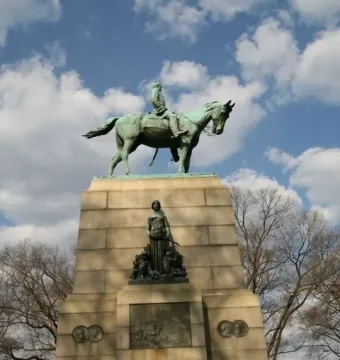
March 2010 © Bernt Rostad · CC BY 2.0
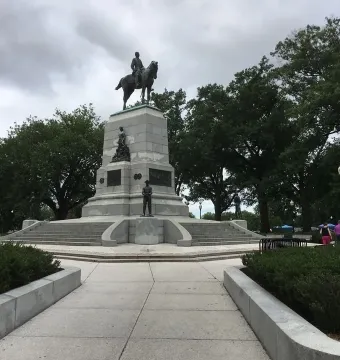
© NPS Photo · Public domain
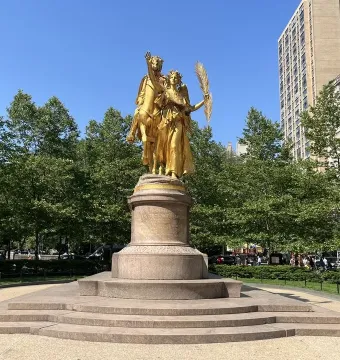
June 2025 © Rosebudd56 · CC0
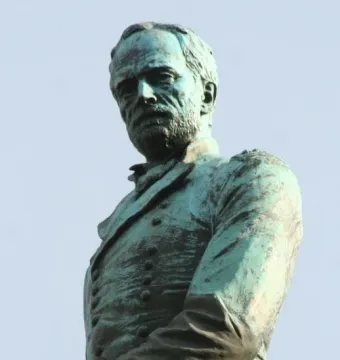
January 2007 © David(dbking) · CC BY 2.0
September 2012 © Tim Evanson · CC BY-SA 2.0
Identification | |
| Title | General William Tecumseh Sherman Monument |
| Type | Equestrian statue monument |
| Subject | General William Tecumseh Sherman |
Historical context | |
| New York Times characterization | Called the decision 'one of the most discreditable events in the annals of public art in the United States' |
| Shortlist | Paul Wayland Bartlett, Charles Henry Niehaus, William Ordway Partridge, and J. Massey Rhind |
| Rohl-Smith shortlist status | Did not make the shortlist; ranked almost dead last |
| Final selection date | May 27 |
| Final selecting body | The memorial commission of the Society of the Army of the Tennessee |
| Winning design | Carl Rohl-Smith's design |
| Reaction of the National Sculpture Society | Outraged and strongly protested the award to the society and the press |
| Media reaction | Several newspapers also protested the award |
| Senate investigation effort | Senator Edward O. Wolcott sponsored legislation to investigate the award process |
| Purpose | Memorial to Sherman, planned after his death by the Society of the Army of the Tennessee |
| Senate investigation outcome | The resolution failed |
| Senate debate | Rancorous and showing deep Senate distrust of 'art experts' |
| Accusation against Rohl-Smith | He was accused of using political influence to win the commission |
| Rohl-Smith response | He vehemently denied the accusation |
| End of dispute | After two months of protests, the National Sculpture Society stopped disputing the award |
| Dedicated by | President Theodore Roosevelt |
| Dedication date | October 15, 1903 |
| NSS judging committee members | Daniel Chester French, Augustus Saint-Gaudens, Olin Levi Warner, and John Quincy Adams Ward |
| Carl Rohl-Smith proposal reception | Generated the most popular acclaim |
| Number of proposals submitted | 23 sculptors |
| Fundraising outreach | The society contacted its own members and members of other veterans' organizations |
| Initiating group | Society of the Army of the Tennessee |
| Initiating group members | Veterans who served in the Army of the Tennessee |
| Planning began | Within days after Sherman died on February 14, 1891 |
| Annual meeting resolution | In October 1891, the society resolved to ask Congress for $50,000 toward the memorial and to establish a Sherman Memorial Commission |
| Congressional act date | July 5, 1892 |
| Congressional act | Established the Sherman Monument Commission |
| Commission members | The president of the Society of the Army of the Tennessee, the Secretary of War, and the Commander of the United States Army |
| Fundraising goal | $50,000, described as half the cost of the monument |
| Other veteran organizations contacted | Grand Army of the Republic; Society of the Army of the Potomac; Society of the Army of the Ohio; Society of the Army of the Cumberland; Military Order of the Loyal Legion of the United States |
| Fundraising result | The appeal raised $14,469.91 |
| Congressional contribution increased | Congress doubled its contribution to make up the difference |
| Design competition announcement year | 1895 |
| Call for proposals issued by | Sherman Memorial Commission |
| Competition requirement | An equestrian statue |
| Competition eligibility | Limited to American artists, whether living in the United States or abroad |
| Judging body | A committee of the National Sculpture Society |
| Proposal deadline | December 31, 1894 |
| Notable submissions | Paul Wayland Bartlett; Henry Jackson Ellicott and William Bruce Gray; Adrian Jones of New York; Fernando Miranda; L. Mullgardt; Charles Henry Niehaus; Victor Olsa; William Ordway Partridge; J. Massey Rhind; Carl Rohl-Smith |
Creator | |
| War and Peace figures revised by | Sigvald Asbjornsen |
| Army of the Tennessee badge completed by | Lauritz Jensen |
| Bas-relief panels completed by | Lauritz Jensen, based on work already done by Rohl-Smith |
| Medallions completed by | Theo Kitson |
| Corner soldier identification | Sources differ on whether Asbjornsen completed the artilleryman or the cavalryman |
| Corner soldier figures completed by | Rohl-Smith completed three of the four corner soldier figures; the fourth was completed by Sigvald Asbjornsen |
| Figures of War and Peace modeled by | Stephen Sinding |
| Artist's death during project | Carl Rohl-Smith died during the design phase in August 1900 |
| Artist selection | The selection of an artist in 1896 to design the monument was highly controversial |
| Designer | Carl Rohl-Smith |
| Main statue completed by | Lauritz Jensen |
| Completion after artist's death | The memorial was completed by several other sculptors after Rohl-Smith's death |
| Other sculptors asked to help | Theo Kitson, Henry Kirke Bush-Brown, and Jens Ferdinand Willumsen |
| Completion overseen by | Rohl-Smith's assistant and wife, Sara, with the memorial committee's agreement |
Materials | |
| Pedestal granite source | Fletcher Granite Company of Westford, Massachusetts |
| Casting company | Gorham Brothers of Providence, Connecticut |
| Pedestal material | Stone |
Technique | |
| Support structure | 204 wooden pilings were driven into the ground; they had to be sunk lower than anticipated due to groundwater at the site |
| Additional congressional appropriation | $10,000 |
| Subfoundation completed | December 1898 |
| Pedestal erected | April 1902 |
| Mosaic around pedestal built by | National Mosaic Company |
| Pedestal built by | Harrison Granite Company |
| Subfoundation materials | Sand and fill, and concrete |
Appearance | |
| Depicted commanders in medallions | James B. McPherson and Oliver O. Howard; John A. Logan and Frank P. Blair Jr.; Grenville M. Dodge and Thomas E. G. Ransom; Benjamin Grierson and Andrew Jackson Smith |
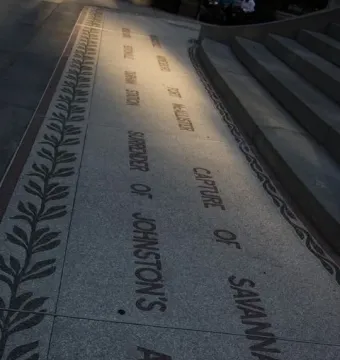
| Mosaic spelling notes | Kenesaw Mountain is misspelled with one 'n' on the monument; Kulp's Farm is misspelled as Kolb's Farm; Colliersville is misspelled with an 's' in the middle, as in most Union reports |
| West side mosaic names | Bull Run, Shiloh, Corinth, Chickasaw Bluffs, Arkansas Post, Steele's Bayou, Jackson, Vicksburg, and Colliersville |
| South side mosaic names | Chattanooga, Ringgold, Missionary Ridge, Relief of Knoxville, Meridian Expedition, Dalton, Resaca, New Hope Church, Dallas, and Kulp's Farm |
| East side mosaic names | Kenesaw Mountain, Ruff's Mills, Peach Tree Creek, Atlanta, Ezra Church, Utoy Creek, Jonesboro, Capture of Atlanta, and Allatoona |
| North side mosaic names | Griswoldville, Waynesboro, Fort McAllister, Capture of Savannah, Averasborough, Bentonville, Durham Station, and the Surrender of Johnston's Army |
| Mosaic content | The names of the battles Sherman fought in |
| Mosaic design | Two low steps and a mosaic surrounding the monument |
| Corner figures | Four figures at the corners of the monument |
| Medallions | Pairs of medallions depicting the army and corps commanders of the Army of the Tennessee on each side of the monument |
| Corner figure subjects | Artillery (northeast), infantry (northwest), cavalry (southeast), and engineers (southwest) |
| Eastern figure group | Peace, shown as a young woman naked from the waist up, holding a flowering branch of a fruit tree, accompanied by a nude young girl tending a wounded young boy and a nude boy feeding a bird |
| Western figure group | War, shown as an older woman tearing asunder her clothing and the straps that bind her, trampling on a dead soldier, with vultures and a cannon around the body |
| Major figure groups | Two major figure groups, one on the east and one on the west side of the monument |
| East side panel | Missionary Ridge |
| West side panel | Sherman by the Campfire |
| South side panel | The Battle of Atlanta |
| North side panel | The March Through Georgia |
| Sherman pose concept | Sherman is depicted on the day he rode up Pennsylvania Avenue at the head of the Army of the Tennessee on May 24, 1865 |
| Bas-relief panels | Four bas-relief panels on the sides of the monument |
Iconography and meaning | |
| Army of the Tennessee badge | An eagle |
| Historical event referenced | Sherman rode up Pennsylvania Avenue at the head of the Army of the Tennessee |
| Depiction date referenced | May 24, 1865 |
Location and ownership | |
| Location | Sherman Plaza, part of President's Park, Washington, D.C., United States |
| Location details | At the intersection of 15th Street NW, Pennsylvania Avenue NW, and Treasury Place NW |
| Original location name | Sherman Park |
| Official area name given by Congress | Sherman Plaza |
| Date Congress gave the area its name | February 18, 1904 |
| Location significance | The site is where Sherman, President Andrew Johnson, and General Ulysses Grant reviewed the Army of the Potomac on May 23, 1865; Sherman also led the Army of the Tennessee parade past the same site the next day |
History and restoration | |
| Restoration | The statue underwent a $2 million restoration in 2011 |
Significance | |
| Historic district status | Contributing monument to the Civil War Monuments in Washington, D.C. (established by Executive Order 11593 on May 13, 1971) and a contributing element of President's Park South (listed on the National Register of Historic Places in 1980) |
| National Register of Historic Places | Both associated historic sites are listed on the National Register of Historic Places |