
Matthias Corvinus Monument
The Matthias Corvinus Monument is a bronze statuary group in Cluj-Napoca, Romania, on today’s Union Square. Created by sculptor János Fadrusz and inaugurated in 1902, it is listed as a historic monument. The work portrays Matthias Corvinus, king of Hungary, on horseback, surrounded by four generals and high officers of the Crown: Pál Kinizsi, Balázs Magyar, István Szapolyai, and István Báthory. The pedestal, designed by architect Lajos Pákey, evokes a bastion from the city’s fortified walls. The monument became an emblem of Cluj and was restored in 2010–2011 under the direction of Tibor Kolozsi.
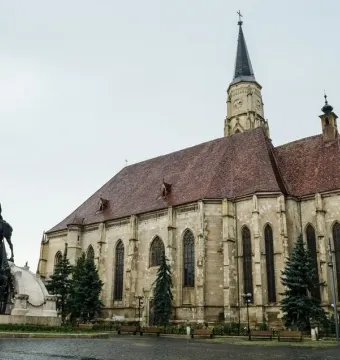
July 2014 © Robert Puțeanu · CC BY-SA 3.0 ro
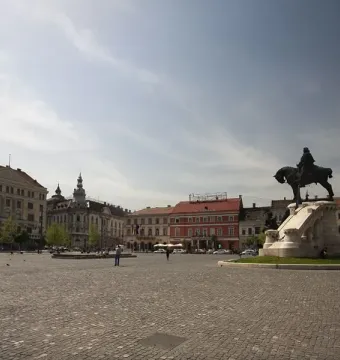
September 2014 © Igor Sirbu · CC BY-SA 3.0 ro
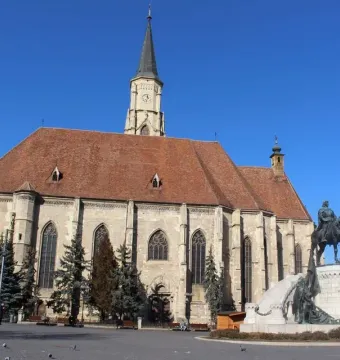
February 2017 © Emőke Dénes · CC BY-SA 4.0
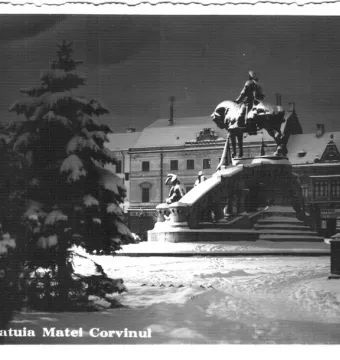
September 2012 © Unknown authorUnknown author · Public domain
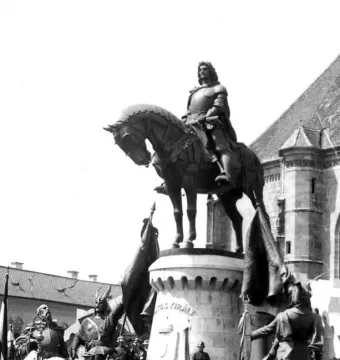
1902 © Unknown authorUnknown author · Public domain
Identification | |
| Title | Matthias Corvinus Monument |
| Alternative names | Monumentul Matia Corvin; Mátyás király emlékmű; Monument to Matthias Corvinus |
| Type | Equestrian statue monument |
Historical context | |
| Historical context | Created when Cluj was the capital of Transylvania and part of the Kingdom of Hungary within the Dual Monarchy |
Creator | |
| Sculptor | János Fadrusz |
| Architect of the pedestal | Lajos Pákey |
| Designer | János Fadrusz |
Discovery and provenance | |
| Initiation | The idea of erecting a statue dedicated to King Matthias, who was born in the city, arose and was approved by the city legislative council in 1882 |
| Model approved | János Fadrusz's model was adopted unanimously in 1894 |
| Award | First prize at the 1900 Paris Universal Exposition |
| Funding | Financed by public subscription |
| Transport | The bronze statues were transported by train from Budapest before the inauguration |
| Casting | Cast in bronze in the ore foundry |
Physical characteristics | |
| Pedestal inscriptions | Mátyás Király at inauguration; Mathias Rex (Latin) currently |
| Figures | Pál Kinizsi; Balázs Magyar; István Szapolyai; István Báthory |
| Pedestal | Represents a bastion of the city's fortified wall, as shown on the city's coat of arms |
| Components | Equestrian statue of Matthias Corvinus with four surrounding sculptures |
Materials | |
| Material | Bronze |
Appearance | |
| Depicted figure | Matthias Corvinus, King of Hungary (1458–1490) |
| Accompanying figures | Four generals and high officers of the Crown surrounding Matthias Corvinus |
Location and ownership | |
| Location | Piața Unirii (Unirii Square), Cluj-Napoca, Romania |
| Heritage status | Listed as a historical monument in Romania (CJ-III-m-A-07819) |
History and restoration | |
| Inauguration date | 12 October 1902 |
| Restoration | Restored in 2010–2011 under the direction of Tibor Kolozsi |
| Inscription change | Changed after World War I when Transylvania passed from Hungary to Romania |
| Honorary recognition for sculptor | Received a doctorate honoris causa from the universities of Cluj and was made an honorary citizen in November 1902 |
Significance | |
| Awarded model at exhibition | The plaster model received the Grand Prix at the Paris World Exhibition |
| Symbolic significance | One of the symbols of Cluj-Napoca; became emblematic of the city over time |
| Literary reference | Mentioned in Gib I. Mihăescu's novel La Femme chocolat, where it symbolizes wandering and the fantasies of the main character, Lucian Negrișor |