
The Endless Column
The Endless Column, also known as the Column of Infinity, is a sculpture by the Romanian artist Constantin Brâncuși. It is part of a monumental three-piece ensemble in Târgu Jiu, together with the Gate of the Kiss and the Table of Silence. Inaugurated on 27 October 1938, the sculpture stands 29.35 metres tall and is made of 16 overlapping octagonal modules, with a half module at each end. It rests on a foundation five metres deep. Originally called the Endless Column of Gratitude, it was created in memory of Romanian soldiers who died in the fighting along the Jiu River during the First World War. In July 2024, the ensemble was added to the UNESCO World Heritage List.
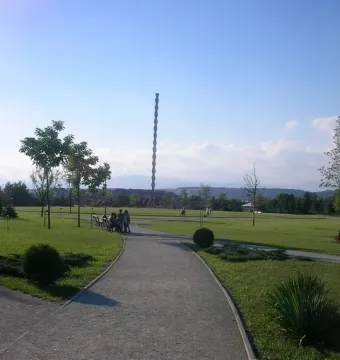
August 2006 © Georgiad · CC BY-SA 3.0 ro
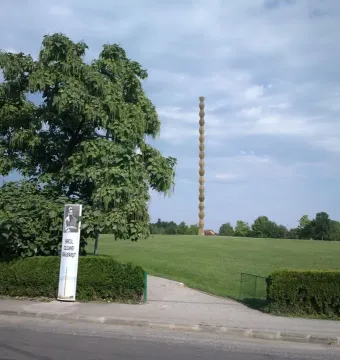
August 2014 © Korinna · CC BY-SA 3.0 ro
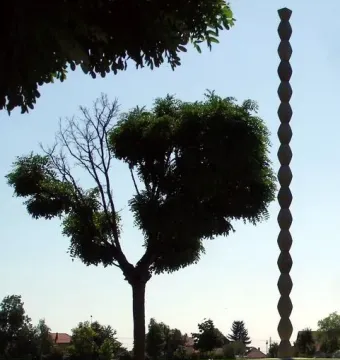
August 2012 © Miehs · Public domain

September 2019 © Vlad Tamnos · CC BY-SA 4.0
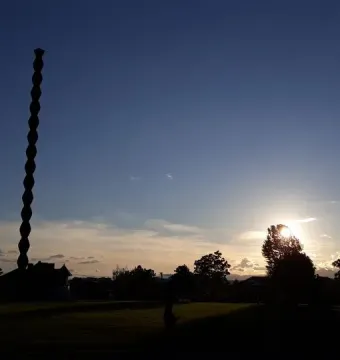
May 2019 © Vlad Tamnos · CC BY-SA 4.0
Identification | |
| Title | The Endless Column |
| Alternative names | The Column of Infinity; Colonne sans fin; Colonne de l'infini; Columna sin fin; Columna del infinito; Coloana fără sfârşit; Coloana infinită; Coloana infinitului; Beskonechnaya kolonna ("Endless Column"); Bесконе́чная коло́нна ("Infinite Column") |
| Type | Sculpture |
Creator | |
| Artist | Constantin Brâncuși |
| Artist nationality | Romanian |
Historical context | |
| Commissioned by | Women's League of Gorj County |
| Purpose | Memorial to Romanian soldiers who died in World War I, especially those killed near the Jiu River in 1916 defending the city against German troops |
| Part of ensemble | The Constantin Brâncuși sculptural ensemble in Târgu Jiu |
| Other ensemble components | The Table of Silence; The Gate of the Kiss |
| UNESCO World Heritage status | Added to the UNESCO World Heritage List in July 2024 |
| Historical threat | In the 1950s, communist authorities in Târgu Jiu planned to demolish it to build a residential district, but the plan was stopped by authorities in Bucharest and was never carried out |
| Restoration period | 1998–2000 |
| Arrangement of ensemble | Placed in a straight line over 1275 m |
Discovery and provenance | |
| Inauguration date | 27 October 1938 |
| Location | Târgu Jiu, Romania |
| Original title | The Endless Column of Gratitude |
| Version history | According to researcher Ionel Jianu, Brâncuși created five wooden versions and one version in plaster and steel between 1918 and 1937 |
Physical characteristics | |
| Foundation | Stands on a foundation five meters deep |
| Height | 29.33–29.35 meters |
| Structure | 17 diamond-shaped cast-iron modules, with half a module at each end |
Materials | |
| Material | Cast iron |
| Materials of earlier versions | Oak; plaster and steel |
Technique | |
| Form | Repeated rhomboid forms rather than a traditional column form |
Appearance | |
| Stylistic character | A simplified work |
| Stylistic inspiration | A stylization of the funerary pillars used in southern Romania and the decorative style of peasant architecture |
Iconography and meaning | |
| Symbolic basis | Axis mundi symbolism |
| Folk motif | The Romanian "heavenly column" |
| Folk-religious meaning | An archaic pre-Christian belief in Romanian folk culture that was quickly Christianized, with references in Christmas colindă songs |
| Symbolic meaning | According to Brâncuși, it symbolizes the ascent of the souls of fallen soldiers to heaven and supports the celestial vault; it is directed toward boundless space beyond the human world |
| Related work | Bird in Space |
Location and ownership | |
| Municipal heraldry | An integral part of the coat of arms of Târgu Jiu |
Significance | |
| Influence on music | Inspired György Ligeti's piano study "Coloana infinită" in the Second Book of Études |
| Historical significance | Brâncuși considered a founder and great initiator of modern sculpture |
Other | |
| Work period | Brâncuși worked on the Endless Column motif periodically for nearly forty years, from 1917 to 1957 |
| Aesthetic stance | Brâncuși rejected the idea that his work was abstract, saying it was pure realism based on idea and essence rather than external appearance |