
Monument of Alexander III
The Monument of Alexander III is a bronze statue mounted on a granite pedestal. A competition for the monument was launched in 1902 after completion of the Trans-Siberian Railway, to honor Alexander III, who had ordered the railway works. Robert Bach won the competition, and the project was approved by Nicholas II with some modifications. The monument was inaugurated in Irkutsk in 1908. It was later destroyed by decree, and a different statue was erected on the site in 1963. After the fall of the USSR, a copy of the original monument was made by Albert Tcharkine and unveiled in 2003 on Gagarin Street.
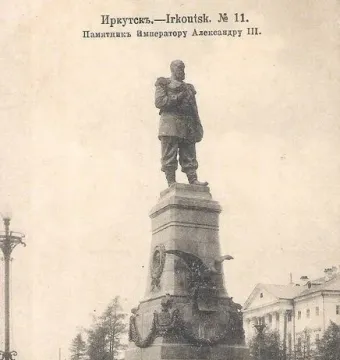
1916 © Unknown authorUnknown author · Public domain
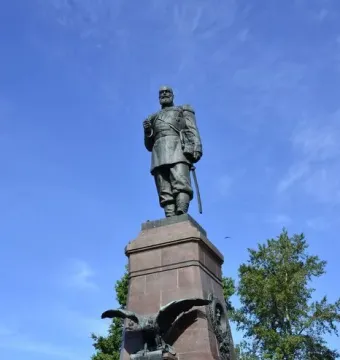
August 2023 © OldmanHank · CC BY-SA 4.0
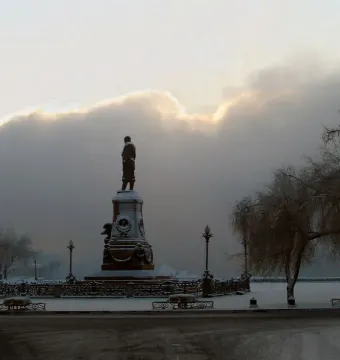
December 2010 © Irkut jazz · CC BY-SA 4.0
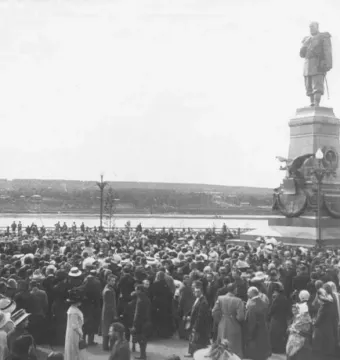
1912 © Unknown authorUnknown author · Public domain
March 2012 © Fanzuga · CC BY-SA 3.0
Identification | |
| Title | Monument of Alexander III |
| Subject | Emperor Alexander III of Russia |
Historical context | |
| Purpose | Erected in gratitude for Alexander III's decision to build the Trans-Siberian Railway |
| Commemorates | Completion of the Trans-Siberian Railway |
Creator | |
| Restoration sculptor | Albert Serafimovich Charkin |
| Replacement monument designer | Viktor Petrovich Shmatkov |
| Designer and sculptor | Robert Romanovich Bakh |
Discovery and provenance | |
| Competition winner | Robert Romanovich Bakh |
| Selection context | His model was selected after members of the imperial family and Interior Minister Siliaguine viewed the projects at the Kouchelevskaïa Gallery of the Imperial Academy of Fine Arts in Saint Petersburg |
| Approval | The project was approved by Nicholas II with some modifications |
| Competition | An all-Russian competition for the design was announced in 1902 after completion of the Trans-Siberian Railway |
| Funding | A committee in Irkutsk raised about 150,000 rubles by early 1903 |
History and restoration | |
| Possible reuse of metal | A Lenin monument cast in the 1940s was probably made from the melted bronze |
| Removal | The monument was removed in 1920 during May Day celebrations under the Decree on Monuments of the Republic |
| Removed elements | The bronze statue and bronze inscriptions were removed |
| Removed inscription text | "To Emperor Alexander III"; "Grateful Siberia" |
| Temporary storage after removal | The removed parts were kept for some time on the grounds of the East Siberian Department of the Imperial Russian Geographical Society |
| Fate of removed parts | Their later fate is unknown; the main version says they were sent for remelting |
| Restoration funding | Funded by the East Siberian Railway |
| Replacement on former site | In 1963 a concrete obelisk known as the monument to the Pioneers of Siberia was installed on the former pedestal |
| Restoration proposal | After the collapse of the USSR, restoration was proposed by the East Siberian Railway |
| Restoration approval | Restoration was approved on 24 April 2003 by the East Siberian Railway and the Irkutsk City Duma |
| Reinstallation | The restored statue was placed back on the pedestal and the monument was ceremonially reopened in autumn 2003 for the centenary of the Trans-Siberian Railway |
| Reopening attendees | Governor of Irkutsk Oblast Boris Govorin and President of the Republic of Buryatia Leonid Potapov |
| Vandalism | The monument has been vandalized at least five times |
| Fence added | 1912 |
| Restoration after vandalism | Restoration work began in 2016 and was carried out by Irkutsk sculptor and foundry worker Georgy Koldushko |
| Foundation laying | Ceremonial laying of the foundations began in summer 1903 |
| Original inauguration | 1908 |
| Original inauguration attendee | Governor-General of Eastern Siberia Selivanov |
Physical characteristics | |
| Original statue material | Bronze |
| Restored statue height | 5 meters |
| Original statue height | 5.5 meters |
| Original statue weight | 4 tons |
| Original pedestal material | Polished Finnish granite blocks |
Materials | |
| Fence material | Cast-iron grille |
| Pedestal relief material | Bronze |
| Restored statue material | Bronze |
Appearance | |
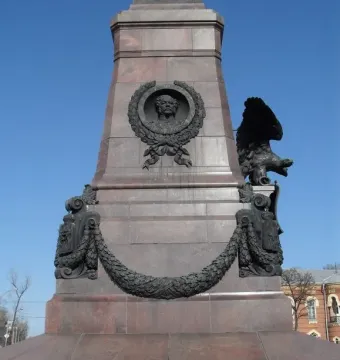
| Pedestal decoration | Bronze portraits of prominent historical figures associated with the exploration and development of Siberia |
| Depicted attire | Uniform of a Cossack ataman of the Siberian troops |
Iconography and meaning | |
| Irkutsk coat of arms detail | A Siberian panther with a sable in its jaws, shown to the right of the double-headed eagle |
| West side relief | Count Muravyov-Amursky looking toward the Angara River |
| North side relief | Yermak Timofeyevich |
| South side relief | Count Mikhail Mikhailovich Speransky |
| East side relief | Arms of the Russian Empire with a double-headed eagle holding the 1891 rescript of Tsarevich Nikolai Alexandrovich expressing gratitude to his father for the development of Siberia through the Trans-Siberian Railway |
| Corner emblems | Coats of arms of Siberia, the Irkutsk Governorate, the Yenisei Governorate, and the Yakutsk Oblast |
Location and ownership | |
| Original site name | Alexandrovsky Square (garden) |
| Related monument location | The Lenin monument stands near the administration of the Irkutsk Hydroelectric Power Station |
| Restoration manufacture | Saint Petersburg, at the Monumentskulptura plant |
| Fence location | Added around the monument in 1912 |
| Westward orientation | The west side faces the Angara River |
| Current location | Gagarine Street, Irkutsk |
| Original location | Irkutsk |