
L'Homme qui marche I
L'Homme qui marche I is a 1.83-meter bronze surrealist sculpture showing a solitary man walking with his arms hanging at his sides. It has been described as “a humble image of an ordinary man” and also as a powerful symbol of humanity. Giacometti saw the natural balance of walking as a sign of the human life force. In 1960, he was asked to join a public project for the Chase Manhattan Bank building in New York, but after disagreements he withdrew from the commission. He cast the work in 1961 and exhibited it at the Venice Biennale the following year. Created at the height of Giacometti’s mature period, it is considered one of his most important works and a major icon of modern art.
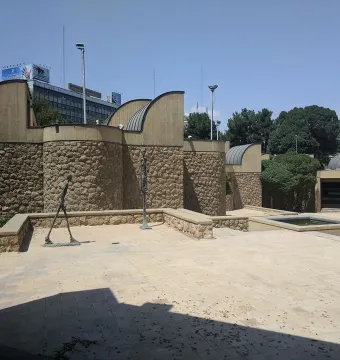
July 2017 © Farzaneh · CC BY-SA 4.0
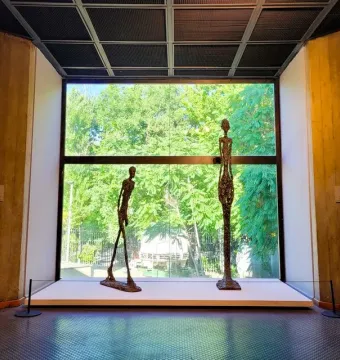
May 2024 © ZarlokX · CC BY-SA 4.0
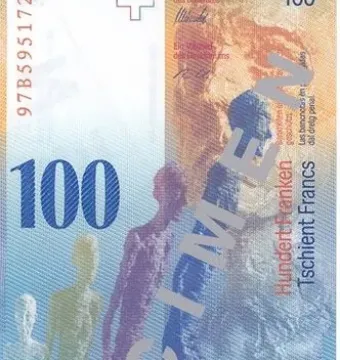
© Swiss National Bank (SNB) · Public domain
Identification | |
| Title | L'Homme qui marche I |
| English title | The Walking Man I |
| German title | Der schreitende Mann I |
| Portuguese title | O Homem que caminha |
| Russian title | Shagayushchiy chelovek I |
| Type | Life-size cast bronze sculpture |
| Original title | L'Homme qui marche |
Creator | |
| Artist | Alberto Giacometti |
| Nationality | Swiss |
Historical context | |
| Related earlier work | Derived in part from Trois hommes qui marchent (1948) and earlier plaza compositions |
| Series | First version in a series of walking-man statues; part of a larger plaza project that also included standing figures |
| Earlier auction context | It was the first life-size Giacometti walking-man figure to reach auction in 20 years; the previous Giacometti auction record was Grande Femme Debout ($27.5 million in 2008) |
| Commission outcome | Giacometti had difficulties with the project and eventually abandoned the commission |
| Commission context | Requested in 1960 for a public project for Chase Manhattan Plaza in New York, to place bronze figures outside the building |
| Creation date | 1960-1961 |
| Artistic period | Postwar mature work |
Discovery and provenance | |
| Casting foundry | Susse Fondeur, Paris |
| Number of bronze casts | Six numbered casts |
| Number of artist proofs | Four artist's proofs |
| Signature and foundry marks | Each cast is marked on the base with Giacometti's handwritten signature, the serial number 1/6 to 6/6, and the foundry stamp 'Susse Fondeur Paris' |
Physical characteristics | |
| Height | 183 cm |
| Length | 97 cm |
| Width | 27 cm |
| Base dimensions | 95.5 cm long and 26 cm wide |
Materials | |
| Material | Bronze |
| Modeling material | Clay, with traces of finger modeling visible on the surface |
Technique | |
| Technique | Cast in bronze from a clay model |
Appearance | |
| Surface | Deliberately rough and highly textured, with pronounced hills and hollows and visible marks of making |
| Movement quality | Austere, elongated, almost formless, with a hieroglyphic sense of movement and no knee bend |
| Body proportions | Emaciated, with very long legs and arms, oversized hands and feet, and a thin waist |
| Face and head | Face and sex organ only suggested; the figure stares into empty space |
| Posture | Striding forward in a wide step stance |
| Subject | A solitary man walking, with his arms hanging at his sides |
Iconography and meaning | |
| Psychological reading | The figure has been described as always searching and moving onward |
| Authenticity theme | The traces of struggle are presented as a sign of authenticity |
| Interpretive theme | Expresses tension between upright dignity and fragile upwardness on one hand, and amorphous materiality on the other |
| Human condition theme | Seen as expressing the human condition between dignity, exposure, and ultimate frailty |
| Giacometti's interpretation | The natural balance of walking symbolized man's life force |
| Descriptive characterization | A humble image of an ordinary man and a powerful symbol of humanity |
Location and ownership | |
| Previous owner of auctioned cast | Dresdner Bank |
| Ownership succession | Commerzbank acquired the cast when it absorbed Dresdner Bank in 2009 |
| Current owner of auctioned cast | An anonymous private collector; the sale was made through an anonymous telephone bidder |
| Other casts locations | Fondation Maeght, Saint-Paul, Alpes-Maritimes; Kröller-Müller Museum, the Netherlands; Albright-Knox Art Gallery, Buffalo, New York; Tehran Museum of Contemporary Art, Iran; Louisiana Museum of Modern Art, near Copenhagen, Denmark |
| Edition 2 status | Private collection |
| Edition 1 location | Carnegie Museum of Art, Pittsburgh, Pennsylvania |
History and restoration | |
| Casting date | 1961 |
| Public first presentation | First shown publicly at the Venice Biennale in 1962 |
| Auction sale date | 3 February 2010 |
| Auction house | Sotheby's, London |
| Auction result | Hammer price £58 million; total price with commission £65 million (US$103.78 million / US$104,327,000) |
| Auction buyer | Lily Safra, probably; identified in some accounts as a private collector or anonymous bidder |
| Color treatment | Some casts were painted by Giacometti with ochre yellow and ink black paint; others remained untreated |
Significance | |
| Artistic significance | Considered one of Giacometti's most important works, one of the most important icons of modern art, and one of the most important works of Swiss art of the 20th century |
| Art historical assessment | Represents the peak of Giacometti's experimentation with the human form and is often described as the quintessence of his sculptural oeuvre |
| Banknote depiction | Depicted on the reverse of the Swiss 100-franc note issued in 1998, shown in four different perspectives alongside two other works; the obverse features a portrait of Giacometti |
| Film appearance | Appears in Iron Man 2 |
| Auction record | At the time, the sale set records as Giacometti's highest auction price, the most expensive sculpture sold at public auction, and one of the most expensive works of art ever sold at auction; it was surpassed by L'Homme au doigt in May 2015 |