
Brno astronomical clock
The Brno astronomical clock is a black stone monument located at Náměstí Svobody, the main square in Brno, Czech Republic. Proposed by Brno mayor Roman Onderka, it was created by Oldřich Rujbr and Petr Kameník and unveiled on September 18, 2010. Although widely referred to as an astronomical clock, it is actually only a clock and is officially known as a clockwork machine. Each day at 11:00 AM, it releases a glass marble that visitors can catch from one of four openings and keep as a souvenir. Construction took three years and cost approximately 12 million CZK.
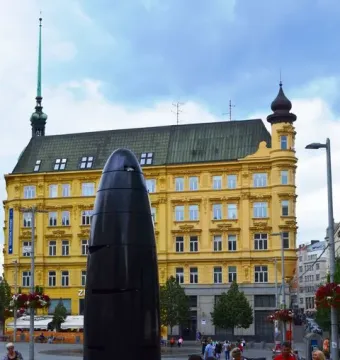
July 2015 © Scotch Mist · CC BY-SA 4.0
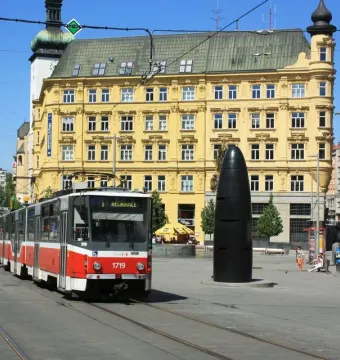
April 2012 © Harold · CC BY-SA 3.0
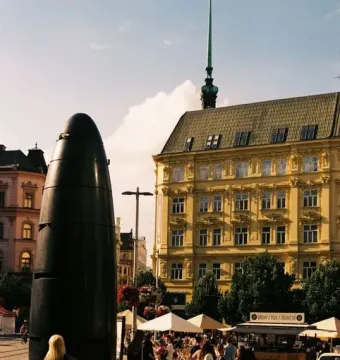
July 2020 © Martin Malec · CC0
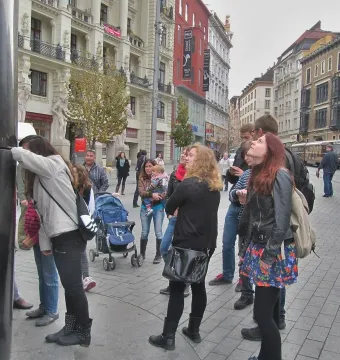
October 2013 © Palickap · CC BY-SA 4.0
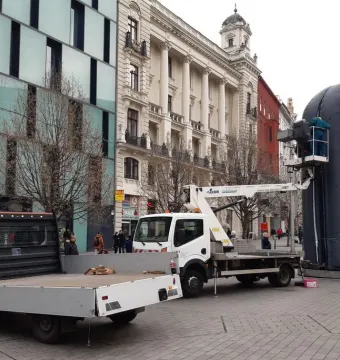
December 2019 © Jindřich Běťák · CC BY-SA 4.0
Identification | |
| Title | Brno astronomical clock |
| Czech name | Brněnský orloj |
| Local name | Brünner Uhr |
| Official name | Clockwork machine (hodinový stroj) |
| Type | Sculpture |
Historical context | |
| Date unveiled | September 18, 2010 |
| Construction period | Three years |
| Cost | Approximately 12 million CZK |
| Occasion for unveiling | The 365th anniversary of Brno's resistance to the Swedish siege during the Thirty Years War |
Creator | |
| Proposed by | Roman Onderka, mayor of Brno |
| Designed by | Oldřich Rujbr and Petr Kameník |
Physical characteristics | |
| Mechanism | Contains a complex radio-controlled clock mechanism |
| Form | Cartridge shape |
| Height | 6 meters |
| Material | Black stone |
Location and ownership | |
| Location | Náměstí Svobody, Brno City Centre, Brno, Czech Republic |
| City | Brno |
| Country | Czech Republic |
Appearance | |
| Reputation | Known for its phallic appearance |
Iconography and meaning | |
| Historical reference | Refers to the failed Swedish siege of Brno in 1645 during the Thirty Years' War |
| Naming basis | The daily marble release is the basis for the name |
Technique | |
| Daily feature | At 11:00 a.m. every day, the clock releases a glass marble that can be caught from one of four openings and kept as a souvenir |
| Movable parts | The individual parts at the top of the object rotate at intervals of 1 minute, 1 hour, and 12 hours |
| Radio signal source | Frankfurt am Main |
Significance | |
| Public reception | Locals received the monument with mixed feelings |
| Tourist appeal | It became a tourist attraction |