
Brevet Lt. General Winfield Scott
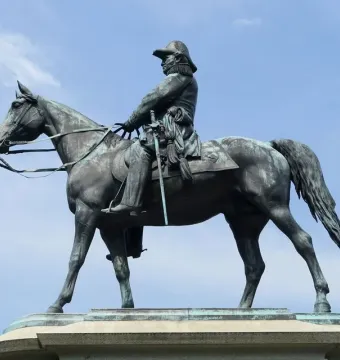
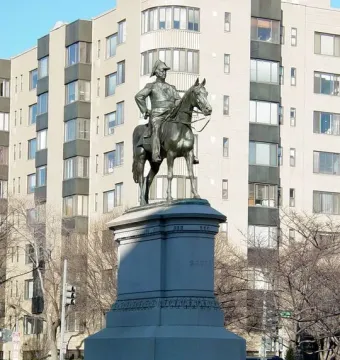
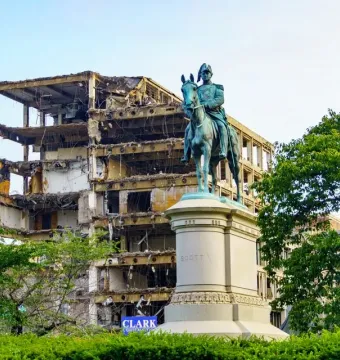
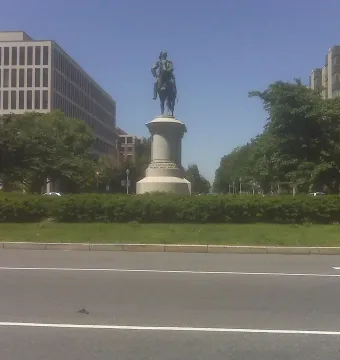
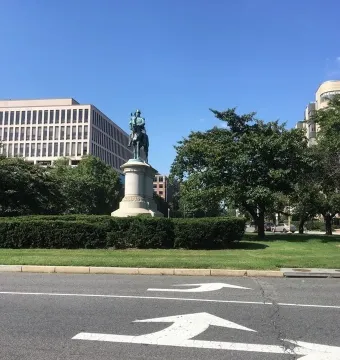
Brevet Lt. General Winfield Scott is an equestrian statue in Washington, D.C., honoring career military officer Winfield Scott. Located at the center of Scott Circle, a roundabout and small park where 16th Street, Massachusetts Avenue, and Rhode Island Avenue NW meet, it was sculpted by Henry Kirke Brown. The bronze figure stands on a granite base that was, at the time, the largest stone ever quarried in the United States. It was the first of many Civil War general monuments placed in Washington’s circles and squares, and the second statue in the city honoring Scott. The monument is one of 18 Civil War monuments in Washington, D.C., listed together on the National Register of Historic Places in 1978.
June 2015 © Daderot · Public domain
January 2006 © Ben Schumin · CC BY-SA 2.0
July 2020 © Ted Eytan · CC BY-SA 2.0
May 2009 © Kas Hayes · CC BY-SA 4.0
© NPS Photo · Public domain
Identification | |
| Title | Brevet Lt. General Winfield Scott |
| Commemorates | Winfield Scott |
| Type | Equestrian statue |
| Subject | Winfield Scott (1786–1866), U.S. Army general and Mexican–American War hero |
Creator | |
| Sculptor | Henry Kirke Brown (1814–1886) |
| Foundry | Robert Wood & Company |
| Base architect | Disputed: James M. Goode cites General Orville E. Babcock; a 1985 National Park Service report credits George Edward Harney |
| Stonework | Jonas H. French of the Cape Ann Granite Company |
Historical context | |
| Part of | One of 18 Civil War monuments in Washington, D.C. |
| Representation in Washington | Second statue in the city to honor Winfield Scott |
| Historical significance | First of many monuments to Civil War generals installed in Washington, D.C. traffic circles and squares |
| Installation date | 1874 |
| Total cost | $77,000 |
| Congressional authorization | March 3, 1867; reauthorized July 15, 1870, and June 10, 1872 |
| Model completed | Around 1872 |
| Original appropriation | $35,000 |
Discovery and provenance | |
| Original planned location | Present-day McPherson Square |
| Former site name | Jamaica |
| Federal material contribution | Captured bronze cannon from Scott's Mexican–American War service, supplied by the federal government to be melted for the statue |
Physical characteristics | |
| Base weight | More than 150 tons |
| Material of statue and base | Bronze statue on a granite base |
| Base dimensions | Width and length are unspecified in the source fragment |
| Dimensions | Height and length are unspecified in the source fragment |
Materials | |
| Base material | Granite |
| Base form | Single block of granite |
| Statue material | Bronze |
Appearance | |
| Inscription | "SCOTT" on the south side of the base |
| Base design | Tiered base with architectural decoration |
| Horse depiction | A small mare with the external genitalia of a stallion |
| Uniform | Field uniform of a lieutenant general, including a hat, long coat with fringed epaulettes, and decorative sash |
| Depicted pose | Scott on horseback, holding the reins in his left hand |
| Right hand | Holds a pair of field glasses and rests on his hip |
| Sword | At his left side |
Iconography and meaning | |
| Horse design controversy | Scott's descendants objected before casting because Brown designed the horse as a small mare rather than a stallion; Brown made only minimal changes |
| Artist response to criticism | Brown was annoyed by the requests and made only minimal changes |
Location and ownership | |
| Pedestrian access | Not intended for pedestrian use; pedestrians use the side reservations to move around it |
| Site status | Scott Circle is considered the southeastern terminus of Embassy Row |
| Ownership | Owned and maintained by the National Park Service, a federal agency of the Department of the Interior |
| Nearby landmarks | Embassy of Australia overlooks the circle and statue; the Daniel Webster Memorial is on the west reservation; the Samuel Hahnemann Monument is on the east reservation |
| Setting | Traffic circle and park |
| Orientation | Faces south down 16th Street toward the White House |
| Neighborhood | On the border of the Dupont Circle and Logan Circle neighborhoods |
| Specific site | Center of Scott Circle, a traffic circle and park at the convergence of 16th Street, Massachusetts Avenue, and Rhode Island Avenue NW |
| Current location | Center of Scott Circle, Washington, D.C., United States |
History and restoration | |
| Phil Sheridan comment | He reportedly told his wife never to let him be immortalized that way |
| Criticism of horse | Mocked as limping and unable to move faster than a walk; its proportions were called too light, too delicate, too thin, too shy, and terribly proportioned |
| Criticism of figure | Scott was described as too old, too fat, too stiff, too short-legged, and like a old sack of meal; critics also objected to his hand resting on his hip |
| Condition and reception | Widely criticized after installation; considered by authors and historians to be one of the worst equestrian monuments in Washington, D.C., and described in 2000 as the city's strangest equestrian statue |
| District of Columbia historic inventory listing | Included in the District of Columbia Inventory of Historic Sites on March 3, 1979 |
| National Register listing | Collectively listed on the National Register of Historic Places on September 20, 1978 |
| Temporary removal | Temporarily removed in 1941 when a four-lane tunnel was built beneath the circle |
| Dedication | No formal dedication |
| Park landscaping | The surrounding park was landscaped with trees and ornamental flowers before installation |
| Site renamed for | Renamed in honor of Winfield Scott when the monument was installed |
Significance | |
| Development impact | The monument stimulated development around Scott Circle; wealthy Washington residents later built mansions nearby, many of which were demolished in the 1940s |
| Uniqueness in city | Scott is the only Civil War officer represented by two statues in the nation's capital |
| Second Scott statue | A second statue by Launt Thompson was erected on the grounds of the United States Soldiers' Home in 1873 |
| Artist's other known works | Statues of George Washington in New York and Nathanael Greene in Washington, D.C. |