
Superlambanana
Superlambanana is a bright yellow sculpture in Liverpool, England, weighing almost 8 tonnes and standing 5.2 metres tall. Designed by Japanese artist Taro Chiezo, who created only a ten-centimetre model, the full-size version was made by local artists Andy Small, Julian Taylor, Tommy Reason, and Ray Stokes. First developed for the 1998 ArtTransPennine exhibition, it is described as a response to the dangers of genetic engineering and as being strongly influenced by Liverpool’s history, when both sheep and bananas were common cargo on the city’s docks. The sculpture is now located on Tithebarn Street, outside the LJMU Avril Robarts Library/Resource Centre.
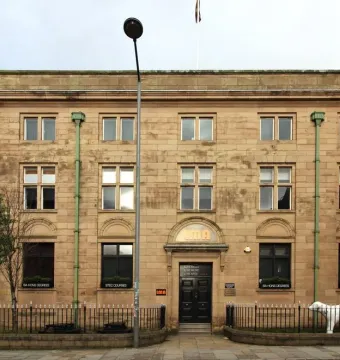
January 2018 © Rodhullandemu · CC BY-SA 4.0
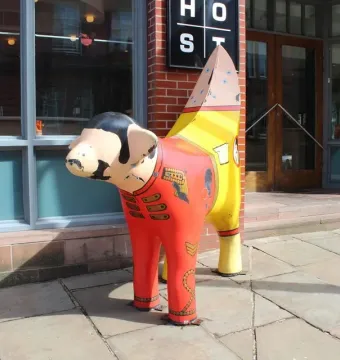
August 2018 © Rodhullandemu · CC BY-SA 4.0
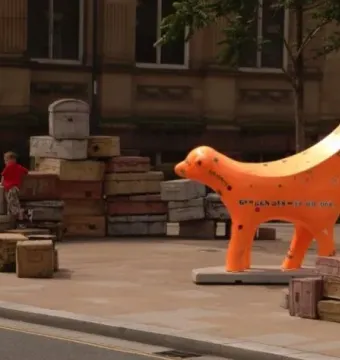
October 2013 © Jerrye & Roy Klotz, MD · CC BY-SA 3.0
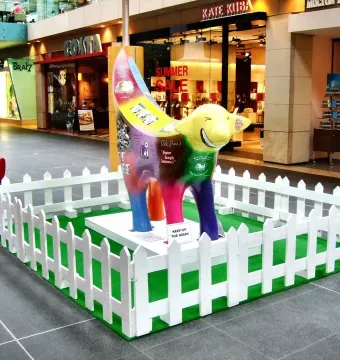
July 2008 © Stuart Ian Burns · CC BY 2.0
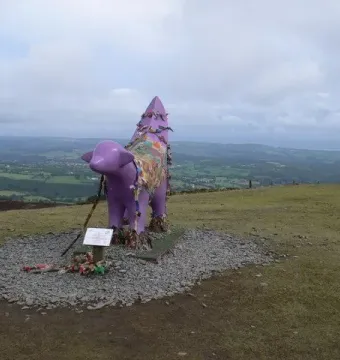
September 2008 © Eirian Evans · CC BY-SA 2.0
Identification | |
| Title | Superlambanana |
| Type | Sculpture |
Physical characteristics | |
| Form | Hybrid of a banana and a lamb |
| Color | Bright yellow |
| Height | 5.18 m (17 ft) |
| Weight | Almost 8 tonnes |
Location and ownership | |
| Main sculpture status | The main sculpture is in the Museum of Liverpool and is movable around the city |
| 2008 London appearance | One replica appeared at Euston station in London |
| 2010 initial location | Strand Street, in front of the Cunard Building and the Royal Liver Building |
| Financial stewardship | Held in financial trusteeship by Liverpool City Council |
| Custodian after exhibition | Liverpool Architecture & Design Trust |
| Unveiled at | The reopening of Tate Liverpool |
| 2010 planned relocation | Lime Street station after reconstruction |
| 2010 Shanghai copy | One of the eight copies, named Archie, was sent to the 2010 World Expo in Shanghai, donated by the city, and is now in the Shanghai World Expo Museum |
| 2014 relocation | As of October 2014, four of the eight copies had been moved to Pier Head, in front of the new Museum of Liverpool |
| 2008 special replica | The Highest SuperLambBanana, installed on the summit of Moel Famau in North Wales to recognise Liverpool's close ties with Wales |
| Location | Liverpool, England |
| Current location | Tithebarn Street, outside the Avril Robarts Library / Learning Resource Centre of Liverpool John Moores University |
| Previous location | Wapping Dock, Liverpool |
Creator | |
| Artist | Taro Chiezo |
| 2010 Shanghai copy designer and maker | Debbie Ryan, a local artist from Liverpool |
| Artist residence | Manhattan, New York City |
| Artist nationality | Japanese |
Historical context | |
| Exhibition purpose | Part of an initiative to create an "art corridor" across northern England |
| 2010 replicas | Eight new two-metre copies were installed in early 2010 as urban public art |
| Development location | Former Bryant & May Matchworks factory in south Liverpool |
| Design date | 1998 |
| 2008 replicas | 125 two-metre designer replicas were installed across Liverpool and the wider Merseyside region in 2008 as part of Liverpool's European Capital of Culture year; local community organisations and city businesses sponsored them |
| Created for | ArtTransPennine Exhibition of 1998 |
Discovery and provenance | |
| Full-size replica makers | Andy Small, Julian Taylor, Tommy Reason, and Ray Stokes |
| Original model size | 10 centimetres (4 inches) |
| Scale of enlargement | 50:1 |
Materials | |
| 2010 Shanghai copy material | Mosaic technique |
| Construction method | Wire-mesh frame supporting a shell of concrete and fibreglass |
| Materials | Concrete and fiberglass on a metal frame |
Other | |
| 2023 Eurovision context | Liverpool hosted Eurovision Song Contest 2023 on behalf of Ukraine because of Russia's war with Ukraine |
| Development cost | £35,000 |
Appearance | |
| Name origin | From English super, lamb, and banana |
Iconography and meaning | |
| Inspiration interpretation | The idea of incorporating a vital piece of engineering into a larger aesthetically pleasing structure |
| Inspiration source | The Queensway Tunnel ventilation shaft |
| Historical reference | Refers to Liverpool's dock history, when sheep and bananas were common cargo |
| Interpretation | An ironic commentary on the dangers of genetic engineering |
| Intended meaning | To reflect the future of Liverpool in the 1990s |
History and restoration | |
| Black and white repainting context | During a period of quasi-vandalism; the colours were those of a Friesian cow |
| Purple repainting purpose | For the SmokeFree Liverpool anti-smoking campaign |
| Blue and yellow repainting purpose | To match the Ukrainian flag during the 2023 Eurovision Song Contest in Liverpool |
| Pink repainting purpose | For the breast cancer awareness charity Breakthrough |
| Repainted colours | Pink, black and white, purple, and blue and yellow |
| Later status | Became a popular city symbol and a valued work of public art |
| Initial reception | Initially controversial, with skepticism about its purpose and value |
| Intended mobility | Designed to move around the city rather than remain in one location |