
Havis Amanda
Havis Amanda is a bronze statue by Ville Vallgren, created in 1905 and standing in the center of a fountain at the edge of Kauppatori Square in central Helsinki. Including the fountain basin, it is 5 meters high. The sculpture depicts a mermaid who has chosen to leave the sea and step onto land. In Vallgren’s imagination, Havis Amanda embodies Helsinki, the daughter of the Baltic Sea, and represents the soul of the city on the shore. She is shown at the moment she takes her first steps on land, looking back one last time toward the sea. The statue has also become central to Vappu celebrations, when students wash it and place a student cap on it.
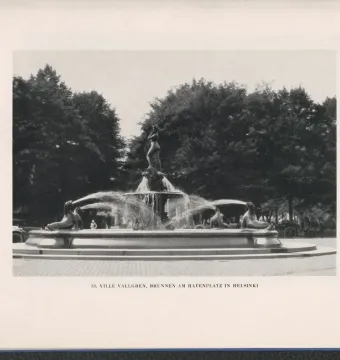
© Konrad Hahm · Public domain
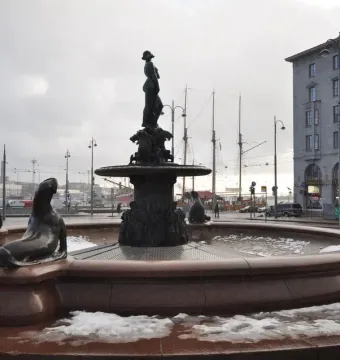
November 2008 © Jorge Láscar · CC BY 2.0
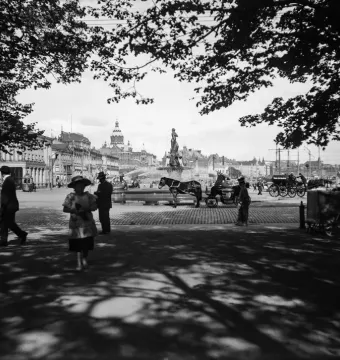
© Creator:Eino Lindholm · Public domain
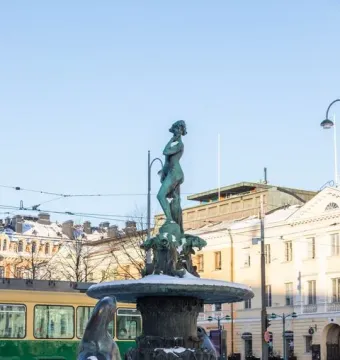
February 2021 © Sofia Ek · CC BY-SA 4.0
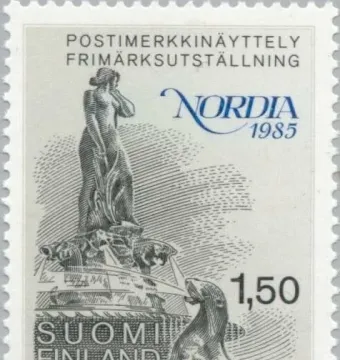
1985 © Post of Finland · Public domain
Identification | |
| Title | Havis Amanda |
| Alternative names | Manta; Merenneito; La sirène; Haaviston Manta |
| Original title | Merenneito |
| Original title meaning | Mermaid |
Historical context | |
| Year created | 1906 |
| Year installed | 1908 |
| Unveiling date | 20 September 1908 |
| Artistic style | Art Nouveau; Parisian Art Nouveau |
Creator | |
| Model | Marcelle Delquini, a 19-year-old Parisian woman; according to Vallgren's letters/recollections |
| Fountain designer | Eliel Saarinen |
| Artist | Ville Vallgren (1855–1940) |
Discovery and provenance | |
| Place of creation | Paris |
| Commissioning influence | Albert Edelfelt helped secure the commission |
Physical characteristics | |
| Type | Bronze fountain statue of a nude female figure |
| Height of sculpture | 194 cm |
| Total height | 5 m |
| Pedestal and basin material | Granite |
Materials | |
| Main material | Bronze |
Appearance | |
| Associated figures | Four fish spouting water at her feet and four sea lions around the composition |
| Depicted figure | A mermaid or sea maiden rising from the water, leaning back and looking over her shoulder as if bidding farewell to the sea |
Iconography and meaning | |
| Interpretation | Seen as the embodiment or soul of Helsinki, the daughter of the Baltic Sea |
| Symbolic meaning | Intended to symbolize the rebirth of Helsinki |
Location and ownership | |
| Current location | Market Square, Helsinki, Finland |
| Setting | At the center of a fountain on the edge of Market Square, near Esplanadi Park |
| Local name | Manta |
History and restoration | |
| Condition | The statue is old and hollow, and there are concerns it could break if people climb on it |
| 2023 removal | Dismantled on 3 May 2023 during reconstruction of the fountain and adjacent square; moved to an unspecified location |
| Associated criticism | The sea lions were also criticized for their exotic appearance |
| Public criticism | Some women's rights critics called the figure plain and compared it to a French prostitute |
| Initial reception | Initially controversial; its nudity and seductive appearance drew criticism, including complaints about the figure's anatomy and placement |
Significance | |
| Popularity | One of the best-known monuments in Helsinki and one of Vallgren's best-known works |
| Vappu tradition | A central feature of Finnish May Day (Vappu) celebrations, especially the Mantan lakitus capping ceremony |
| Vappu ritual | Students wash the statue and place a student cap on it on 30 April at 6:00 PM; people present often wear caps and celebrate with champagne |
| Vappu participation | Typical attendance is about 20,000 to 30,000 people |
| Related customs | Local students also kiss Amanda despite the water |
| 2014 temporary installation | In 2014, Tatzu Nishi created a temporary hotel installation called Hotel Manta of Helsinki around the statue, used as a hotel room at night and exhibition space by day; it attracted over 23,000 visitors |
| 2002 event | In 2002, Spencer Tunick organized the Nude Adrift, Finland 3 photoshoot of voluntary nude Finns around the statue, drawing almost 2,000 participants |
| 2020 measures | During Vappu 2020, the city and police temporarily fenced off the statue because of COVID-19 concerns and directed the public to a digital capping version |
| Historical reception context | After installation, the work gradually gained acceptance and came to be seen by residents as the spirit of the city |