
Charging Bull
Charging Bull is a bronze sculpture by Arturo Di Modica that weighs 3,200 kg and is located in Bowling Green near Wall Street in New York City. Shaped as a bull with its front legs bent and head slightly lowered, it appears ready to charge and symbolizes strength and power. Di Modica created and placed the work after the 1987 stock market crash as a symbol of American strength, spending his savings on the project. He installed it in front of the New York Stock Exchange as a guerrilla art act in December 1989, and public demand later helped secure its place in Bowling Green. The sculpture has become one of the most photographed works in the area and an unofficial symbol of the Financial District.
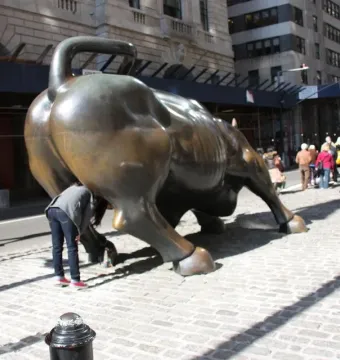
© Andrés Nieto Porras · CC BY-SA 2.0
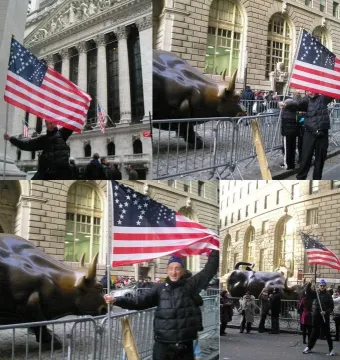
January 2012 © Art Palmer · CC BY-SA 3.0
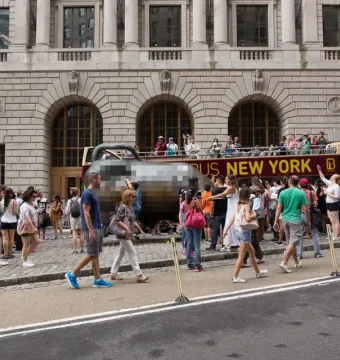
© Andy Rusch · CC BY 4.0
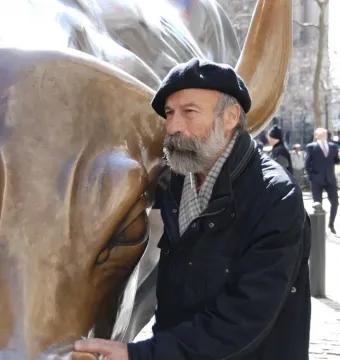
November 2014 © Artislife1406 · CC BY-SA 4.0
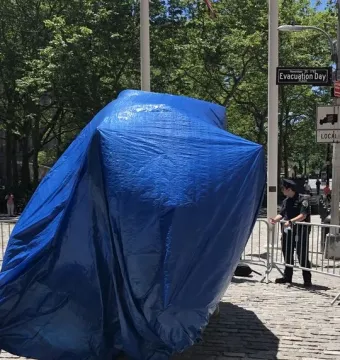
June 2020 © NicoARicoA · CC BY-SA 4.0
Identification | |
| Title | Charging Bull |
| Literal translation of title | "bull charging" |
| Type | bronze sculpture |
| Alternative names | Wall Street Bull; Bull of Wall Street; Bowling Green Bull; The Bull; The Charging Bull |
Creator | |
| Artist | Arturo Di Modica |
| Artist nationality | Italian |
Physical characteristics | |
| Appearance | Aggressive, energetic, and in motion; it suggests a dangerous animal |
| Weight | 3,200 kg |
| Height | 3.4 m |
| Length | 4.9 m |
| Subject | A bull |
| Pose | The bull is crouching with its head lowered, front legs bent, and body leaning as if ready to charge |
| Details | All muscles are tense; the tail is curved like a whip; the horns are long and sharp; the right hoof points forward |
Materials | |
| Material | bronze |
Location and ownership | |
| Relative location | Two blocks south of the New York Stock Exchange building |
| Popularity | One of the most photographed works in New York City; a popular tourist destination that draws about 1,000 visitors a day and thousands of people overall |
| Copyright | The artist retained the rights to the sculpture's image |
| Ownership | Owned by Arturo Di Modica |
| Orientation | Facing Broadway |
| Current location | Bowling Green, at the north end of the Bowling Green traffic median on Broadway, Financial District of Manhattan, New York City |
Discovery and provenance | |
| Reinstallation status | Initially placed under a temporary permit; later treated as a permanent public monument |
| Reinstallation location | Bowling Green plaza, two blocks south of the Stock Exchange |
| Reinstallation date | 20 December 1989 |
| Initial purpose | A Christmas gift for the people of New York |
| Commissioning | Not commissioned; initiated by the artist himself |
| Initial installation method | Brought by truck and illegally dropped outside the New York Stock Exchange without prior authorization |
| Creation funding | Di Modica spent his own savings; the cost is reported as $300,000 or $360,000 in the sources provided |
| Creation context | Created after the 1987 stock market crash |
| Edition | One of an edition of five |
| Intended circulation | The other four were intended for cities around the world if purchased |
| Initial installation date | 15 December 1989 |
| Initial installation location | In front of the New York Stock Exchange, under a large Christmas tree |
Iconography and meaning | |
| Symbolism | A symbol of financial optimism and prosperity, and of Wall Street and the Financial District |
| Meaning | Represents the force, strength, power, and hope of the American people |
| Market symbolism | In stock-market slang, bulls are traders oriented toward economic growth and rising stock prices |
| Interpretation | Associated with American capitalism, economic prosperity, and good luck for stock-market investors |
| Comparisons | Compared with the Frankfurt Stock Exchange bull-and-bear sculptures and with the biblical golden calf |
Significance | |
| Critical reception | Criticized from anti-capitalist perspectives, including during the Occupy Wall Street protests of 2011 |
| Reception | Immediately popular after installation; widely discussed in the media as a symbol of optimism and prosperity |
| Status | An unofficial symbol of the Financial District, Wall Street, and New York City |
History and restoration | |
| Public reaction to installation | Crowds came to see and admire the sculpture; Di Modica handed out leaflets explaining the work |
| Removal | The NYPD removed the sculpture on the day of its first installation because it had been installed without permission |
| Later disputes | Di Modica later said the sculpture was for sale or auction in 2004, on condition that it not be moved from Bowling Green |
| Legal disputes | Di Modica sued Random House and other companies in 2006 for copyright infringement and again in 2009 over reproduction of the bull image |
| Related works | Di Modica later created versions for private collectors and installed a similar bull in Shanghai in 2010; the Shanghai bull was described by him as redder, younger, stronger, and not much different in size |
| Related artwork | Fearless Girl was installed in front of the sculpture in 2017 and moved in late 2018 to in front of the New York Stock Exchange |
Other | |
| Viewing design | Designed so viewers can walk around it |
| Cultural associations | Described as strongly masculine because of the bull's testicles; a popular tradition says touching them brings luck |
| Source descriptions | Described by Dianne Durand in Monuments of Manhattan: A Historical Guide and by Arturo Di Modica in a 1998 New York Daily News interview |