
Manuel Belgrano Equestrian Monument
The Manuel Belgrano equestrian monument is a memorial to Manuel Belgrano, a hero of Argentina’s War of Independence against Spanish rule and the creator of the Argentine flag. It stands in Plaza de Mayo in Buenos Aires, Argentina, and was ceremonially unveiled on 24 September 1873, on the sixty-first anniversary of the Battle of Tucumán, in the presence of President Domingo Sarmiento and about 20,000 people. The work was created by the French sculptor Louis-Robert Carrier-Belleuse. It depicts General Manuel Belgrano as a bronze statue holding the flag of Argentina, mounted on a granite pedestal.
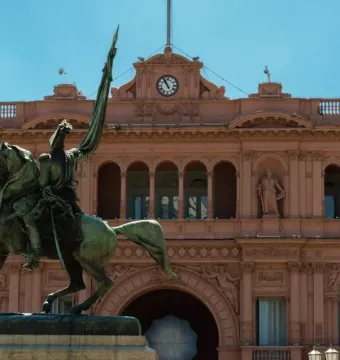
© Luis Ezcurdia · CC BY-SA 3.0
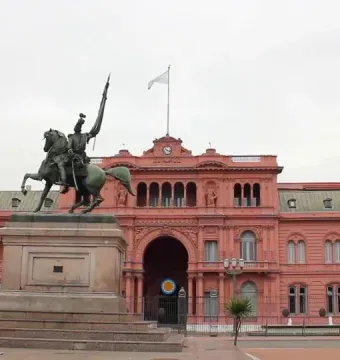
September 2018 © Fernandezs Mariana · CC BY-SA 4.0
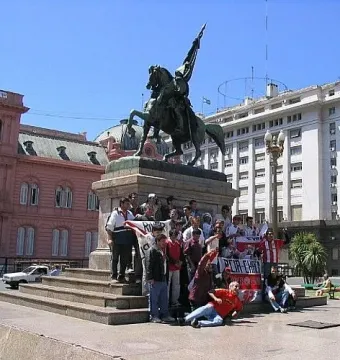
November 2004 © Louis-Robert Carrier-Belleuse · CC0
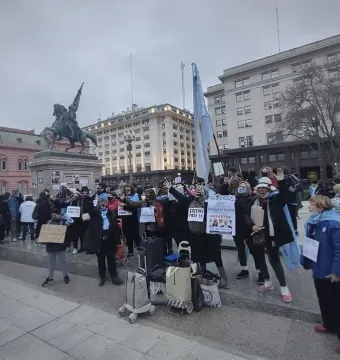
September 2021 © Roberto Fiadone · CC BY-SA 4.0
December 2022 © MinervaAustral · CC BY-SA 4.0
Identification | |
| Title | Equestrian Monument to General Manuel Belgrano |
| Subject | Manuel Belgrano |
| Status | Landmark of Buenos Aires, Argentina |
| Type | Equestrian monument |
Historical context | |
| Honoree significance | Hero of the Argentine War of Independence against Spanish rule; author of the Argentine flag |
Creator | |
| Sculptor | Louis-Robert Carrier-Belleuse |
| Horse sculptor | Manuel de Santa Coloma |
| Assistant contribution | Carrier-Belleuse made the body of the general |
| Horse sculptor significance | Described as the first monument made by an Argentine sculptor |
Discovery and provenance | |
| Unveiling occasion | 61st anniversary of the Battle of Tucumán |
| Contemporary press comment | La Prensa said the inauguration was one of the most sumptuous and crowded events the city had seen in a long time |
| Inauguration setting | The plaza was filled; people also occupied nearby rooftops and balconies |
| Attending groups | Government, army, navy, clergy, commerce, banking, schools, corporate delegations, and foreign country representatives |
| Attending officials | President Domingo Faustino Sarmiento and Buenos Aires province governor Mariano Acosta |
| Unveiling attendance | About 20,000 people |
| Commission purpose | To erect a monument to General Manuel Belgrano in Plaza 25 de Mayo (today Plaza de Mayo), then separated from Plaza Victoria by the Recova |
| Unveiling date | 24 September 1873 |
| Transported to | Buenos Aires |
| Completion date | 1872 |
| Funding | Public national subscription; funded by public gratitude |
| Commission members | Generals Bartolomé Mitre, Enrique Martínez, and Manuel José Guerrico |
| Commission date | 1870 |
Appearance | |
| Horse depiction | The horse is said not to resemble a Criollo horse like the one Belgrano used |
| Object held by figure | Argentine flag |
| Depiction | Bronze equestrian statue of General Manuel Belgrano holding the Argentine flag in the act of taking an oath |
| Figure pose | Belgrano is mounted on horseback |
Physical characteristics | |
| Material | Bronze |
| Pedestal material | Polished Rosa del Salto granite |
| Base | Set on a pedestal |
| Plaques | Two plaques are installed on the monument's pedestal |
Location and ownership | |
| Location | Plaza de Mayo, Buenos Aires, Argentina, in front of the Casa Rosada |
| Original orientation | Facing Buenos Aires Cabildo |
| Current orientation | Facing north |
| Current setting | The pedestal stands on a polished marble esplanade that slopes down to a large flagpole with the Argentine flag |
| Current fencing | No fence or grille |
History and restoration | |
| Ceremony music | The Argentine National Anthem was performed at Teatro Colón that night because of the inauguration |
| Critical assessment | The ensemble has long been criticized as very flat, and the horse as small and short-legged; it was said that with such a mount the hero could hardly have gone very far |
| Associated anecdote | Years earlier, Sarmiento had pointed out the sculptor's uncle, Martín de Santa Coloma, to General Justo José de Urquiza to be beheaded at Caseros |
| Mitre's statement | He said the statue was erected by public gratitude under the auspices of the Buenos Aires government and with the participation of the national government and the people's contribution |
| Bartolomé Mitre's role at inauguration | He was present and gave a speech |
| Base modification reason | The base was thought to be too low for the monument's importance |
| Pedestal decoration at unveiling | Covered with flowers and wreaths |
| Orientation change reason | To avoid showing the horse's rear toward the Casa Rosada / Casa de Gobierno |
| Pedestal arrival date | 1885 |
| Pedestal construction location | Genoa |
| Base modification | The base was raised; the simple grille was replaced with a French-style iron-and-bronze grille |
| Base modification period | During the government of Marcelo Torcuato de Alvear |
| Reorientation and pedestal alteration | During Torcuato de Alvear's administration, the monument was rotated from facing the Cabildo to facing north and the pedestal was raised |