
Tiber Dionysus
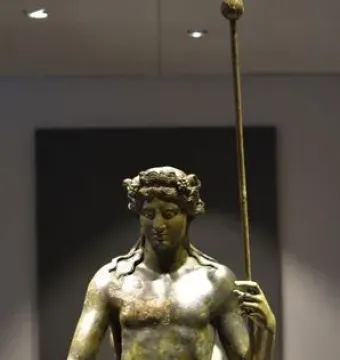
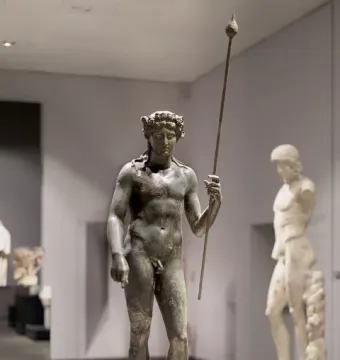
Tiber Dionysus is a bronze statue of the Greek god of wine, Dionysus. It stands 150 cm tall and its features show a close resemblance to the works of Praxiteles and to artists best known from the Antonine and Hadrianic periods. The sculpture was discovered in 1885 during dredging of the Tiber for the construction of Ponte Garibaldi, built for Giuseppe Garibaldi and designed by Angelo Vescovali. After a later discovery of Apollo of the Tiber nearby in 1891, the statue was restored between 1984 and 1985. It is now displayed in the National Roman Museum at Palazzo Massimo, inventory number 1060.
November 2016 © Rabax63 · CC BY-SA 4.0
November 2024 © Fabrizio Garrisi · CC0
October 2006 © Sergey Sosnovskiy · CC BY-SA 2.0
November 2016 © Rabax63 · CC BY-SA 4.0
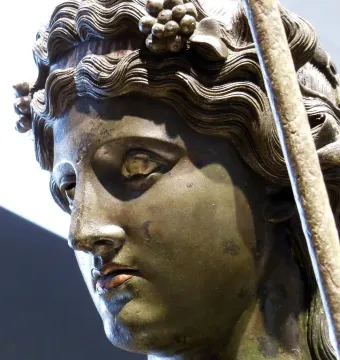
April 2014 © MM · CC BY-SA 4.0
Identification | |
| Title | Tiber Dionysus |
| Alternative name | Dionysus of the Tiber |
| Type | Ancient bronze statue |
| Subject | Dionysus, the Greek god of wine |
| Original title | Il Dioniso del Tevere |
Physical characteristics | |
| Height | 150 cm |
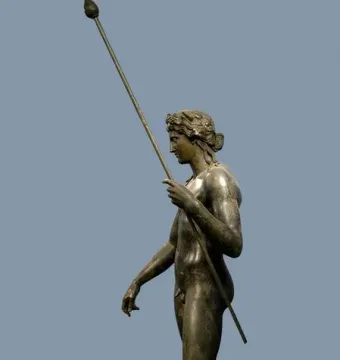
| Pose | Standing on the right leg with the left leg bent backward, resting on the forefoot |
| Head position | Head turned slightly to the right |
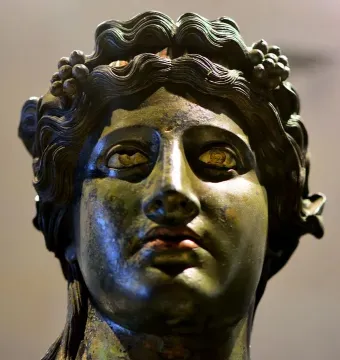
| Hair | Long, slightly wavy hair falling on both sides and resting on the shoulders |
| Head ornament | A vine-leaf wreath or headband decorated with ivy twigs and grapes |
| Facial details | Incised pupils and notably thick upper eyelids |
| Attribute | A thyrsus held in the left hand |
Materials | |
| Material | Bronze |
Technique | |
| Casting technique | Lost-wax technique |
Historical context | |
| Stylistic influences | Shows strong resemblance to Praxiteles and to leading artists of the Hadrianic and Antonine periods, with influences also attributed to Polykleitos |
| Proposed date | Probably Hadrianic or Antonine period |
| Artistic character | An eclectic creation of the Imperial period, indicative of classical taste |
Iconography and meaning | |
| Depiction | A nude, youthful Dionysus |
| Reference model | The so-called Dionysus of Woburn Abbey, a mid-4th-century BC model known from more than twenty copies and variants and highly successful in the Hellenistic and Roman periods |
| Comparison with other examples | The position of the left arm differs from examples in the Ny Carlsberg Glyptotek, Copenhagen, and the Horti Lamiani statue in the Capitoline Museums, Rome |
| Scholarly interpretation | Paul Zanker proposed that the composition derives from the so-called Athlete Stefano, a Roman classicizing creation of the 1st century BC, later modified by the addition of long, wavy hair |
Discovery and provenance | |
| Discovery date | 1885 |
| Discovery context | Found in the Tiber during dredging for the construction of Ponte Garibaldi, including work on one of the bridge piers |
| Bridge information | Ponte Garibaldi, designed by Angelo Vescovali and dedicated to Giuseppe Garibaldi |
| Related find | The Apollo of the Tiber was discovered nearby in 1891 and is kept in the same museum |
| Proposed provenance | Campanian provenance has been proposed |
Location and ownership | |
| Current location | Museo Nazionale Romano, Palazzo Massimo alle Terme, Rome |
| Inventory number | 1060 |
History and restoration | |
| Restoration | Conserved and restored in 1984–1985; stucco finishes applied shortly after discovery around the legs were removed |