
Marzocco
Marzocco is a work by Donatello in pietra serena, dating to 1419–1420 and now preserved in the Museo del Bargello in Florence. It originally stood in Piazza della Signoria, where it has been replaced by a copy to protect the original from weathering. The sculpture depicts the marzocco, a heraldic lion resting one paw on a shield bearing the Florentine lily. Since the Middle Ages, this image has symbolized the city of Florence and its totemic animal. Donatello treated the subject in a groundbreaking way, giving the animal a solemn majesty and a tightly animated expression through chiaroscuro effects and the calm gesture of the paw on the shield.
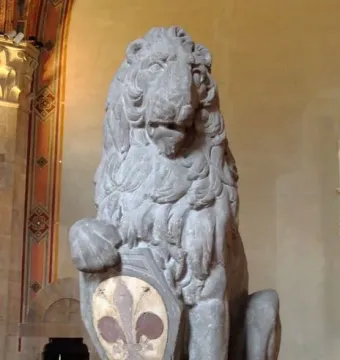
August 2014 © Rabe! · CC BY-SA 4.0
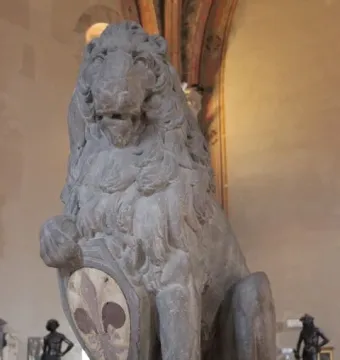
July 2015 © Miguel Hermoso Cuesta · CC BY-SA 4.0
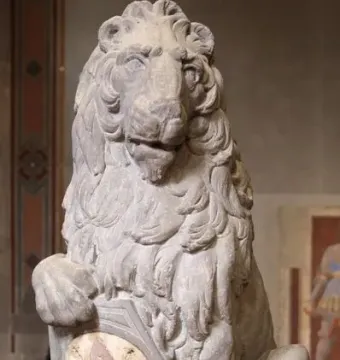
May 2022 © Francesco Bini · CC BY-SA 4.0
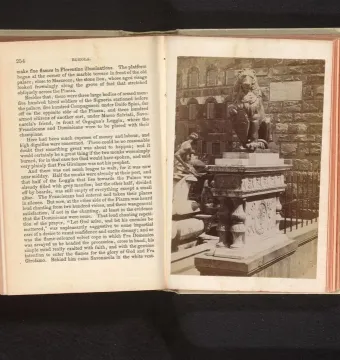
© Rijksmuseum · CC0
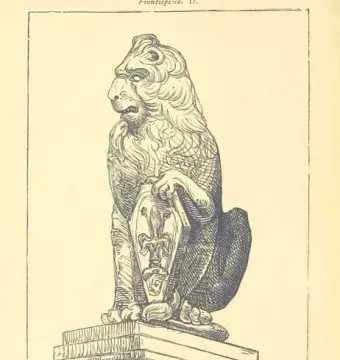
November 2013 © The British Library · No restrictions
Identification | |
| Title | Marzocco |
| Type | lion statue |
| Alternative names | Mardzokko, Marzokko |
Historical context | |
| First statue | a late 14th-century statue in Florence, made by an unknown author, which deteriorated and became unusable due to natural causes |
| Date | 1419-1420 |
| Work period | 1418–1420 |
| Commissioned by | the Republic of Florence |
| Commissioned for | the apartments of Pope Martin V in the monastery of Santa Maria Novella in Florence |
| Occasion for commission | the visit to the city of Pope Martin V |
Creator | |
| Artist | Donatello |
| Artist's nationality | Italian |
Materials | |
| Technique | carved sculpture |
| Material | pietra serena, Tuscan fine-grained gray sandstone |
Appearance | |
| Subject | a marzocco, a heraldic lion symbolizing Florence |
| Pose | the lion rests one paw on a shield |
| Shield depicted | the coat of arms of Florence with the Florentine lily |
| Expression | majestic, proud, and lively |
| Muzzle expression | vividly tense |
| Light and shadow effect | chiaroscuro accentuates the expression |
Iconography and meaning | |
| Historical significance | later became an important symbol of the Florentine Republic |
| Public presence | statues and images of Marzocco were installed throughout the city and became objects of veneration |
| Use during siege of Florence | Florentine troops defending the city during the Siege of Florence in 1529–1530 called themselves the sons of Marzocco |
| Linguistic association | the Tuscan word "marziale" means "war-like" and is linked to Mars through the zodiac sign of Leo |
| Animal symbolism | the lion was Florence's totemic animal |
| Symbolic meaning | symbol of Florence since the Middle Ages |
| Etymology | possibly connected with the Evangelist Mark or with the god Mars |
| Meaning of name | Tuscan for "Little Mars" |
| Symbolic meaning | originally symbolized a force capable of conquering the wolf and the eagle, symbols of Siena and Pisa |
Location and ownership | |
| Original display location | the Donatello Hall and the 15th-century sculpture section of the National Bargello Museum |
| Replacement | a copy is installed in Piazza della Signoria to protect the original from weathering |
| Current location | Museo del Bargello, Florence |
| Former location | Piazza della Signoria, Florence |
| Intended location | on a pedestal by the staircase leading to the papal rooms of Santa Maria Novella |
History and restoration | |
| Moved to Piazza della Signoria | 1810-1812 |
| Original placed in museum display | 1885 |
| Related earlier statue | a statue of the god Mars stood at the entrance to the Ponte Vecchio over the Arno River and was destroyed in a flood in 1333 |
| Replacement idea | after the destruction of the Mars statue, the inhabitants decided to place a "guardian Mars" in the same location |
Significance | |
| Significance | one of the most famous works of Donatello and a symbol of Florence |
Other | |
| Artistic treatment | Donatello treated the subject in a revolutionary way |
| Artistic comparison | the sculpture's majesty is compared to Donatello's works of the same years, such as the Prophet of Thought and the Beardless Prophet for Giotto's Campanile |