
Crouching Venus
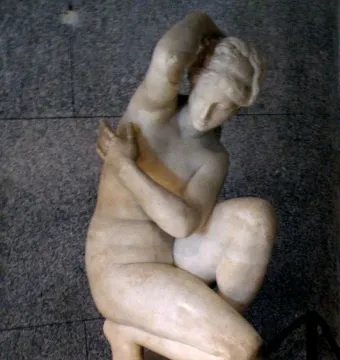
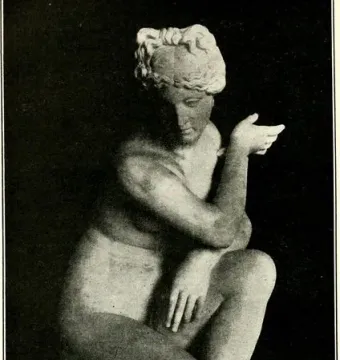
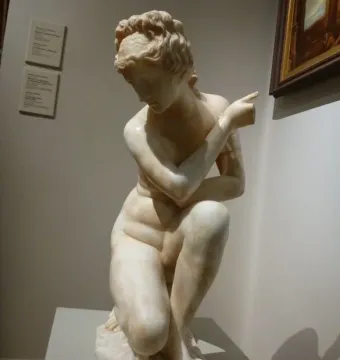
Crouching Venus is the conventional name for a group of ancient Greek and Roman replicas of a sculpture by Doidalsas of Bithynia, showing Aphrodite, or Venus, bathing. Created in the second half of the 3rd century BC, the original is thought to have been in bronze, while a marble version was later copied many times. The figure crouches on one knee, arranging her hair with one hand and covering her body with the other. Surviving replicas are held in major collections, including the National Roman Museum at Palazzo Massimo, the Louvre, the Vatican, the Naples Archaeological Museum, the Uffizi, Rhodes, and the British Museum.
July 2009 © Twice25 · Copyrighted free use
1887 © Internet Archive Book Images · No restrictions
January 2022 © Иван Абатуров · CC BY-SA 4.0
· CC0
© anonymous photographers, early 20th century · Public domain
Identification | |
| Title | Crouching Venus |
| Type | Ancient Greek/Hellenistic sculpture type of a crouching Venus; known from Roman marble copies and later bronze versions |
| Subject | Aphrodite, known to the Romans as Venus, surprised while bathing |
| Alternative names | Venus on Her Hips; Bathing Aphrodite; Aphrodite of Doidalsas; Afrodite accovacciata; Afrodita agachada, acurrucada, lavándose, en el baño; El baño de Afrodita; Vénus Accroupie; Aphrodite Crouching of Rhodes |
Historical context | |
| Date of original model | Hellenistic period, probably the second half of the 3rd century BC, possibly around 250 BC |
| Possible patron | Possibly commissioned by Nicomedes I of Bithynia for a sanctuary in Nicomedia |
| Ancient testimony | Mentioned in a damaged and corrupt passage of Pliny the Elder's Naturalis Historia 36.4 |
| Historical note on attribution | The ancient written tradition is brief and disputed; some readings misread the artist's name, and the identification with Doidalsas of Bithynia is only probable |
Creator | |
| Ancient biographical information | Ancient sources provide no information about Doidalsas's life |
| Related work by sculptor | Statue of Zeus Stratios (Zeus the Warlike); bronze |
| Activity center | Nicomedia |
| Attributed sculptor | Doidalsas of Bithynia (also spelled Doidalsas/Doidalses/Daedalsas/Daedalses in sources) |
Discovery and provenance | |
| Villa Adriana example | A copy found in the villa of Emperor Hadrian at Tivoli in the 1920s, now in the Museo Nazionale Romano (Museo Nazionale delle Terme) |
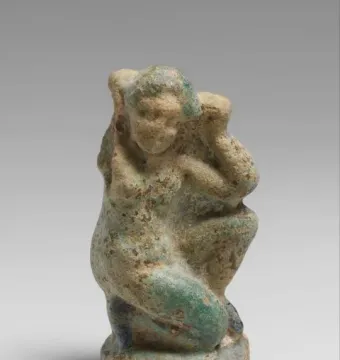
| Bronze versions | Some small bronze versions survive, including one found in Syria that was once in the collection of Joseph Durighello and sold by Galerie Georges Petit in Paris |
| Metropolitan Museum examples | Two examples in the Metropolitan Museum of Art, New York, both headless and lacking most of their arms, dated between the 2nd and 3rd centuries AD |
| Rhodes example | A small marble copy dated to the 2nd century AD, discovered in Rhodes and now in the Museum of Archaeology of Rhodes |
| Spanish royal collection example | Formerly owned by Camillo Massimo, Christina of Sweden, Livio Odescalchi, and Philip V of Spain; later passed through La Granja de San Ildefonso and the Royal Palace of Madrid; now in the Museo del Prado |
| Vienne example | Discovered in 1828 in Sainte-Colombe near the ancient city of Vienne, bought for the Louvre in 1878; studied by Cézanne and adapted for figures in his Grandes Baigneuses |
| Medici example | Recorded in the Villa Medici in Rome and now in the Uffizi Gallery, Florence |
| Borghese example | A copy purchased in 1807 from Camillo Borghese and now in the Louvre; imaginatively restored as Diana with a hunting bow in her right hand |
| Salona example | Found in Salona (modern Solin, near Split, Croatia), bought by the Vatican Museum, confiscated by the French under Napoleon, returned in 1816, and still in the Vatican |
| Louvre example | A headless and armless copy from Sainte Colombe near Vienne, France, now in the Louvre, Paris |
| Best-preserved example | The best-preserved copy is an armless marble version in the National Museum of Palazzo Massimo, Rome |
| British Museum example date | Roman period, dated to the time of Octavian Augustus |
| British Museum example provenance | In the early 17th century it was in the Gonzaga collection in Mantua; Rubens sketched it there; acquired by Charles I of England in 1628; later owned by Peter Lely; now in the Royal Collection and on loan to the British Museum |
| Farnese collection example | A crouching Venus with Cupid was kept in the Farnese family collection in Rome; now in the National Archaeological Museum of Naples |
| Findspots of copies | Many examples have been found at Roman sites in Italy and France |
| Copying tradition | Copied by many sculptors of the Roman and Neo-Attic schools |
| Roman copies | Known only through many Roman-period copies and later reproductions |
| Evidence for appearance | Images of the sculpture are preserved on the reverse sides of coins from Bithynia |
Physical characteristics | |
| Pose | Crouching in a forced squat, with the right knee near the ground; in some versions the head turns to the right, in others to the left |
| Arm position | In most versions, the right arm crosses to the left shoulder to cover the breasts and the other hand shields the abdomen; some versions instead raise the right arm to the hair or the back of the head |
| Body treatment | The figure is shown in a humanized, naturalistic manner, with unequal inclination of the legs, a bent back, and, in some descriptions, folds on the abdomen rendered very naturalistically |
| Restoration elements in copies | Copies were restored with shells, turtles, and sometimes figures of Eros or a dolphin |
Materials | |
| Copy material | Marble |
| Original material | Bronze, considered the original medium |
Technique | |
| Replication and restoration | Later copies were made in Roman and Neo-Attic workshops, with restorations such as added Eros figures, shells, turtles, dolphins, and sometimes a hunting bow |
Appearance | |
| Iconographic variants | Variants show the goddess bathing, wringing or arranging her hair, or looking directly at the viewer; some include a small Eros pouring water or standing behind her |
| Common version | The most common version shows the goddess with gently bent arms, one covering the breast and touching the shoulder and the other shielding the abdomen |
Iconography and meaning | |
| Narrative situation | She appears to have been unexpectedly caught while bathing, or shown in the act of receiving the water of the sacred bath |
| Interpretation | The pose can also be read as a modest, self-covering gesture after noticing a viewer |
| Iconographic source | Develops the idea of Praxiteles' Cnidian Aphrodite and anticipates later pudica Venus types; sometimes linked to Aphrodite Anadyomene |
| Art-historical significance | A more explicit, down-to-earth, almost genre-like Hellenistic treatment of the nude goddess after Praxiteles and the Aphrodite of Knidos |
Location and ownership | |
| Common display pairing | Often displayed as a pendant to the Arrotino |
Significance | |
| Popularity | A very popular model, as shown by the large number of Roman copies found, especially in Italy and France |
| Influence | Influenced later artists and sculptors, including Martin Heemskerck, Giambologna, Antoine Coysevox, and Cézanne |
| Later reinterpretations | In the 16th and 17th centuries many sculptors in Italy and France made versions after antique models; Giambologna made variants in Florence, and Coysevox sculpted Venus Crouching on a Turtle for Marly in 1686 |
| Drawn by artists | Drawn by Martin Heemskerck, including the Farnese example |
Other | |
| Uncertainty notes | Several ancient readings, attributions, and copy identifications are disputed or reconstructed from corrupt text |