
Sphinx of Naxos
The Sphinx of Naxos is an ancient statue of a sphinx from Greek mythology, carved from Naxian marble and dedicated around 570/560 BC by the people of Naxos to the sanctuary of Apollo at Delphi. It shows a creature with a woman’s head, a lion’s body, and the wings of a bird of prey. The body was discovered broken into several large pieces in 1861 and later restored; the head was found in 1893. The statue originally sat on an Ionic column and the full structure once reached more than 13 meters in height. Today, the body and head are kept in the Archaeological Museum of Delphi.
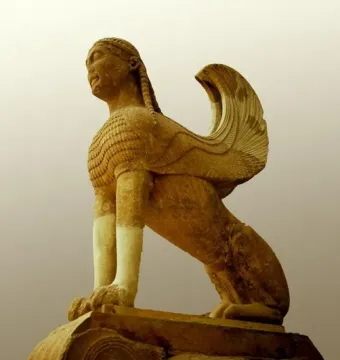
November 2007 © PMRMaeyaert · CC BY-SA 4.0
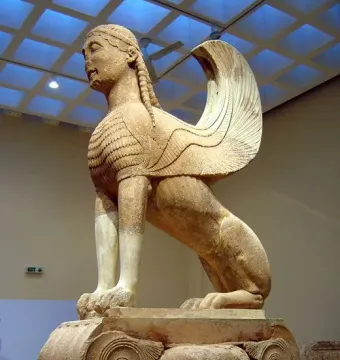
· CC BY-SA 3.0
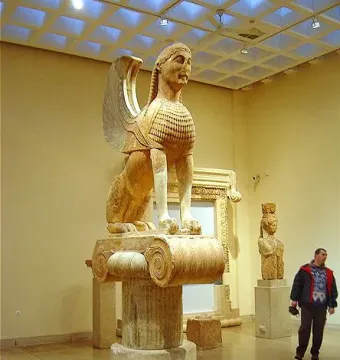
2005 © User:Tetraktys · CC BY-SA 3.0
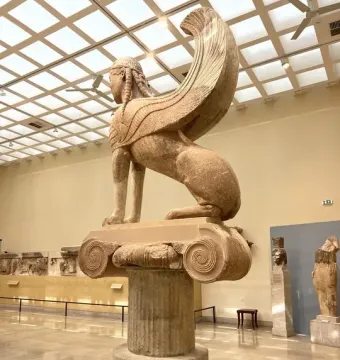
March 2022 © Chabe01 · CC BY-SA 4.0
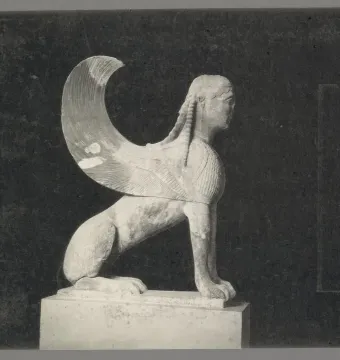
© Rijksmuseum · CC0
Identification | |
| Title | Sphinx of Naxos |
| Type | Ancient Archaic Greek marble statue of a sphinx, monumental and colossal |
| Alternative name | Naxian Sphinx; Sphinx of the Naxians |
Historical context | |
| Date | Around 570–560 BC |
| Period | 6th century BC |
| Historical context | Naxos was one of the richest Cycladic islands of the time |
| Cultural style | Nesiotic; Ionian |
Creator | |
| Dedicated by | The people of Naxos |
| Dedicated to | Apollo, at the Sanctuary of Apollo in Delphi |
Discovery and provenance | |
| Original location | Delphi, beside the Temple of Apollo, near the Halos |
| Discovery | The main fragments were discovered in 1860–1861 in the sanctuary of Apollo; the remaining fragments, including the head, were found in 1893 |
| Damage | The lower part was damaged between the discoveries, reportedly by villagers and an earthquake |
| Restoration | Restored after discovery and completion of the missing parts |
| Inventory numbers | Body 1050; head 380 |
Physical characteristics | |
| Original total height | More than 13 m including the column and base |
| Support | Originally stood on a 10 m Ionic column with one of the earliest Ionic capitals; only parts of the capital and shaft survive, and the shaft had 44 flutes |
| Total height | About 12.45–12.5 m including the statue, column, and base |
| Head height | 0.67 m including the preserved neck base; 0.50 m from chin to crown |
| Length | 1.35 m |
| Height including wings | 2.32 m |
| Height | 2.22 m |
Materials | |
| Material | Naxian marble |
Technique | |
| Carving technique | Carved in the round, not in relief |
Appearance | |
| Depicted figure | A sphinx with a woman's head, lioness body, and bird-of-prey wings |
| Appearance details | The figure has an enigmatic smile; the hair, breasts, and wings are emphasized and create a sense of movement and vitality |
Iconography and meaning | |
| Interpretation | A guardian figure associated with temple entrances and with tombs or temples more generally; the inscription shows the Naxians' promanteia at Delphi was renewed |
| Symbolic meaning | Earthly divinity and heavenly power |
| Mythological context | A Greek interpretation of the sphinx, a creature also linked in myth to the riddle of Oedipus and to traditions involving Thebes and Ethiopia |
Location and ownership | |
| Current location | Archaeological Museum of Delphi |
| Replica location | Entrance of the Archéopôle d'Aquitaine, campus of Bordeaux-Montaigne University |
History and restoration | |
| Inscription date | 328–327 BC |
| Inscription text | The Delphians grant the Naxians promantia as in former times. During the archonship of Theolytos, under the bouleutes Epigenes. |
| Inscription significance | The base inscription records the renewal of promanteia, the Naxians' right of priority consultation of the oracle |
| Archon mentioned in inscription | Theolytos |
| Bouleutes mentioned in inscription | Epigenes |
Significance | |
| Art-historical significance | A typical example of Naxian sculpture at its peak and an early example of fully round monumental sculpture |
| Historical significance | The column may have been the oldest Ionic construction project at Delphi; the monument impressed visitors |
| Possible influence | It has been suggested that the Sphinx of Naxos and similar Greek sphinx-crowned columns may have inspired the Pillars of Ashoka in India, via contacts beginning with Alexander the Great in 320 BC and continuing under the Greco-Bactrians and Indo-Greeks |
| Related examples | Similar sphinx-crowned columns are known from Sparta, Athens, and Spata; a funerary stele topped with a sphinx dated 530 BC is a comparable example |