
Memorial to Robert Gould Shaw and the Massachusetts Fifty-Fourth Regiment
Memorial to Robert Gould Shaw and the Massachusetts Fifty-Fourth Regiment, also known as the Shaw Memorial, is a bronze sculpture by Saint-Gaudens in Boston, Massachusetts. It is located opposite 24 Beacon Street, on the edge of Boston Common. The work depicts Colonel Robert Gould Shaw leading members of the Massachusetts infantry regiment as they marched along Beacon Street, leaving the city to fight in the South during the American Civil War. The sculpture was unveiled in 1897. It is regarded as the first monument to honor the heroism of African American soldiers.
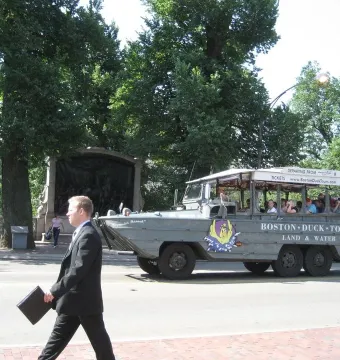
June 2007 © Infrogmation of New Orleans · CC BY 2.5
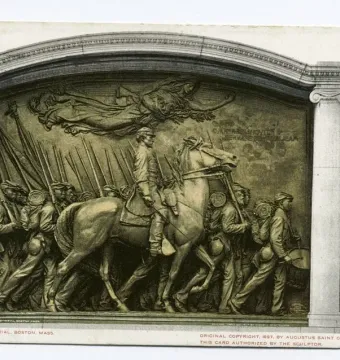
© Scan by NYPL · Public domain
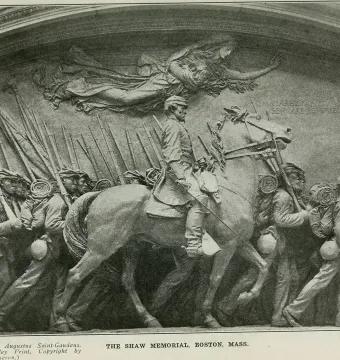
1910 © Internet Archive Book Images · No restrictions
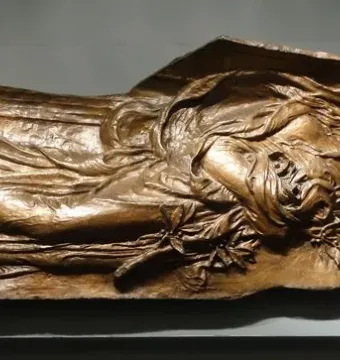
October 2013 © Daderot · CC0
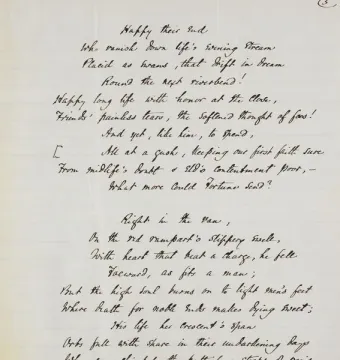
1863 © James Russell Lowell · Public domain
Identification | |
| Title | Memorial to Robert Gould Shaw and the Massachusetts Fifty-Fourth Regiment |
| Alternative names | Shaw Memorial; Shaw monument; Robert Gould Shaw Memorial |
| Type | Bronze relief sculpture; memorial monument |
Creator | |
| Artist | Augustus Saint-Gaudens |
Historical context | |
| Subject | Robert Gould Shaw and the 54th Massachusetts Volunteer Infantry |
| Depicted scene | Colonel Robert Gould Shaw leading the 54th Regiment Massachusetts Volunteer Infantry marching down Beacon Street on May 28, 1863, as they left Boston to fight in the South during the American Civil War |
| Commemorated event | Shaw's death on July 18, 1863, after the attack on Fort Wagner during the Civil War |
| Purpose | To show public gratitude to Shaw and commemorate events recognizing Black men's citizenship |
| Historical significance | First civic monument to honor the heroism of African-American soldiers |
Discovery and provenance | |
| Initial monument advocacy | Led by Joshua Bowen Smith, a Massachusetts state legislator |
| Early planners | Joshua Bowen Smith, Governor John Albion Andrew, Samuel Gridley Howe, and Senator Charles Sumner |
| John Albion Andrew's role | He had urged Shaw to take command of the regiment |
| Fundraising | Began immediately after the battle, led by survivors of the 54th Massachusetts Volunteer Infantry and emancipated Black people from Beaufort, South Carolina |
| Original proposed site | Beaufort, South Carolina |
| Reason for site change | The Beaufort site was judged unsuitable and local white people expressed resentment |
Physical characteristics | |
| Style | Stylistically unprecedented hybrid work that modifies the traditional Western equestrian monument |
| Figure style | Each soldier is rendered with distinct, individualized features based on live models hired by Saint-Gaudens |
| Figures represented | Shaw on horseback and twenty-three Black soldiers in bas-relief |
Materials | |
| Primary material | Bronze |
| Base material | Concrete foundation |
Location and ownership | |
| Location | Opposite 24 Beacon Street at the edge of the Boston Common, Boston, Massachusetts, United States |
| Dedicated by | William James |
| Inscriptions | A Latin inscription appears on the relief; the pedestal bears lines from James Russell Lowell's "Memoriae Positum"; the reverse bears words by Charles W. Eliot |
| Plaster cast | A plaster cast exists; it was exhibited at the 1901 Pan-American Exposition and is now in the National Gallery of Art, on loan from the Saint-Gaudens National Historical Site, Cornish, New Hampshire |
| Plaster cast inscription | The cast's bottom inscription incorrectly gives the assault on Fort Wagner and Shaw's death as "July 21," five days later than the historical events |
History and restoration | |
| Restoration completed | March 2021 |
| Restoration cost | US$2.8 million |
| Unveiled | May 31, 1897 |
| Restoration | Began on May 20, 2020, with the memorial removed off-site; the bronze was cleaned and repaired, and a new concrete foundation was poured |
| Condition during renovation | The façade was covered with plywood, which also received graffiti |
| Vandalism | The monument was vandalized in 2012, 2015, 2017, and on May 31, 2020, during the George Floyd protests, when the back was marked with "Black Lives Matter," "ACAB," and "Fuck 12" |
Other | |
| Visitor interpretation | A mobile augmented-reality app and new signage with QR codes were added to help visitors learn about the monument, the Civil War, and the 54th Regiment |
| Later public debate | The monument became a focus of discussion during iconoclasm associated with the George Floyd protests, including in August 2021 |
| Related work | Saint-Gaudens later drew on this model in his 1903 memorial to William T. Sherman in New York's Central Park |
| 2023 incident | A copy of the monument in the National Gallery of Art was damaged by a climate activist in November 2023 |