
Unisphere
Unisphere is a spherical stainless steel representation of the Earth in Flushing Meadows–Corona Park in Queens, New York City. Designed by Gilmore D. Clarke for the 1964 New York World's Fair, it was commissioned to celebrate the beginning of the space age and served as the fair’s theme symbol. The structure reflects the fair theme of “Peace Through Understanding” and was dedicated to “Man's Achievements on a Shrinking Globe in an Expanding Universe.” Constructed by American Bridge Company from March to August 1963, it later became a permanent attraction and an unofficial symbol of Queens. After periods of neglect, it was restored in the early 1990s and early 2010s, and it was designated a New York City landmark in 1995.
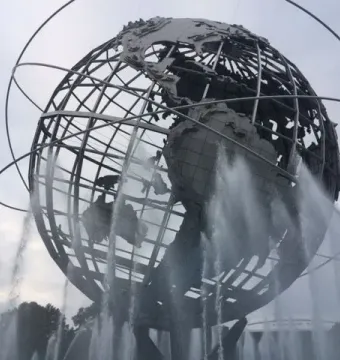
September 2018 © Panda hello · CC BY-SA 4.0
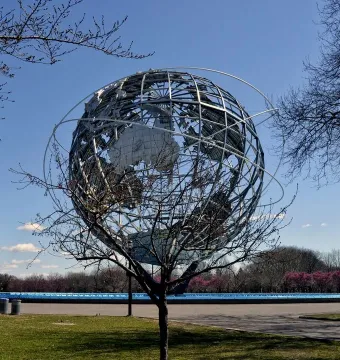
April 2019 © Salivega · CC BY 4.0
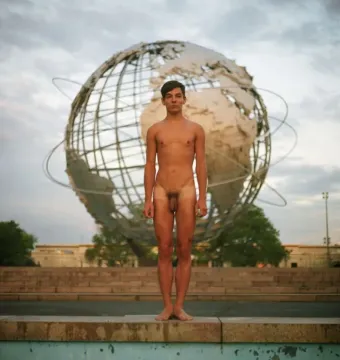
June 2012 © https://www.flickr.com/people/kargaltsev/ · CC BY 2.0
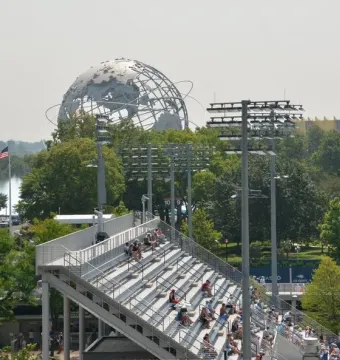
August 2018 © Carine06 · CC BY-SA 2.0
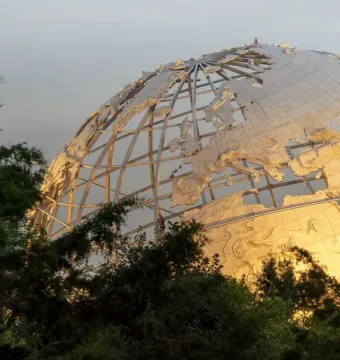
June 2018 © Ajay Suresh · CC BY 2.0
Identification | |
| Title | Unisphere |
| Scale | 1:350000 |
| Original-language name | L'Unisfera; Унисфе́ра |
| Type | Monumental globe sculpture representing the Earth |
Historical context | |
| Fair theme | Peace Through Understanding |
| Symbolic purpose | To symbolize the fair's motto, represent global interdependence, and celebrate the beginning of the Space Age |
| Role at the fair | Theme symbol and icon of the 1964 New York World's Fair |
| Site context | Built on the site of the former Perisphere / Theme Center at the center of the fairgrounds |
| Commissioned for | the 1964 New York World's Fair |
Creator | |
| Designer | Gilmore D. Clarke |
| Associated designers and collaborators | Peter Muller-Munk Associates; William S. Boice; Peter Martecchini; Clarke & Rapuano; Hamel & Langer |
Discovery and provenance | |
| Construction start | March 6, 1963 |
| Opened as permanent park feature | 1967 |
| Dedication date | Early March 1964 |
| Permanent donation announced | March 1966 |
| Funding / donation | U.S. Steel Corporation |
| Concept date | September 1960 |
| Construction company | American Bridge Company, a division of U.S. Steel |
| Construction period | March to August 1963 |
| Approval date | Early 1961 |
| Approved by | Robert Moses |
Physical characteristics | |
| Height | 42.7 m |
| Width | 36.6 m |
| Diameter | 36.6 m |
| Weight | About 317.5 tonnes; some sources give 408 tonnes including the base |
| Base weight | 70 tons |
| Total length of meridians, parallels, and orbital rings | About 2.4 km |
| Pool diameter | 94.5 m |
| Tripod height | 6 m |
| Tripod weight | 100 tons |
| Total height | 43 m |
| Total weight | 420 tons |
| Support structure | Stainless-steel tripod base |
| Base height | 6 m |
Materials | |
| Orbital rings attachment | Aircraft cables |
| Other materials and components | Metallic mesh continents; fountains and water features; plywood used in the model |
| Pool rim material | Pink granite |
| Main material | Type 304L stainless steel |
Technique | |
| Construction method | Fabricated and installed by American Bridge Company / American Bridge Division for U.S. Steel |
| Design features | A stainless-steel sphere supported by a stainless-steel tripod |
Appearance | |
| Lighting | Capital cities were marked by lights of different sizes; nighttime lighting created the effect of sunlight moving over the globe |
| Visual effect | From a distance, it appears to float in the air |
| Setting | Located in the center of a circular basin, surrounded by fountains that conceal the support structure |
| Orbital rings | Three stainless-steel rings positioned at different angles above the globe |
| Surface depiction | The continents are shown with simplified mountain relief |
| Tilt | 23.5 degrees |
| Shape | A revolving globe with rings of latitude and longitude |
Iconography and meaning | |
| Orbital ring symbolism | The rings represent the paths of Yuri Gagarin, John Glenn, and Telstar 1 |
| Yuri Gagarin reference | First human in space |
| John Glenn reference | First American to orbit the Earth |
| Telstar 1 reference | First communications satellite |
| Capital city markers | Lights of three sizes, with larger lights for more important capitals |
| Quoted interpretation by Moses | "Illustrates, symbolizes and embodies man's achievements on a shrinking globe in an expanding universe" |
Location and ownership | |
| Ownership / custody | Permanent attraction in Flushing Meadows–Corona Park |
| Location | Flushing Meadows–Corona Park, Queens, New York City, United States |
| Site within park | Unisphere Plaza |
Significance | |
| Claimed distinction | Largest globe in the world |
| Cultural significance | Unofficial symbol of Queens; one of the major icons of the district |
| Visitor attendance | Over 51 million people visited the fair; many passed by the Unisphere |
| Commemorative depiction | Depicted on a special commemorative stamp issue and on fair media and souvenirs |
History and restoration | |
| Later maintenance issues | Fountains shut off in 2001 due to citywide water restrictions; reactivated in early 2003; by 2008 they leaked excessively and were operated only on U.S. Open days; restored again in 2010 for daily summer operation |
| Status by 2025 | The mist garden and the Unisphere's fountains were out of service due to electrical issues |
| Nearby addition | A mist garden was planned east of the Unisphere in the Fountains of the Fairs and dedicated in 2020 |
| Safety measures | NYC Parks added barricades, opened fire hydrants, and hired patrol officers to deter people from entering the pool area |
| 2010 tornado damage | The Sri Lanka landmass was blown off in the September 2010 Brooklyn–Queens tornadoes and reinstalled the following year |
| 2010 restoration | A $2 million restoration of the pumps, valves, and paintwork completed with rededication on August 12, 2010 |
| Restoration work | Structural repairs, grime removal, replacement fountains, new floodlighting, and rose gardens planted on two surrounding lawns |
| Landmark designation | Designated a New York City landmark in 1995 by the New York City Landmarks Preservation Commission |
| Queens Museum change | Its entrance was relocated to face the Unisphere directly |
| Landscaping | The grounds around the Unisphere were landscaped in 1992 |
| Restoration cost | More than $3 million |
| Restoration | Restored in the early 1990s / 1989–1994 |
| Initial post-fair condition | Lightly used at first; fountains were turned off by 1969 |
| Condition in the 1970s | Poorly maintained, visibly dirty, and covered in grime; the pools were shut off and graffiti appeared |
Other | |
| Historical context | Built when NASA was at its peak; the orbital rings refer to early space-age achievements |