
Napoleon as Mars the Peacemaker
Napoleon as Mars the Peacemaker is a statue by the Venetian sculptor Antonio Canova, now conserved at Apsley House in London. Created in 1806, it is regarded as one of the most perfect male nudes in art history and one of Canova’s masterpieces. Napoléon refused the work when he saw it, saying it was too athletic, as he preferred to be presented as a working lawgiver rather than as heroic and divinized. A plaster cast of the sculpture is preserved at the Museo Canova, and copies are also found in Milan and in the gardens of Miramare Castle in Trieste.
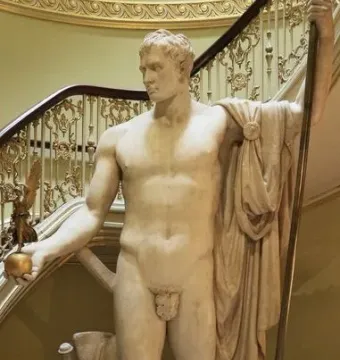
1806 © Antonio Canova · CC BY-SA 3.0
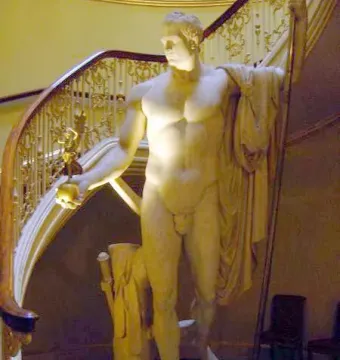
· CC BY-SA 3.0
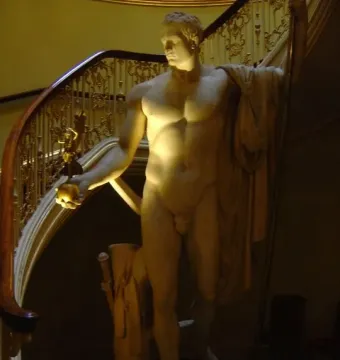
© YukioSanjo · CC BY 3.0
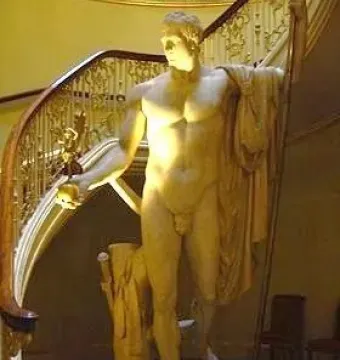
© West one girl · CC BY-SA 3.0
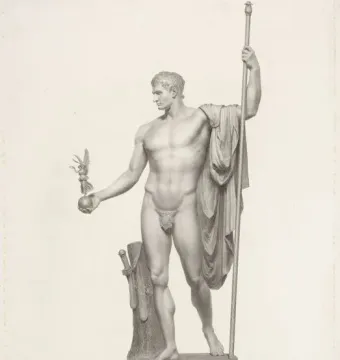
© Rijksmuseum · CC0
Identification | |
| Title | Napoleon as Mars the Peacemaker |
| Italian title | Napoleone Bonaparte come Marte pacificatore |
| Spanish title | Napoleón como Marte pacificador |
| French title | Napoléon en Mars désarmé et pacificateur |
Creator | |
| Sculptor | Antonio Canova |
| Nationality | Venetian; Italian Neoclassical |
Historical context | |
| Creation period | 1803–1806; the marble carving took three years and was begun in Rome after Canova returned from Paris |
| Napoleon's reaction | He rejected it as 'too athletic' and ordered it hidden from public view |
| Paris display | Displayed in the Musée Napoléon (the renamed Louvre) and later hidden in the Salle des Hommes Illustrés behind a screen or veil |
| Completion date | 1806 |
| Transport to France | Sent to France in late 1810 and arrived in Paris on 1 January 1811 |
| Preliminary studies | Canova made preliminary bozzetti and a portrait study from life during his visit to Paris in 1802 |
| Historical context | Commissioned despite political tensions between France and the Papal States |
| Possible original location | Some historians proposed a square in Milan, and another proposed site was the courtyard of the Palazzo del Senato |
| Commissioned | Late September 1802 in Paris, when Napoleon was First Consul of the French Republic |
| Intended setting | An interior display, not a freestanding public monument |
| Purpose | To celebrate Napoleon and present him as Mars the Peacemaker rather than as a contemporary general or lawmaker |
Discovery and provenance | |
| Installed in London | Moved to Apsley House in 1817, with the floor beneath it specially reinforced |
| Presented by | The Prince Regent in late 1816 |
| Purchase | Bought by the British government in 1816 from the Bourbon government / Louis XVIII for 66,000 francs (under £3,000) |
| Gift recipient | Arthur Wellesley, Duke of Wellington |
| Artistic assessment by contemporaries | Cacault wrote that it 'must become the most perfect work of this century'; Canova also wrote in 1803 that it 'should become the most perfect work of this century' |
| Viewed in progress by | François Cacault and Dominique Vivant Denon |
Location and ownership | |
| Current location | Apsley House, London, in the Duke of Wellington's residence and the Wellington Collection |
| Former location | The Louvre / Musée Napoléon, Paris |
| Collection | Wellington Collection |
Physical characteristics | |
| Pose | Standing full-length, nude except for a military chlamys or mantle draped over one shoulder |
| Support element | A tree trunk supports the composition |
| Type | Colossal full-length heroic nude statue |
| Height | 3.45 metres to the raised left hand |
| Scale | Colossal |
Materials | |
| Primary material | White Carrara marble |
| Secondary material | Gilded bronze or gilt metal on the Victory/Nike attribute |
| Model material | Plaster |
Technique | |
| Casting | A bronze copy was cast in Rome in 1811 by Francesco and Luigi Righetti from cannons taken from Castel Sant'Angelo |
Appearance | |
| Attributes | A spear in the left hand, and a golden globe or victory symbol with a winged Nike/Victory in the right hand |
| Figure | Napoleon Bonaparte depicted in the guise of Mars, idealized as a victorious colossal hero |
| Anatomy | Completely nude and idealized, with a slender, agile body rather than a heavily muscular one |
| Clothing | A chlamys or military cloak draped over one shoulder |
| Style | Italian ideal beauty and Neoclassical idealization based on antique models |
Iconography and meaning | |
| Interpretation | Mars is presented not only as the god of war but also as a victor and protector |
| Subject | Napoleon Bonaparte depicted as Mars the Peacemaker, also understood as Mars the Pacifier |
| Meaning | An allegorical image of Napoleon as a victorious, protective ruler rather than a purely military figure |
| Iconographic sources | Draws on the iconography of Augustus and other ancient Roman and Greek models, including the Apollo Belvedere and possibly the Uffizi Athlete |
History and restoration | |
| Plaster model | The plaster model is preserved at the Gipsoteca Canoviana in Possagno |
| Plaster casts | Canova made five plaster copies for Italian art academies; one is owned by the Academy of Fine Arts of Brera |
| Brera copy | Displayed in the Galleria Reale in Brera from 1809 to 1814, installed in the Brera Palace courtyard in 1859, kept in storage until 2008, restored in 2009, and displayed at the Pinacoteca di Brera |
| Bronze copy | A bronze copy made by the Righetti brothers was installed in the Brera courtyard in 1859 |
| Theft and restoration | The gilded Nike statuette in the right hand was stolen on 25 October 1978 and replaced with an exact copy in the 1980s |
Significance | |
| Art-historical assessment | Considered one of the most perfect male nudes in art history and a masterpiece of Canova |
| Critical reception | Received coolly in Paris but praised by Italian critics |
| Interpretive commentary | Later scholars such as H. W. and E. F. Janson saw it as a departure from Enlightenment ideals toward equating the emperor with divine rulers |