
The Three Shades
The Three Shades is a bronze sculpture by Auguste Rodin, dated by researcher Georges Grapp to 1880. It appears at the top of The Gates of Hell and is linked to The Thinker through its three repeated silhouettes. The figures have little muscular detail, unnatural positions, and deliberately incomplete forms. Their right hand was added at Rodin’s request in 1904 by Josef Mařatk, giving the group a central axis and helping create a monumental effect based on Dante’s Divine Comedy. The work was not originally part of The Gates of Hell, though Rodin later decided to unite it with the ensemble. It emphasizes movement, balance, and the modeling of emptiness rather than solid form.
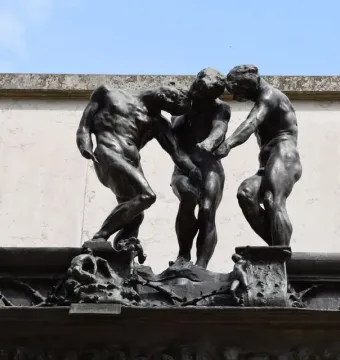
June 2016 © Omar David Sandoval Sida · CC BY-SA 4.0
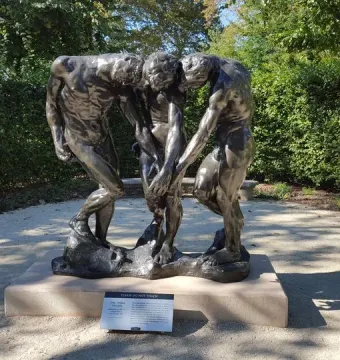
October 2015 © Thekohser · CC BY-SA 4.0
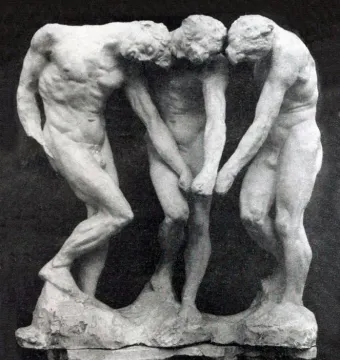
© Unknown authorUnknown author · Public domain
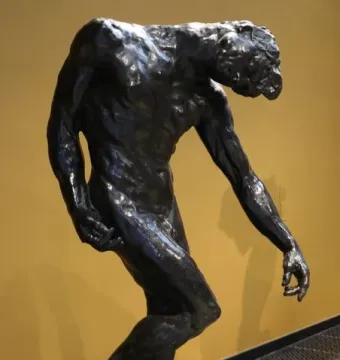
June 2024 © Francesco Bini · CC BY-SA 4.0
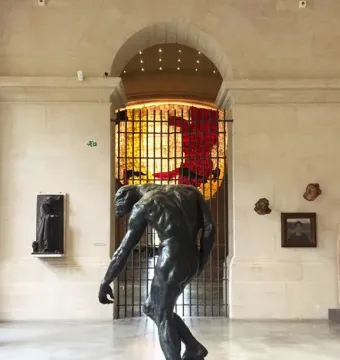
January 2017 © ZHANG JING · CC BY-SA 4.0
Identification | |
| Title | The Three Shades |
| Title in Spanish | Las tres sombras |
| Type | sculptural group |
| Original title | Les Trois Ombres |
Creator | |
| Artist | Auguste Rodin |
| Nationality of artist | French |
| Sculptor | Auguste Rodin |
Historical context | |
| Autograph plaster copy date | 1917 |
| Use of repetition in Rodin's work | Rodin also used repeated figures in The Three Fauns and The Secret |
| Relation to Dante's inscription | The shades' posture and position were intended as an allegory of the phrase "abandon all hope, ye who enter here" |
| Relation to The Thinker | The figures point toward The Thinker, originally conceived as Minos of Crete and later as Dante Alighieri |
| Studies | Rodin made several individual studies before deciding to combine the figures |
| Second version of Adam | Created after the first was destroyed and exhibited at the Paris Salon of 1881 |
| First figure of Adam | Destroyed by Rodin |
| Source of dissatisfaction | Rodin was dissatisfied with the first figure of Adam because of its closeness to Michelangelo's style |
| Shared model in The Secret | The same hand model is used |
| Independent monumental version | Created in 1901 as an autonomous group by Henri Lebossé |
| Date of decision to unite with The Gates of Hell | Between 1881 and 1886 |
| Placement within The Gates of Hell | At the top of the entablature |
| Part of | The Gates of Hell |
| Related work | The Gates of Hell (La Porte de l'Enfer) |
| Literary inspiration | Dante's Divine Comedy |
| Date of creation | Before 1886 |
| Original placement status | Not originally on The Gates of Hell; Rodin later decided to unite it with the work |
| Date | 1886 |
| Conceived | 1885 |
Materials | |
| Cast in bronze | Later cast in bronze in several editions |
| Other material | Plaster |
| Material | Bronze |
Discovery and provenance | |
| Autograph plaster copy location | Musée d'arts de Nantes |
Location and ownership | |
| Current autograph plaster copy location | Musée d'arts de Nantes |
| Bronze cast locations | Musée Rodin, Paris; Cantor Sculpture Garden, Stanford University; California Palace of the Legion of Honor; Rodin Museum, Philadelphia; Museo Soumaya, Mexico; Dixon Gallery and Gardens, Memphis, Tennessee |
Physical characteristics | |
| Functional role in composition | Given a central axis to the whole sculptural ensemble |
| Conceptual aim | Rodin sought to materialize what has no body, modeling emptiness |
| Movement style | Violent movements that do not exceed the body contour |
| Style / appearance | Repeated similar silhouettes with little muscle detail and deliberately incomplete forms |
| Right hand status | The right hand is absent in each figure |
| Number of figures | Three |
| Figure type | Identical figures |
| Arrangement of figures | The bodies point toward the center of the gate and toward The Thinker |
| Placement | Above the Gates of Hell, looking down at the viewer |
| Head angle | The heads hang at an extremely exaggerated angle |
| Anatomical deformation | The neck and shoulders form an almost horizontal line |
| Composition | Three identical figures gathered around a central point; they seem to rotate around the same point |
| Right hand addition | A right hand was added at Rodin's request in 1904 by Josef Mařatka |
Appearance | |
| Emphasis | Movement and the sway of the bodies |
Iconography and meaning | |
| Possible origin | According to Judith Cladel, it comes from the first study of Adam, or The Creation of Man |
| Source of the shadow motif | Derived from the first study of Adam |
| Interpretation of the missing right hand | The condemned's impotence before fate or tragic destiny |
| Dante-related inscription | Rodin chose not to engrave Dante's epigraph on the gates and instead expressed it through the shades' gestures and postures |
| Associated inscription | "abandon all hope, ye who enter here" |
| Depicted subject | The souls of the damned at the entrance to Hell |
| Relationship to another work | A repetition of La sombra |