
Kernosivka Idol
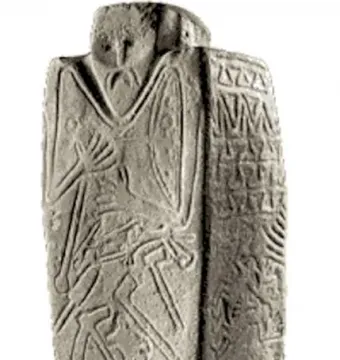
Kernosivka Idol is a stone anthropomorphic statue from the Eneolithic period, dating to the 3rd millennium BC and associated with the Yamnaya archaeological culture. It belongs to a group of statuary monuments known as "idols," which were found near destroyed burial mounds and may originally have stood in or on the mounds as part of a cult sanctuary dedicated to an deified ancestor. One hypothesis suggests it depicts a deity from the Indo-European pantheon. The artifact was discovered in 1973 near the village of Kernosovka in the Novomoskovsk district of Dnipropetrovsk Oblast. It is now held in the Dnipro National Historical Museum named after D. I. Yavornytskyi, inventory no. DIM-A-9039.
© User:Narada Lefvf · Public domain
June 2013 © Denis Vitchenko · CC BY-SA 3.0
June 2013 © Denis Vitchenko · CC BY-SA 3.0
Identification | |
| Name | Kernosovka idol |
| Alternative names | Kernosivsky idol |
| Object type | Anthropomorphic stone statue; kurgan stele; unique stele |
| Original name | Керносівський ідол |
Historical context | |
| Period | Eneolithic (Copper Age), mid-3rd millennium BC |
| Associated culture | Late Yamnaya culture |
Creator | |
| Attribution | Unknown |
Discovery and provenance | |
| Named after | The place where it was discovered |
| Named by | Museum archaeologist Lyudmila Krylova |
| Rediscovery/reporting | Schoolchildren found it and reported it to the Dmytro Yavornytsky National Historical Museum of Dnipro |
| Initial handling after discovery | Its importance was not recognized and it was set aside for disposal |
| Discovery context | Found accidentally by schoolchildren/workmen while a trench or pit was being dug for a silo; the museum was informed after the area had already been filled in |
| Discovery place | Kernosivka, Novomoskovsk Raion, Dnipropetrovsk Oblast, Ukraine |
| Discovery date | 1973 |
Physical characteristics | |
| Dimensions | 120 cm high, 36 cm wide, 24 cm deep |
| Form | Rectangular, fairly massive slab with an upper human figure and a lower segment that narrows and was buried in the ground; the lower part is pointed |
| Depicted figure | Male figure with an elongated face, small deep-set eyes, a moustache, a protruding chin, and small protruding ears with a central depression; calm, somewhat stern expression |
| Condition | The right side is badly damaged, apparently by an excavator or bulldozer during the initial excavation |
Materials | |
| Material | Sandstone |
Technique | |
| Surface treatment | Numerous low-relief carvings on all four sides |
Appearance | |
| Depicted subjects | Weapons: bow and arrow, mace; tools: axes, hoe, crucible; animals: bull, two horses, turtles; human scene: a man and a woman copulating; geometric designs |
| Body markings interpretation | The illustrations on the body may represent tattoos |
| Clothing and nudity | Deliberately nude, wearing only a belt and shoes |
| Shoulder motifs | Near-regular circle and square motifs above the ribs, interpreted as shoulder blades and also as symbols of the sun and moon |
| Back motif | A vertical spine-like rod and fir-tree-like ribs on the back, possibly symbolizing the Tree of Life; the back also includes a tail-like form |
| Anatomical emphasis | Prominent genitalia |
Iconography and meaning | |
| Function | Likely intended for cultic, ritual, or sacred purposes |
| Main interpretation | Most commonly interpreted as a deity of the Indo-European pantheon, possibly a supreme deity |
| Comparative mythological connection | Valentyn Danylenko proposed a connection with stories from the Rigveda |
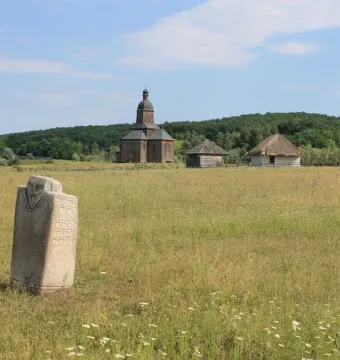
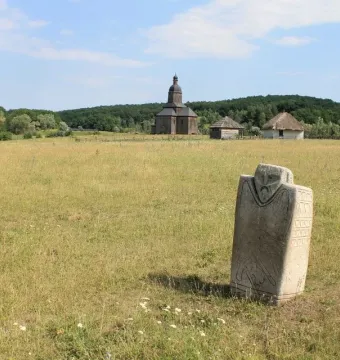
| Original location | May originally have stood on or in a kurgan mound, possibly as part of a sanctuary of a deified ancestor cult above the Oril River |
Location and ownership | |
| Inventory number | DIM-A-9039 |
| Current collection | Collection of the Dmytro Yavornytsky National Historical Museum of Dnipro |
| Current location | Dmytro Yavornytsky National Historical Museum of Dnipro, Ukraine |
History and restoration | |
| Exhibition history | After accession and documentation, it was exhibited at the National Historical Museum of Dnipro; it was later loaned to the Pushkin Museum and then to the Hermitage Museum in Saint Petersburg for three months |
| Reception on loan | It was extremely popular at the Pushkin Museum |
| Proposed permanent relocation | The Hermitage Museum |
| Reason for proposed relocation | Its popularity and the broader context of the Hermitage's prehistoric collections |
| Relocation outcome | The proposed change of loan conditions was denied and the object was returned to its region of origin in Dnipro |
| Preservation campaign | Its remaining in the Ukrainian SSR was secured by Horpyna Vatchenko, director of the Dnipro National Historical Museum, with support from Oleksy Vatchenko, chairman of the Presidium of the Supreme Soviet of the Ukrainian Soviet Socialist Republic |
Significance | |
| Related monuments | Anthropomorphic statues from Natalyevka, Fedorovka, Svatovo, Novocherkassk, and Kruchi are grouped by archaeologists in the same category |