
Sounion Kouros
The Sounion Kouros is a colossal statue of a youth in the archaic kouros scheme, carved from Naxian marble around 615–590 BC. It was named after its findspot, Cape Sounion, where it was discovered in 1906 together with a torso in a deep pit east of the temple of Poseidon. The statue, now in the National Archaeological Museum in Athens, stands 3.05 m high and has been restored with several modern additions, including parts of the face, arms, and legs. Its rigid frontal stance, elongated proportions, broad shoulders, large eyes, and stylized hair make it an important example of early Greek marble sculpture.
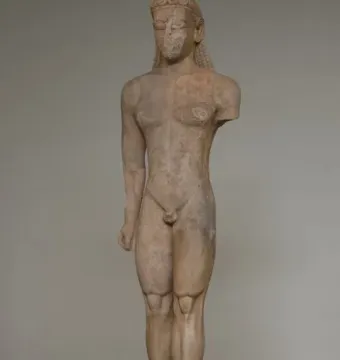
September 2017 © Peulle · CC BY-SA 4.0
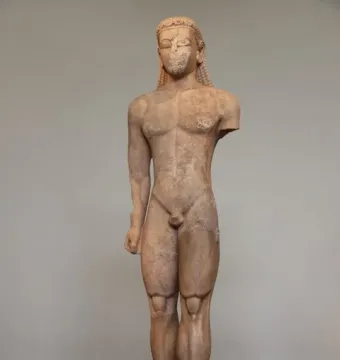
July 2016 © Gary Todd · CC0
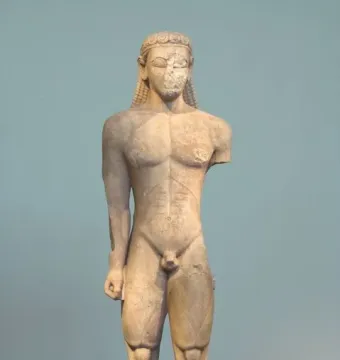
March 2014 © Zde · CC BY-SA 3.0
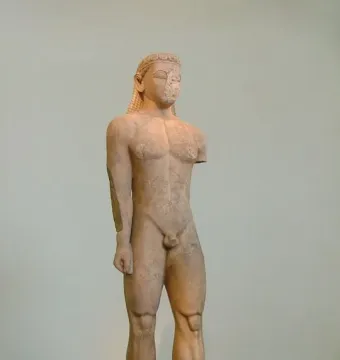
August 2007 © Dorieo · CC BY-SA 4.0
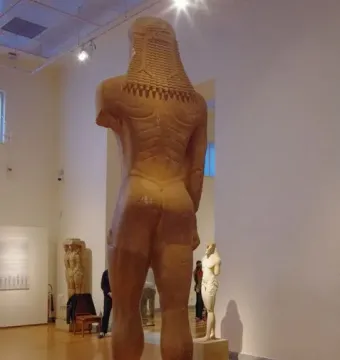
February 2020 © Paolo Villa · CC BY-SA 4.0
Identification | |
| Title | Sounion Kouros |
| Type | Kouros statue |
| Subject | Nude young male figure (kouros) |
| Alternative names | Kouros of Sounion; Kouros of Cape Sounion |
Historical context | |
| Date | Probably created between 615 and 590 BC; also given as about 600 BC / c. 600 BC / early 6th century BC / beginning of the 6th century BC |
| Cultural period | Early Archaic Greek; Archaic Greek sculpture |
| Style | Archaic Greek style with kouros schema, Egyptian influence, and a naturalistic turn |
| Function | Votive offering to Poseidon; dedicated in the kouros tradition to gods or heroes |
Creator | |
| Artist intention | To idealize the human form through stylized, formal patterns rather than real-life appearance |
Discovery and provenance | |
| Find condition | Badly damaged, heavily weathered, and exposed to the weather |
| Possible post-destruction history | May have been removed and buried by the Persians after the sanctuary was destroyed in 480 BC during the Second Persian War |
| Discovery date | 1906 |
| Discovery location | Near the Temple of Poseidon at Cape Sounion; found buried in a pit/deep hole east of the temple among fragments of other statues |
| Material source | Naxian marble |
Physical characteristics | |
| Height | 3.05 m (10.0 ft) |
| Scale | Larger than life-size |
| Base | Rectangular plinth, 0.98 × 0.80 m |
| Condition | Restored; survives with major losses and damage |
| Missing parts | Most of the left leg, the right leg below the knee, the left arm below the shoulder, and parts of the right arm |
| Reconstructed parts | Left side of the face including the nose and most of the mouth, part of the right arm, the right lower leg, and almost the entire left leg were reconstructed during restoration |
| Attribution uncertainty | Ancient feet were found, but their attribution to the sculpture is doubtful |
Materials | |
| Primary material | Marble |
Technique | |
| Surface traces | Red color traces remain on the hairband / in the hair strands; the pupils were probably enhanced by paint and differential corrosion |
| Technical note | A small drill hole on the inner side of the right forearm is important evidence for the development of marble carving; it suggests the arms were separated from the torso by parallel drill holes and the bridges later removed and smoothed |
Appearance | |
| Ears | Large spiral/volute earlobes set very high |
| Comparative note | The sculpture shows less developed anatomical detail than Late Archaic or Early Classical works such as the Kritios Boy; Gisela M. A. Richter described the anatomy as rendered by grooves, furrows, elevations, and knobs |
| Details | Fishbone-like back grooves, two curved lines marking the shoulder blades, and eight divisions of the abdomen are visible; the inguinal ligament is strongly modeled, forming a triangle in the lower abdomen |
| Torso and limbs | Square in section and flat at the back, with broad shoulders, a long thin waist, a strongly bulging chest, and heavily modeled shoulder and thigh forms |
| Anatomical modeling | Muscles and surface anatomy are strongly emphasized with grooves, furrows, elevations, and knobs; abdominal and back muscles are carefully modeled but still stylized |
| Hair | Braided hair with curls falling onto the forehead and back, tied with a ribbon/double ribbon in a Heracles knot |
| Eyes | Large almond-shaped eyes |
| Head and face | Large square head with a flat face, cylindrical neck, clear chin, and an archaic smile |
| Proportions | Elongated; broad shoulders with a narrow waist and hips |
| Overall appearance | Highly stylized, formal, and idealized rather than fully naturalistic |
| Movement | Despite the rigid pose, the advanced left leg suggests slight movement or readiness for action |
| Orientation | Strictly axial and frontal toward the viewer |
| Pose | Front-facing kouros stance with strict frontality, left leg advanced, arms at the sides, and fists clenched beside the thighs |
Iconography and meaning | |
| Nudity | Completely nude heroic nudity, unlike Egyptian art |
| Meaning | The kouros was intended as an idealized, beautiful and morally virtuous offering pleasing to humans and gods; its pose and nudity express heroic feeling |
Location and ownership | |
| Current location | National Archaeological Museum, Athens |
History and restoration | |
| Restoration status | Restored, with some old restorations still visible in back-view and head close-up images |
| Condition notes | Clear traces of erosion show it stood outdoors for a long time |
Significance | |
| Stylistic significance | An early kouros that shows innovations toward greater naturalism while retaining strong symmetry and pattern |