
Day
Day is a marble sculpture by Michelangelo, made between 1526 and 1531. It forms part of the decoration of the New Sacristy in the Basilica of San Lorenzo in Florence. The work is one of the four allegories of the Parts of Time and appears on the right side of the sarcophagus on the tomb of Giuliano de' Medici, Duke of Nemours. Its meaning has been interpreted in several ways, including political rebellion, Christian light, life, fire, and human emotions. Michelangelo may originally have planned a mouse as an attribute, suggesting that the figure symbolizes time that consumes all things.
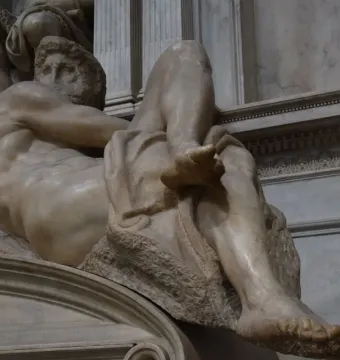
June 2019 © George M. Groutas · CC BY 2.0
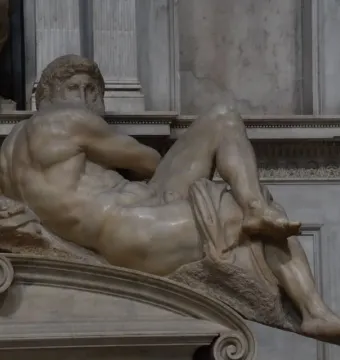
June 2019 © George M. Groutas · CC BY 2.0
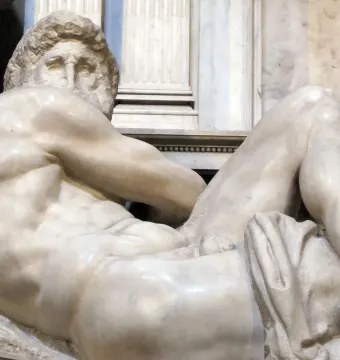
June 2014 © Francesco Bini · CC BY-SA 4.0
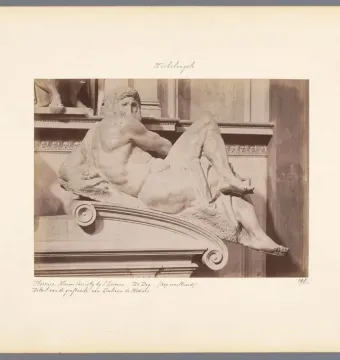
© Rijksmuseum · CC0
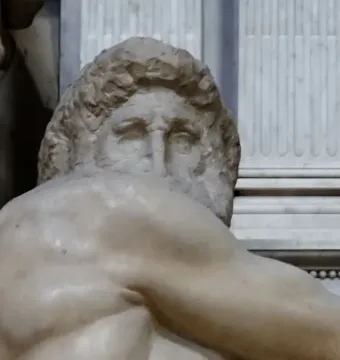
June 2019 © Richard Mortel · CC BY 2.0
Identification | |
| Title | Day |
| Series | One of the four allegories of the Times of Day |
| Original title | Il Giorno |
| Subject | Personification of Day |
| Type | Allegorical marble sculpture |
Creator | |
| Artist | Michelangelo Buonarroti |
Historical context | |
| Completion status | Left unfinished; probably completed after the work resumed following the Siege of Florence, but still unfinished when Michelangelo left for Rome in 1534 |
| Historical interruption | Work was interrupted by the Siege of Florence and its consequences |
| Patronage | Originally conceived by Pope Leo X; supported by Pope Clement VII |
| Probable start date | 1526 |
| Work period | 1520–1534 |
| Date | c. 1526–1531 |
| Commission context | Created for the New Sacristy of San Lorenzo in Florence as part of the Medici memorial chapel for Giuliano de' Medici and Lorenzo de' Medici |
Discovery and provenance | |
| Terracotta model | A terracotta model survives at the Museum of Fine Arts, Houston, in Houston, Texas |
| Terracotta model date | c. 1524 |
| Terracotta model features | The model lacks the right foot; the head is fully finished; the back and right arm are finished; it is more muscular than the finished statue; the face closely corresponds to the defeated figure from the sculptural group Spirit of Victory |
| Documentation | Tintoretto depicted the model in his sketches |
Physical characteristics | |
| Face | Bearded, roughly sketched, with a mysterious expression and blind eyes without pupils |
| Anatomy | Muscular, strong build with a powerful, tense anatomical structure |
| Figure age | Appears as an exhausted old man |
| Completion state | Non finito; the head and right hand are unfinished, and the figure is partly sketched |
| Pose | Semi-reclining, with the left elbow bent for support, the right arm stretched backward as if reaching for something, the legs crossed opposite the rotation of the torso, and the head turned toward the viewer |
| Figure type | Male nude, semi-reclining figure |
| Dimensions | 160 × 150 cm; maximum diagonal length 185 cm |
| Orientation | The only figure in the series turned with its back to the viewer |
Materials | |
| Material | Marble |
Appearance | |
| Stylistic effect | Highly evocative and emblematic, especially because of its unfinished state |
| Facial expression | Looks gloomy and unfriendly over the shoulder, as if shielding itself from a hostile world |
| Iconographic comparisons | Possibly inspired by the river gods on the Arch of Septimius Severus, the Belvedere Torso, the Child in the youthful Madonna della Scala, and one of the bronze nudes in the Sistine Chapel vault |
| Stylistic comparisons | Described as reminiscent of a powerful avalanche and of the titanic figures of the Sistine Chapel; also considered another variant of the Belvedere Torso |
Iconography and meaning | |
| Philosophical significance | Used in connection with Edmund Husserl as a personification of subjective experience as a source of knowledge of objective phenomena |
| Possible attributes | A tiara or diadem of sun rays may originally have been intended; a mouse was also proposed as an attribute |
| Literary description | In Irving Stone's The Agony and the Ecstasy (1961), it is described as a wise, strong man who had learned the transient pain and pleasures of life, with the head turned over a massive shoulder and forearm so the muscular torso emphasizes a back capable of bearing the world |
| Interpretations | A political symbol of rebellion against slavery, an autobiographical theme of the impulse toward freedom, a symbol of Christian light, a personification of life, an allegory of fire, a personification of the choleric temperament, a personification of action, pain, anger, contempt, or vengeance; it has also been interpreted as suggesting that time consumes all things |
Location and ownership | |
| Original location | Decoration of the Sagrestia Nuova (New Sacristy) of the Basilica of San Lorenzo, Florence |
| Current location | Still in the New Sacristy, Florence |
| Location within monument | On the right side of the sarcophagus of the tomb of Giuliano de' Medici, Duke of Nemours |
History and restoration | |
| Artist's departure | Michelangelo left for Rome in 1534 without installing the sculpture or completing the tomb |
Other | |
| Related work in fiction | In the Japanese anime series Ergo Proxy (2006), the statue is one of four allegories serving as advisers to the ruler of the city of Romdo |