
Stone of Motecuhzoma I
Stone of Motecuhzoma I is a pre-Columbian stone monolith dating to the rule of Motecuhzoma I, the fifth Tlatoani of Tenochtitlan, from 1440 to 1469. Also known by several other names, it is described in historical sources simply as a temalacatl, or “round stone.” The monolith measures about 12 feet in diameter and 39 inches tall. Its sides depict conquests made under Motecuhzoma I, when Tenochtitlan was strengthening its role as the capital of the Aztec Empire and receiving tribute from expanded rule. The top contains a sacrificial well, reflecting the rise in ritual human sacrifice during his reign.
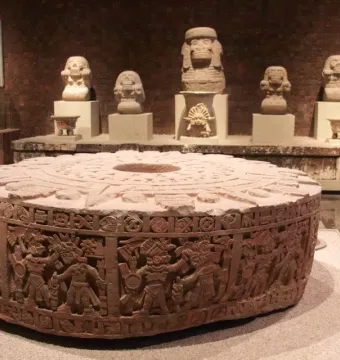
July 2015 © Mike Peel · CC BY-SA 4.0
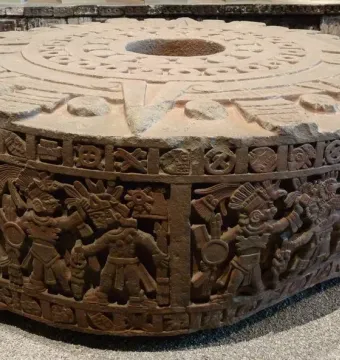
July 2009 © El Comandante · CC BY-SA 3.0
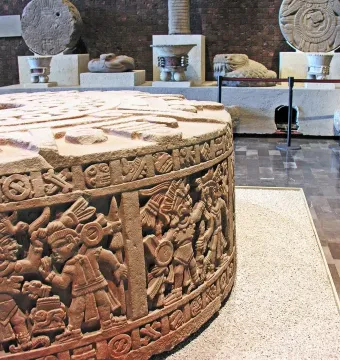
March 2007 © Dennis G. Jarvis · CC BY-SA 2.0
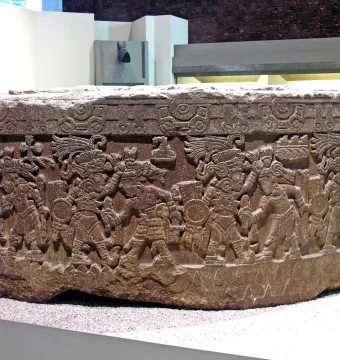
March 2007 © Dennis G. Jarvis · CC BY-SA 2.0
July 2012 © Gary Todd · CC0
Identification | |
| Title | Stone of Motecuhzoma I |
| Alternative names | Stone of Motecuhzoma Ilhuicamina; Cuauhxicalli of Motecuhzoma Ilhuicamina; Archbishop's Stone; Ex-Arzobispado Stone; Sánchez-Nava Monolith; Piedra de Moctezuma; Stone of Montezuma I |
| Historical name | Temalacatl |
| Type | Aztec stone monolith, probably a sacrificial stone (temalacatl); also identified as a temalacatl-cuauhxicalli |
Historical context | |
| Date | During the reign of Motecuhzoma I (1440–1469); some researchers date it to the reign of Axayacatl |
| Culture | Mexica civilization; Pre-Columbian Aztec Empire |
Creator | |
| Attribution | Traditionally attributed to Motecuhzoma I (Motecuhzoma Ilhuicamina); disputed by recent studies |
| Associated ruler | Motecuhzoma I (Motecuhzoma Ilhuicamina), fifth tlatoani of Tenochtitlan |
Discovery and provenance | |
| Original location | In front of the Temple of Tezcatlipoca, in Tenochtitlan |
| Discovery location | Under the patio/courtyard of the former Archbishop's Palace (Palacio del Arzobispado) on Moneda Street, south of the Templo Mayor, Mexico City |
| Discovery date | July 1988 |
Location and ownership | |
| Current location | National Museum of Anthropology, Mexico City, in the Mexica hall |
Physical characteristics | |
| Form | Large circular/cylindrical monolith |
| Dimensions | Approximately 224 cm in diameter and 68–76 cm tall |
Materials | |
| Material | Basalt |
Appearance | |
| Depicted figure | Motecuhzoma I dressed as Tezcatlipoca, dominating enemy captives |
| Border motifs | Symbols alluding to human sacrifice, including crossed bones, skulls, hearts, knives, human hands, and other motifs such as copilli, tied bundles, circular rings with a cross, bone crosses, profile skulls, Cipactli, and Técpatl |
| Lower band | 57 small squares with symbols |
| Upper band | 59 small squares with symbols |
| Side decoration | Three horizontal bands of reliefs around the cylinder |
| Middle band | Eleven conquest scenes, each marked by a glyph |
| Upper face decoration | Concentric-circle band, cardinal-direction arrows, and an outer band with jade and cuauhxicalli motifs |
| Depiction on top | Face of the sun deity Tonatiuh, with a headdress, open mouth, and originally a protruding tongue in the form of a sacrificial knife |
| Top feature | Solar disc with a circular basin in the center |
| Orientation | Intended to be placed face-up |
Iconography and meaning | |
| Associated ceremonial object | Cuauhxicalli, a receptacle for human hearts after sacrifice |
| Combat participants | Captured enemy soldiers or prisoners against fully equipped Mexica warriors |
| Function | Probable temalacatl used for gladiatorial combat and gladiator sacrifice |
| Meaning | A monument to Aztec conquests and imperial expansion under Motecuhzoma I; the solar imagery is linked to sacrifice and the continuation of the sun's movement |
| Associated deity | Tezcatlipoca |
| Depicted deity | Tonatiuh, the sun deity |
| Depicted conquests | Culhuacan, Tenayuca, Xochimilco, Chalco, Tamazulapan, Acolhuacan, Texaxic o Tepanoaya, Tlatelolco, Tonatiuhco, Mixtlan, and Cuetlaxtlan |
| Depicted subject matter | Conquests of Motecuhzoma I; the scenes evoke his conquests over the peoples of the Valley of Mexico |
History and restoration | |
| Historical significance | Associated with the expansion and consolidation of the Aztec Empire under Motecuhzoma I; Tenochtitlan was becoming the capital of the empire |
| Historical interpretation | The top basin may have collected sacrificial blood, and the stone was once painted entirely red |
| Historical documentation | Well-documented in historical sources |
| Alternative dating hypothesis | Some scholars propose a date in the time of Axayacatl, possibly because one scene may depict the conquest of Tlatelolco in 1473 |
| Historical sources note | Historical sources mention many other temalacatl that have not yet been discovered |