
Pilier d'Yzeures-sur-Creuse
Pilier d'Yzeures-sur-Creuse is an ancient monumental column carved in Jurassic coquillier limestone. Remains were discovered in 1895 during the reconstruction of the parish church of Notre-Dame in Yzeures-sur-Creuse, Indre-et-Loire, in the foundations and nearby trenches. Of the many blocks found, twenty-one were identified as belonging to the monument. They form three levels of low-relief decoration showing Roman deities such as Jupiter and Mars, as well as Greek mythological heroes including Hercules and Perseus, likely once topped by a lost statue. The pillar is thought to have stood about nine metres high and to date from the early Roman period. The preserved blocks are now displayed at the Musée Minerve in the same commune.
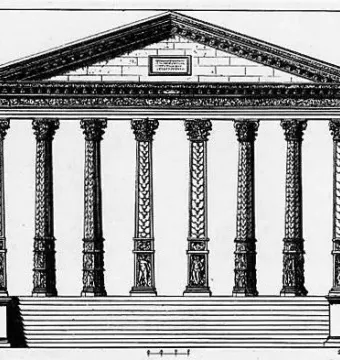
1897 © Octave de Rochebrune · Public domain
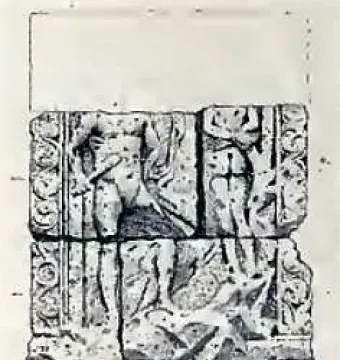
December 1911 © Emile Espérandieu (1857-1939) · Public domain
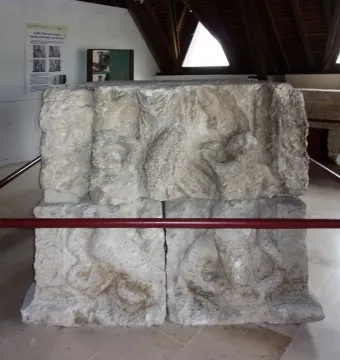
April 2019 © Joël Thibault · CC BY-SA 4.0
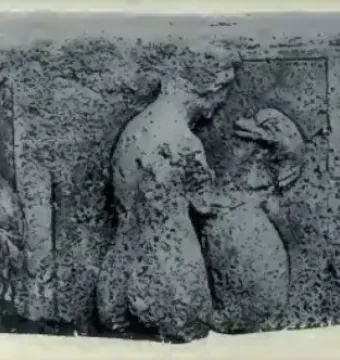
December 1911 © Emile Espérandieu (1857-1939) · Public domain
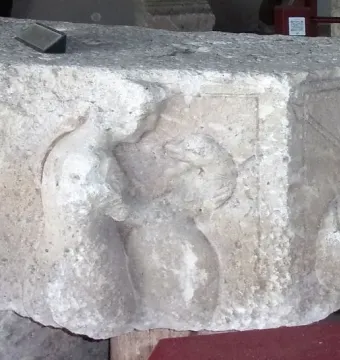
April 2019 © Joël Thibault · CC BY-SA 4.0
Identification | |
| Title | Pilier d'Yzeures-sur-Creuse |
| Type | Monumental pillar |
Historical context | |
| Date | Early 3rd century |
Creator | |
| Excavator | Father Camille de La Croix |
| Later study and reconstruction | Jean-Pierre Adam |
| Earlier reconstructions and interpretations | Louis-Auguste Bosseboeuf; Octave de Rochebrune; Émile Espérandieu; Charles Normand; Henry Auvray; Franz Cumont |
Discovery and provenance | |
| Possible earlier structure | The blocks may have been reused in the foundations of a Merovingian church, possibly the one mentioned by Gregory of Tours as founded by Bishop Eustochius of Tours |
| Associated site interpretation | The remains were interpreted as belonging to several monuments or structures: a monumental pillar, a fanum-type temple with a polygonal cella, an altar, and a dedication inscription to Minerva |
| Later publication | Émile Espérandieu photographed and published the blocks in 1911 |
| Early publication | Charles Normand published a rough plan in 1896, based on de La Croix's indications |
| Blocks found | About 85 to 95 blocks were uncovered in total; about 21 or 25 are attributed to the pillar, with 13 undecorated blocks unassigned and about 10 to 20 blocks thought to have been lost |
| Documentation at discovery | De La Croix extracted and stored the blocks without order, took about one hundred photographs, and made drawings and measurements; no proper in situ survey was made |
| Associated finds | Numerous ancient stone blocks and a few Merovingian sarcophagi |
| Discovery context | Found during the demolition of the old church and the reconstruction of Notre-Dame church on the same site |
| Discovery location | Found in and near the foundations of the former parish church of Yzeures-sur-Creuse, Indre-et-Loire, France |
| Discovery date | Autumn 1895, with excavations continuing in 1896 |
Materials | |
| Material | Jurassic coquillier limestone with shell inclusions |
| Material properties | Very hard; fossils and flint nodules are visible in relief in the sculptures |
Technique | |
| Surface treatment | The monument faces were coated with limewater for smoothing or repair |
Physical characteristics | |
| Summit statue | Probably existed but is lost; its form is uncertain |
| Third sculpted level | An octagonal tier, the most poorly preserved; only 2 blocks are identified and three of the eight faces are missing |
| Second sculpted level | Smaller square tier, about 2 meters on a side; probably originally three courses, with 7 known blocks surviving in two courses |
| First sculpted level | Square plan, about 3 meters on a side and 2.5 meters high, with 12 identified blocks arranged in three courses |
| Socle | Four courses of large unsculpted ashlar blocks on a square plan, set back successively |
| General form | A very slender stepped pyramid made of a bare socle, three receding sculpted tiers, and a lost summit statue |
| Estimated height | About 9 meters |
Appearance | |
| Decoration | Three levels of bas-relief sculpture |
| First level subjects | Jupiter, Vulcan, Mars, and Apollo; decorated pilasters with rinceaux separate the faces |
| Second level subjects | Scenes of Hercules rescuing Hesione, Perseus rescuing Andromeda, and Mars and Minerva fighting the Gigantes |
| Third level subjects | Leda with the swan, Castor, Pollux, Neptune, and a possible fifth figure |
| Paint and color | Traces of polychrome paint survive, especially on the third level and on cornices |
| Cornices | Transitions between tiers may have been marked by ornamental or plain cornices; some sculpted elements may belong to one of them |
Iconography and meaning | |
| Associated temple dedication | The temple may have been dedicated to Minerva, as suggested by an inscription of three blocks out of a probable five |
| Possible function | Probably part of a complex of cult monuments and buildings |
| Summit statue interpretation | Possible identities include Jupiter, Minerva, or the emperor; proposals also include Jupiter on horseback defeating the Anguipede, but no hypothesis can be preferred |
| Interpretation | The monument is generally understood as a symbolic dedication to the emperor through allegorical representations; the first two levels may allude to Roman victory, and the summit statue was probably the major element |
Location and ownership | |
| Current display location | Musée Minerve, Yzeures-sur-Creuse, France |
| Museum history | The museum was founded in 1972 to house and display the remains |
History and restoration | |
| Protection status | Protected objects since 1896 |
| Database record | Recorded in the Palissy database since 1992 |
| Storage history | After discovery the blocks were kept in the presbytery garden under a simple shelter until relocation in 1970 |
| Relocation and study | The blocks were moved in 1970 for road works and studied in detail from 1970 to 1972 under Jean-Pierre Adam |
| Restoration | All blocks displayed in the museum were restored and the display was reorganized in 2014 |
| Assembly issue | Some blocks had been incorrectly assembled in the 1972 museum display, which complicated later study |
| Later interpretation | The monuments are now considered part of a secondary settlement or vicus, comparable in some respects to Gué-de-Sciaux in Antigny |
Other | |
| Scholarly controversy | There was disagreement between Louis-Auguste Bosseboeuf and Camille de La Croix over who made the discovery and how the blocks should be interpreted |
| Incomplete evidence | Some authors suggested that only about half of the original blocks were recovered, and that additional ancient blocks may still be embedded in later foundations |