
Gemma Augustea
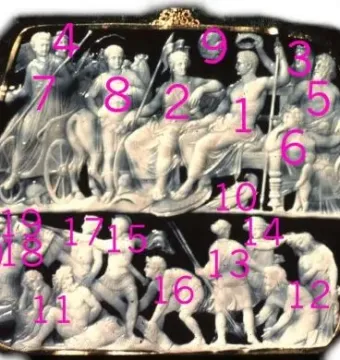
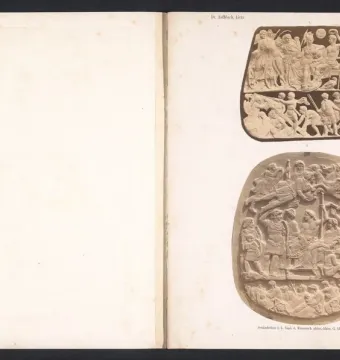
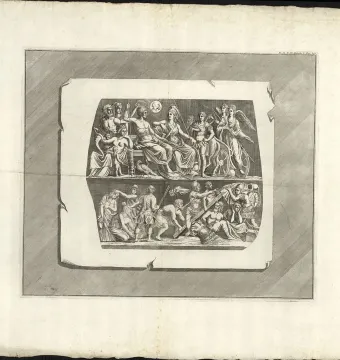
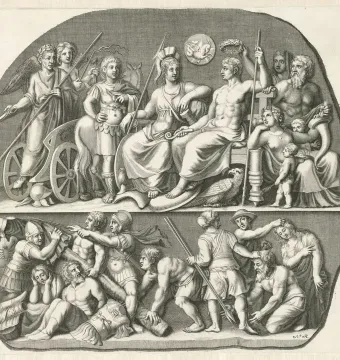
Gemma Augustea is an ancient Roman cameo, regarded as one of the finest Roman artworks. It was made from black-and-white onyx, also known as Arabian onyx, and measures 22.9 × 18.7 cm. It is thought to have been created by Dioscurides or one of his pupils between 10 and 20 CE. The relief is divided into two horizontal zones: the upper scene presents Augustus, Roma, Tiberius, Victoria, and other symbolic figures, while the lower scene shows Roman soldiers raising a trophy with Mars, captives, and allied or personified figures. The cameo is believed to commemorate Tiberius’ victory over the Germans in 7 CE. It is housed in the Kunsthistorisches Museum in Vienna.
© Zephlon · Public domain
© Rijksmuseum · CC0
1700 © onbekend (prentmaker) · Public domain
© prentmaker: Nicolaes Ryckmans (vermeld op object) naar prent van: Paulus Pontius · Public domain
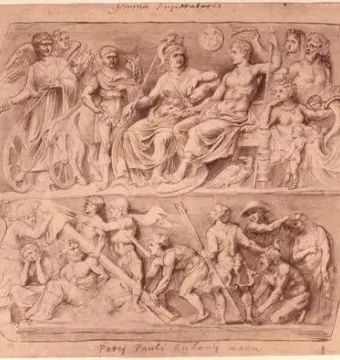
1621 © Peter Paul Rubens · Public domain
Identification | |
| Title | Gemma Augustea |
| Alternative titles | Gemma Augusta; Gema de Augusto; Gema Augusta; Gema Augusteia; Vienna Cameo |
| Type | Ancient Roman cameo |
Historical context | |
| Date | Probably made around AD 10–20; some scholars date it later, up to the reign of Caligula |
| Subject | The apotheosis of Augustus; probably commemorates Tiberius's victory over the Germanic peoples in AD 7, and is associated with the triumph awarded to Tiberius in AD 12 |
Creator | |
| Attribution | Probably Dioscurides of Aegeae in Cilicia or one of his students/disciples |
| Workshop | Probably the imperial workshop of Dioscorides in Rome; possibly made in Augustus's court circle |
Physical characteristics | |
| Dimensions | 23 × 19 cm |
| Thickness | About 1.3 cm |
Materials | |
| Layer colors | One layer is white; the other is bluish-brown to brownish-blue |
| Stone | Two-layer Arabian sardonyx (Arabian onyx) |
Technique | |
| Technique | Low-relief carving |
Appearance | |
| Composition | The surface is divided horizontally into two relief zones |
| Upper register | Augustus is seated with Roma and surrounded by allegorical figures; Tiberius descends from a chariot with Victoria; Capricorn appears above Augustus; an eagle is at Augustus's feet |
| Lower register | Roman soldiers, assisted by Mars, erect a trophy while captives and other figures look on |
Iconography and meaning | |
| Crowning figure | Oikoumene/Ecumenus, personification of the inhabited world, crowning Augustus with a civic crown |
| Possible interpretations | Some captive-like figures have also been interpreted as gods or personifications; a figure with a broad-brimmed hat may personify Thracian troops, and another may personify the Spanish provinces |
| Lower register symbols | A scorpion on a shield behind the Macedonian soldier, also on the trophy shield; interpreted as a zodiac sign linked to Augustus's birth month or to Tiberius's victory |
| Lower register figures | Roman soldiers erect a tropaion or victory monument, while barbarian captives are humiliated and observed; one allied Macedonian soldier stands beside the Romans |
| Germanicus | A young figure beside Roma, probably Germanicus in officer's attire |
| Right-side figures | Gaea/Tellus/Italia, Oceanus/Okeanos, and possibly Telo with children |
| Eagle | Symbol of Jupiter and the Roman legions; also a sign of Augustus's deification |
| Victoria | The goddess of victory, standing on or driving the chariot behind Tiberius |
| Tiberius | Shown descending from a chariot or biga, wearing a laurel wreath |
| Capricorn | Augustus's birth constellation and favorite symbol |
| Roma | Personification of Roma seated beside Augustus |
| Augustus attributes | Scepter and augur's staff |
| Lower register meaning | Symbolism of victory |
| Upper register meaning | Symbolizes Augustus's military power over the world |
Location and ownership | |
| Current mounting | Set in a 17th-century German gold ring setting with ornamental openwork on the back |
| Inventory number | IXa 79; AS IXa 79 |
| Current location | Collection of Greek and Roman Antiquities, Kunsthistorisches Museum, Vienna |
Discovery and provenance | |
| First recorded mention | 1246, in the treasury of the Abbey of Saint-Sernin, Toulouse, France |
| Earlier provenance | Undocumented before 1246; possibly transferred from the imperial palaces on the Palatine to Byzantium under Constantine I |
| Later ownership | Acquired by Francis I of France in 1533, taken to Paris and Fontainebleau, then stolen around 1590 and sold to Rudolf II for 12,000 ducats/gold coins |
| Later location | Placed in the German treasury after acquisition by Rudolf II |
History and restoration | |
| Condition and damage | The gem was damaged before 1700; the upper-left part broke off and at least one figure was lost |
Significance | |
| Artistic significance | Considered one of the most beautiful Roman monuments, one of the masterpieces of glyptics, one of the most valuable cameos in the world, and one of the highlights of the Kunsthistorisches Museum's Antikensammlung |
| Comparative status | One of the largest surviving ancient cameos |
Other | |
| Artistic period | Augustan classicism |
| Historical grouping | One of the so-called State Cameos |