
Sarcophagus of the Triumph of Bacchus
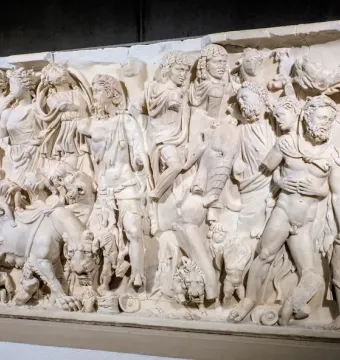
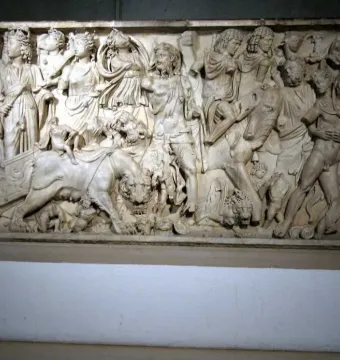
The Sarcophagus of the Triumph of Bacchus is a monumental ancient Roman stone sarcophagus carved from Carrara marble. Its high-quality reliefs and the subject of Bacchus triumphing over India suggest that it was made in a Roman workshop, possibly at the start of the 3rd century, during the reigns of Caracalla or Elagabalus. It was discovered in 1824 on the Saint-Just hill in Lyon, France, during work on the foundations of the church of Saint Irenaeus. After being reburied for lack of funds, it was excavated again in 1845 and moved to the Musée lapidaire. It is now in the Musée gallo-romain de Fourvière in Lyon.
November 2024 © Romainbehar · CC0
2006 © Pline · CC BY-SA 3.0
March 2023 © Romainbehar · CC0
· CC BY-SA 2.0 fr
© Phyrexian · CC BY-SA 4.0
Identification | |
| Title | Sarcophagus of the Triumph of Bacchus |
| Object type | Monumental Roman sarcophagus |
Historical context | |
| Period | Roman era |
| Date | Early 3rd century CE, probably in the reigns of Caracalla to Elagabalus; not later than 220–225 CE according to Turcan |
Creator | |
| Origin | Probably from a Roman workshop |
| Workshop attribution | The style and high quality of the reliefs suggest a Roman workshop origin; it may come from the same workshop as the Indian triumph preserved in the Museo del Laterano |
Discovery and provenance | |
| Reexcavation date | 1845 |
| Later transport | Transported to the Musée lapidaire |
| Excavator | A. Comarmond / Ambroise Comarmond |
| Post-reexcavation treatment | One detached head was put back in place; the other was sent to Paris and lost |
| Reexcavation condition | Unearthed in three pieces; the main face was fractured into three pieces, the right face into eleven fragments, and several small parts were missing; despite the damage, the whole remained very legible |
| Initial treatment after discovery | Left in place and reburied because of a lack of funds |
| Condition at discovery | Broken into three pieces and buried; two heads were detached when first discovered |
| Discovery depth | About 4 meters below ground |
| Discovery context | Found during reconstruction/restoration works and the digging of the foundations for the 19th-century church of Saint-Irénée / Église Saint-Irénée |
| Discovery location | Saint-Just hill, Lyon, France, at the foot of the staircase of Saint-Irénée church |
| Discovery date | Around 1800; formally uncovered in 1824 |
| Reexcavation impetus | At the urging of Ambroise Comarmond |
Location and ownership | |
| Current location | Musée gallo-romain de Fourvière / Museum of Gallo-Roman Civilization / Museum of Gallo-Roman Lyon / Museum Lugdunum, Lyon |
Physical characteristics | |
| Material | Carrara marble |
| Container | White marble tub |
| Condition | The elephant's trunk and tusks have not survived |
Materials | |
| Material details | White Carrara marble with large regular crystals and gray veining |
Technique | |
| Relief technique | Main figures carved in very high relief or high relief; background and side faces in low relief; the short sides are carved in bas relief |
Appearance | |
| Awkward detail | The left maenad has a disproportionately long leg |
| Side visibility | The lateral sides are little visible once the sarcophagus is placed in the tomb |
| Stylistic character | Dense, crowded composition with many figures filling all available space, dynamic diagonals and opposing directions, and elongated proportions that give the figures dignity |
| Overall impression | A very lively scene |
| Composition | Two-register composition with a vertical grouping around Pan and a horizontal arrangement of genre scenes from bottom to top |
| Perspective effect | Relief levels create an effective perspective, though not without awkwardness |
Iconography and meaning | |
| Elephant group | A lion stands between the elephant's forefeet, with other exotic animals from the Orient and Africa behind it, including a camel or giraffe |
| Iconographic theme | Bacchic imagery with Pan, Bacchus/Dionysus, Ariadne, Victory, satyrs, bacchantes, Hercules, Silenus, and exotic captives and animals |
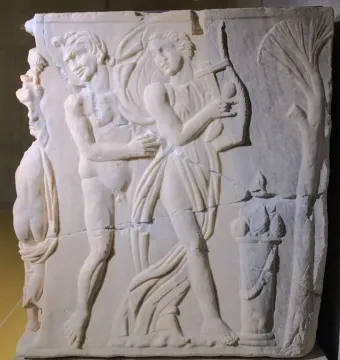
| Right short side | A satyr approaches a Bacchante before a garlanded altar with fruits and pine cones |
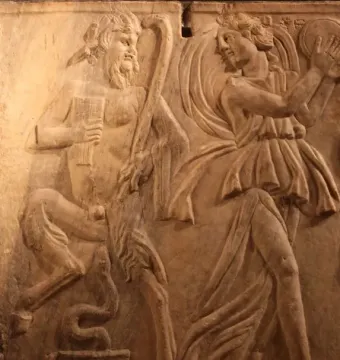
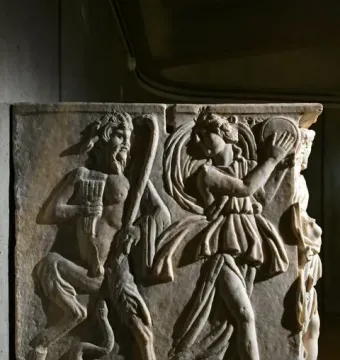
| Left short side | A smiling Pan or satyr holds a lagobolon and a flute beside a stone cyst from which a serpent is slithering, with a bacchante next to him playing a tambourine |
| Minor decorative elements | Smaller figures and motifs, such as squatting goats, fill the spaces between the main figures |
| Shepherd scene | A shepherd lies between two goats and is accompanied by a genius loci |
| Silenus | The link between Bacchus and Hercules is confirmed by the figure of Silenus |
| Hercules interpretation | His drunkenness is associated with the cult of Bacchus, and his presence also marks the scene as foreign because he has travelled to the ends of the earth |
| Hercules scene | Hercules in his lionskin tries to approach a nymph, who pushes her right hand against his shoulder while he appears to struggle and is supported by a satyr |
| Captives' appearance | The captives wear a short tunic, mantle, barbarian German trousers, and braided hairstyles |
| Elephant depiction | One captive rides an elephant; its face is covered with corymbs, its body with a net, and its neck bears a bell |
| Captives and animals | Exotic captives and animals accompany Bacchus's triumph over India |
| Ariadne | Seated to Bacchus's right, crowned with foliage, partly hidden by a Bacchante |
| Victory | Standing behind Bacchus and holding a palm in her left hand |
| Chariot decoration | The chariot is decorated with acanthus foliage |
| Bacchus scene | Bacchus rides in a triumphal chariot drawn by two panthers, holding a thyrsus, wearing a royal tunic and a woman's chiton covered by a nebris, with Victory crowning him and Ariadne seated to his right |
| Child figure | A child Pan/panisque stands between Pan's legs, holding a lagobolon and playing the pan flute |
| Central figure | Pan shown frontally at the center, looking backwards and wearing a nebris |
| Subject | The triumph of Bacchus/Dionysus over India, an exploit he accomplished in his youth |
Other | |
| Style and quality | High quality reliefs |