Farnese Diadumenos
Farnese Diadumenos is a 1st-century Roman marble sculpture measuring 1.49 m, slightly under life size. It depicts a young athlete wearing a band on his head, indicating victory in some contest. The statue is believed to be a Roman copy of an ancient Greek original, probably the Anadumenos created by Phidias in Olympia. Its subject is similar to Polykleitos’ Diadumenos, though the athlete’s pose differs slightly. Formerly part of the Farnese Collection, it is now in the British Museum in London.
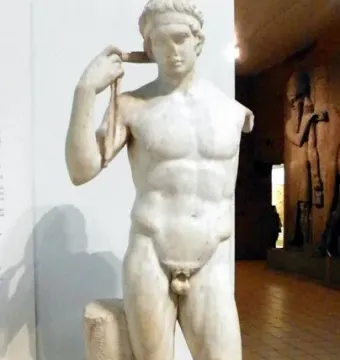
February 2016 © Peter O'Connor aka anemoneprojectors · CC BY-SA 2.0
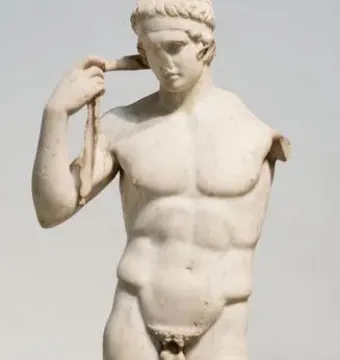
© Polykleitos · Public domain
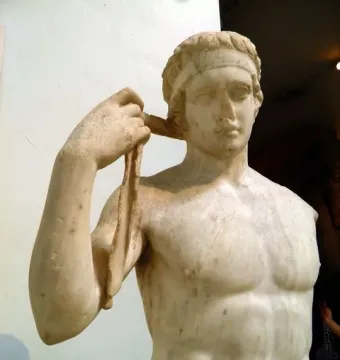
July 2012 © Carole Raddato · CC BY-SA 2.0
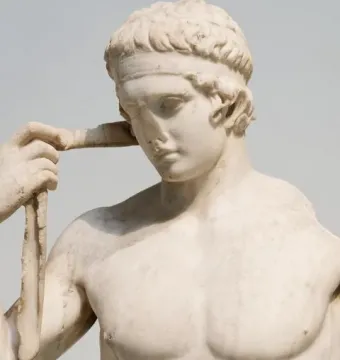
© Copy of Pheidias · CC BY 2.5
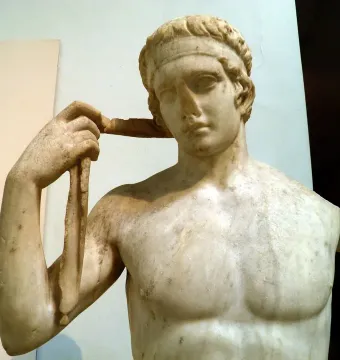
July 2012 © Carole Raddato · CC BY-SA 2.0
Identification | |
| Title | Farnese Diadumenos |
| Alternative names | Diadúmeno Farnésio; Diadúmeno Farnese; Diadumenos; Anadumeno Farnesio |
| Type | Roman sculpture |
Historical context | |
| Date | 1st century AD |
| Cultural origin of original | Classical Greek |
Creator | |
| Original sculptor | Polykleitos |
| Original work | Diadumenos |
| Original model | Probably a copy of the Greek sculpture Anadoumenos / Anadumeno attributed to Phidias in Olympia |
Discovery and provenance | |
| Former collection | Farnese Collection |
| Acquisition | Acquired from the Farnese Collection in 1864 |
| Comparative references | Compared by scholars with the replica from Delos now in Athens, figure V from the west frieze of the Parthenon, and the Copenhagen Anakreon |
| Related ancient works | An ivory relief of the same name attributed to Phidias, near the Temple of Zeus, Olympia, c. 430 BC; a round bronze statue of the same name by Phidias; a statue of the athlete Pantarkes by an unknown author |
| Scholarly attribution history | Usually identified as a late Roman marble copy of Polykleitos's Diadumenos, though some scholars instead connect it with the Pheidian Anadoumenos; proposed dates for the original range from around 450–440 BC to the early 1st century BC |
Location and ownership | |
| Current location | British Museum, London, United Kingdom |
| Current collection | British Museum collection |
Materials | |
| Material | Marble |
Physical characteristics | |
| Condition | The left arm and shoulder are lost; the hair is blurred by weathering; the right leg has been altered and repaired; remains of a palm support are present beside the statue |
| Support | A tree-trunk support was added in the marble copies; the original bronze did not have it |
| Height | 1.49 m |
| Scale | Slightly smaller than life-size |
| Original material | Bronze |
Appearance | |
| Depicted figure | A nude young athlete |
| Action depicted | Binding a victory ribbon or band around his head |
| Arm position | The arms were raised |
Iconography and meaning | |
| Related work | Similar to Polykleitos's Diadumenos, but with a different pose |
| Possible identification | Some scholars associate it with the Pheidian Anadoumenos, a ribbon-wearing athlete known from ancient sources |
| Interpretation | Believed to represent a young athlete who won an event |
| Etymology | From Greek διαδούμενος (diadoúmenos), from διαδέω (diadéô), meaning "to attach" or "to bind" |
| Name meaning | "The one who binds himself with the band" |
| Subject | A young athlete wearing a headband or diadem, indicating victory in a contest |
Other | |
| Proportions | The statue closely follows Polyclitus's Canon: the total height equals seven times the height of the head; the head height equals the length of the foot and the distance between the nipples; the torso fits within a square |
| Scholarly notes | John Boardman described it as a copy of an earlier work from around 450–440 BC in a pre-Polykleitan style, with both heels on the ground; A. Corso agreed with an original date around 450–440 BC and noted that the statue has been overly polished, producing a softer line more in keeping with the copyist's taste than the original design |
Significance | |
| Artistic significance | A symbol of early Greek classicism |
| Style | Balances equilibrium and dynamism |
| Formal composition | Its harmony comes from the coordination of the shoulders, hips, head, and legs |