
Tusculum portrait
Tusculum portrait is a 33 cm-high portrait head of Gaius Julius Caesar, now kept in the Museo di Antichità in Turin. It is a Trajanic-era copy in Carrara marble after a bronze original dated to 50–40 BC, and is considered the only surviving portrait type made during Caesar’s lifetime. The likeness was identified from coin portraits, especially issues of the moneyer Marcus Mettius. Its corroded surface, elongated crown, receding hair, and wrinkled neck reflect the realism of late Republican portraiture. The head was found in 1825 during excavations at the Forum of Tusculum, later moved to Castello d’Aglie near Turin, and was identified as a portrait of Caesar in 1940.
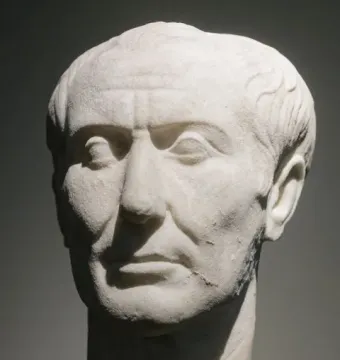
© Marie-Lan Taÿ Pamart · Public domain
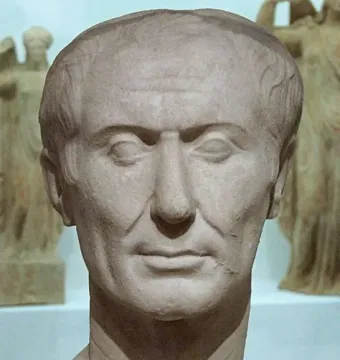
© Gautier Poupeau · CC BY 2.0
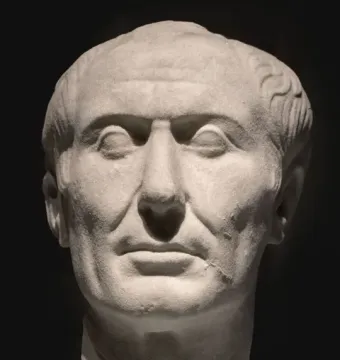
© Ángel M. Felicísimo · Public domain
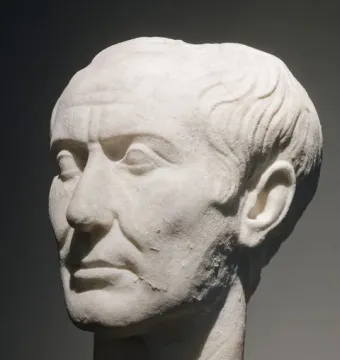
© Marie-Lan Taÿ Pamart · Public domain
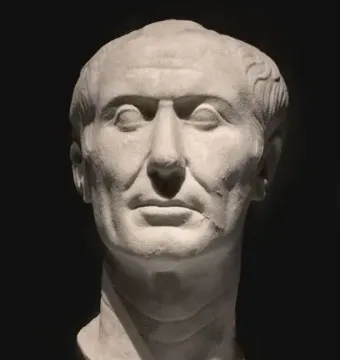
© Ángel M. Felicísimo · Public domain
Identification | |
| Title | Tusculum portrait |
| Alternative names | Tusculum bust; Caesar Tusculum; Type Agliè |
| Type | Portrait bust |
| Subject | Julius Caesar |
| Identification status | Speculated to depict Julius Caesar; identified by Maurizio Borda in 1940, according to many modern scholars |
Historical context | |
| Date | 50–40 BC |
| Historical significance | One of the two accepted pre-imperial portraits of Caesar, and possibly the only surviving portrait made during his lifetime |
| Stylistic tradition | Late Republican verism |
Creator | |
| Discovery and excavation | Discovered in 1825 at the Forum of Tusculum, Latium, during excavations carried out on behalf of Lucien Bonaparte |
Discovery and provenance | |
| Later locations | Castello d'Agliè; exhibited in the Louvre; later transferred to the Museo di Antichità, Turin |
| Current location | Museo di Antichità, Turin, Italy |
| Provenance | Originally unclear; identified as a bust of Caesar only in 1940 by Maurizio Borda |
| Known copies | Three copies are known |
| Known copy locations | Woburn Abbey, Bedfordshire; private collections in Florence and Rome |
| Most recent comparable example | A specimen found in 2004 on Pantelleria, restored in antiquity |
Materials | |
| Original model material | Bronze |
| Material | Fine-grained Carrara marble |
Technique | |
| Relation to original | Copy of a bronze original |
Physical characteristics | |
| Height | 33 cm |
| Condition | Surface heavily corroded; otherwise described as well preserved with slight retouching visible on the left side of the face |
Appearance | |
| Hair | Sparse, thinning |
| Neck | Wrinkled |
| Head shape | Elongated, saddle-shaped |
| Forehead | Slightly furrowed |
| Mouth expression | Slightly smiling |
| Overall expression | Concentrated and caring, with irony and aristocratic reserve |
| Style | Realistic |
| Cephalic type | Dolichocephalic |
| Coin comparison | Facial features correspond especially to Caesar coin portraits from the last year of his life, particularly denarii issued by Marcus Mettius |
Iconography and meaning | |
| Interpretation of neck | According to Jiří Frel, the wrinkled neck characterizes Caesar as a general rather than as a ruler; wrinkles were also read as signs of life experience, virtus, and gravitas |
| Possible medical explanation | The elongated, saddle-shaped skull may reflect premature ossification of the sutures between the parietal and temporal bones, possibly associated with dolichocephaly |
Location and ownership | |
| Collection status | Permanent collection |