
Zero Kilometre Stone
Zero Kilometre Stone is a 1975 sculpture by Miklós Borsos in Budapest, Hungary. It stands at Clark Ádám tér on the Buda side of the Chain Bridge and serves as the symbolic starting point for Hungarian distance measurements for major roads, with the exception of Road 8, which begins in Székesfehérvár. The sculpture is 3 metres high and made of limestone. It takes the form of a stylized zero, with the initials KM carved on its square base. Earlier monuments on the same theme stood here in 1932 and again in 1953 before being replaced by the present work.
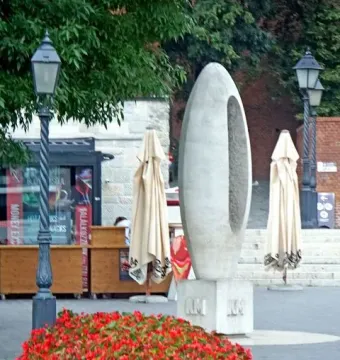
September 2016 © Dennis G. Jarvis · CC BY-SA 2.0
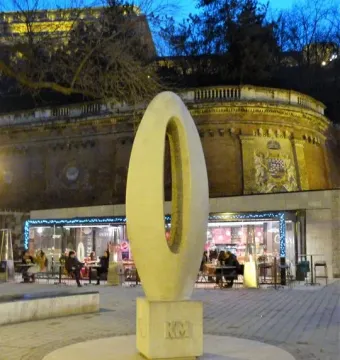
February 2015 © Elekes Andor · CC BY-SA 4.0

© Globetrotter19 · CC BY-SA 3.0

July 2025 © Envagyokabela · CC BY-SA 4.0
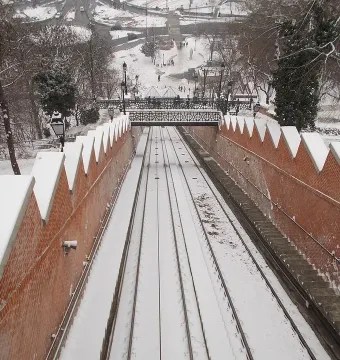
2016 © Globetrotter19 · CC BY-SA 3.0
Identification | |
| Title | Zero Kilometre Stone |
| Original-language name | Zerowy kilometr |
| Original-language name | Камень нулевого километра |
| Original-language name | Камінь нульового кілометра |
| Type | Sculpture |
Historical context | |
| Year created | 1975 |
Creator | |
| Artist | Miklós Borsos |
Discovery and provenance | |
| Original location | At the threshold of the Buda Royal Palace |
| Relocation to current site | Moved to near the Széchenyi Chain Bridge in 1849 when the bridge crossing was completed |
| Predecessor monuments at the site | A marble Madonna statue by Jenő Körmendi-Frim stood there from 1932 and was destroyed in World War II; it was followed in 1953 by a worker sculpture by László Molnár, later moved in 1974 to Rákoshegy railway stop in District XVII |
Physical characteristics | |
| Base | Quadrangular pedestal |
| Base height | 80 cm |
| Shape | A stylized zero |
| Height | 3 m |
Materials | |
| Material | Limestone |
Appearance | |
| Inscription | KM on the pedestal, an abbreviation for kilometre |
| Depicted subject | The digit 0 |
Iconography and meaning | |
| Function | Zero-kilometre reference point from which road distances in Hungary to Budapest are measured |
| Symbolic meaning | Symbol of Hungarian distance measurement; the starting point for Hungarian main roads, with exceptions including Road 1 and Road 8 |
Location and ownership | |
| Location | Clark Ádám tér, Budapest, Hungary, near the Buda end of the Chain Bridge |
| Unveiled | 4 April 1975 |
History and restoration | |
| 2011 artwork based on the monument | In 2011, András Csüllög made a 1.5-minute film and a styrofoam installation called ZERO, a copy of the monument, which was shown in multiple places and exhibitions |
Significance | |
| Comparable monuments | Similar zero-kilometre markers exist in other cities, including Kecskemét, Kyiv, Minsk, Moscow, and Washington, D.C.; the best-known ancient example is the Milliarium Aureum in the Roman Forum under Octavian Augustus |