
The Kiss of Death
The Kiss of Death is the most famous statue in Poblenou Cemetery in Barcelona. Also known in Catalan as El petó de la mort, it was originally commissioned by the Catalan textile manufacturer Josep Llaudet i Soler for the funeral of his young son, who died in adolescence. Sculpted in marble in 1930, the work is in the Art Deco style and is attributed to sculptor Jaume Barba and his son-in-law Joan Fontbernat. Today, it is a tourist landmark that attracts photographers and visitors from around the world.
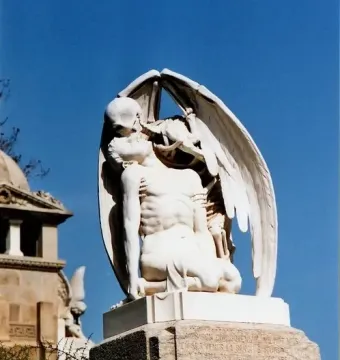
© Xavier Badia Castellà · CC BY-SA 3.0
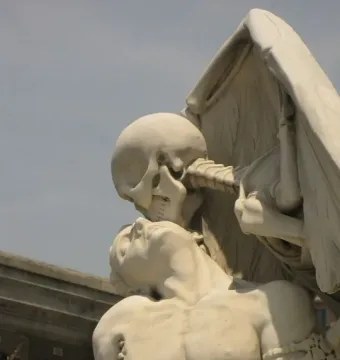
June 2011 © Enfo · CC BY-SA 3.0
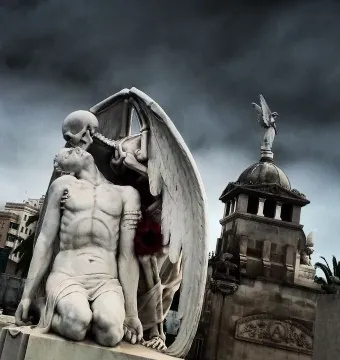
July 2014 © diveuniversefest · CC BY-SA 2.0
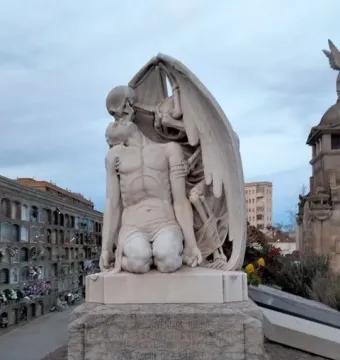
January 2025 © Enric · CC BY-SA 4.0
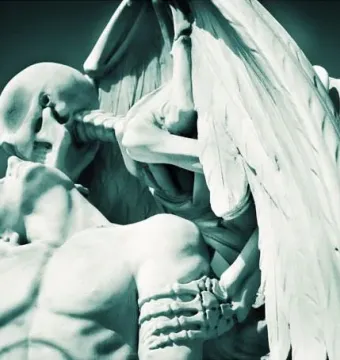
June 2006 © Pilar · CC BY-SA 2.0
Identification | |
| Title | The Kiss of Death |
| Type | Funerary marble sculpture |
| Titles in other languages | El petó de la mort (Catalan); El beso de la muerte (Spanish); Der Kuss des Todes (German) |
Historical context | |
| Date of creation | 1930 |
| Style | Art Deco |
Creator | |
| Artist | Jaume Barba |
| Co-artist | Joan Fontbernat |
| Place of creation | Jaume Barba's atelier |
| Attribution | Usually attributed to Jaume Barba; some sources suggest Joan Fontbernat may have designed it; the final design is not known with certainty |
| Signature | Signed "J. Barba" on the front of one side of the octagonal base |
| Artist age at creation | About 70 years old |
Discovery and provenance | |
| Possible workshop contribution | Joan Fontbernat Paituví is suspected of having transformed the relief into the three-dimensional sculpture |
| Inspiration | Very similar to Lorenzo Maroni's Italian relief |
| Commissioned by | The Llaudet i Soler family |
| Source of design | Based on a relief by Lorenzo Maroni, from the tomb of the Ercole Mentasti family at the Cimitero Monumentale in Milan, around 1910 |
| Commission subject | Josep Llaudet i Soler's son, who died in adolescence |
| Commissioned for | The funeral of the young son of Josep Llaudet i Soler |
Physical characteristics | |
| Form | Free-standing sculpture |
| Base shape | Octagonal |
Materials | |
| Material | Marble |
| Other material | Natural-stone pedestal |
Technique | |
| Execution | Extremely realistic carving in most areas |
Appearance | |
| Distinctive features | Death is shown as a skeleton with wings and no scythe |
| Death's clothing | A drape partially covers the figure while revealing the bones |
| Death's action | Holds the young man under the right armpit and by the left arm, and kisses him on the temple |
| Death's pose | Leaning over the young man from the left side |
| Young man's clothing | A cloth covers his loins |
| Young man's pose | Kneeling with his head tilted back to the right, eyes closed, mouth slightly open, arms hanging downward, and hands open with the backs of the hands or fingers resting on the ground |
| Depicted figures | A young man and Death personified as a winged skeleton |
Iconography and meaning | |
| Theme | Memento mori |
| Meaning of the kiss | The kiss releases the young man into eternal life |
| Emotional tone | Romantic and terrible; both attractive and terrifying |
| Interpretation | The pose can suggest resignation, relaxed acceptance, or eroticism; the kiss has palpable erotic force |
| Viewer response | It attracts and repels at the same time, creating a desire both to touch and to flee |
| Literary inscription | A four-line verse by Jacint Verdaguer in Catalan, placed on the natural-stone pedestal beneath the sculpture |
Location and ownership | |
| Original location note | Placed on the family burial plot of the Catalan textile industrialist family Llaudet i Soler |
| Inscription on tomb slab | "Llaudet Soler" |
| Later burials in the grave | The son was buried there in 1930; Josep Llaudet i Soler was buried there in 1955; later Enric Llaudet i Ponsa (1916–2003) was also buried there |
| Commemorated person | Josep Llaudet i Soler (1879–1955) |
| Function | Marks the grave of Josep Llaudet i Soler |
| Specific location | On the grave of the Llaudet i Soler family |
| Location | Poblenou Cemetery, Barcelona, Spain |
Significance | |
| Notability | The best-known marble sculpture in Poblenou Cemetery |
| Tourist status | Tourist attraction and part of traditional tourist circuits |
| Popularity | Attracts photographers and tourists from around the world; popularized by social media and the press |
| Tourism history | Became better known from 1992 and especially in the 2000s with the growth of international tourism in Barcelona |
| Cemetery impact | Contributes to tourist crowds at Poblenou Cemetery |
| Comparisons | Often compared to Brancusi's Kiss in Montparnasse Cemetery in Paris; Poblenou Cemetery is also compared with Montparnasse Cemetery because it is flat |
| Possible influence on film | Frequently mentioned as an inspiration for Ingmar Bergman's The Seventh Seal |
Other | |
| Associated poet | Jacint Verdaguer (1845–1902) |
| Associated family | Llaudet i Soler family |
| Associated relative | Enric Llaudet i Ponsa (1916–2003), younger brother of Josep Llaudet i Soler and former president of Futbol Club Barcelona |
| Photographer | Albert Plana |