
Ain El Fouara Fountain
Ain El Fouara Fountain is an emblematic and famous monument in Sétif, Algeria. Originally, it was a simple fountain built around a spring by military engineering after the occupation of Sétif. Its water was warm in winter and cool in summer. As the fountain gradually deteriorated, the municipal council considered restoring it, with councilor M. Bastide raising the issue in 1894. In 1896, the mayor of Sétif, M. Aubry, asked the director of Les Beaux-Arts in Paris to help secure a donated statue for the fountain’s decoration. The statue and the full work were completed in 1899, and the sculpture was made by the French sculptor François de Saint-Vidal.
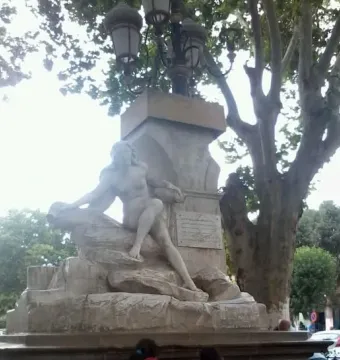
September 2013 © Assala19 · CC BY-SA 3.0
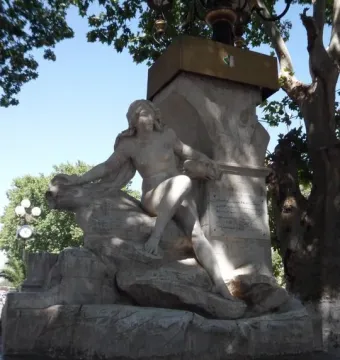
August 2013 © Kebbab abdelaziz · CC BY-SA 3.0
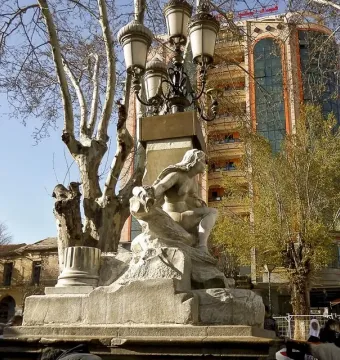
© habib kaki · CC BY 3.0
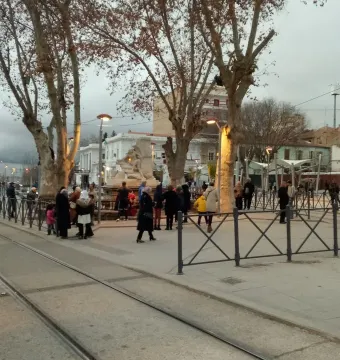
January 2019 © BEDIAF SALIM · CC BY-SA 4.0
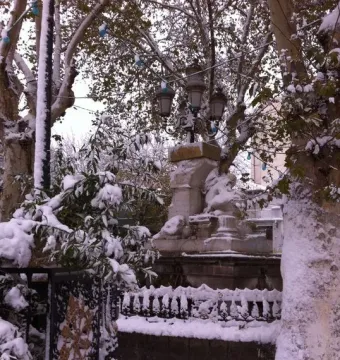
© ABDERRAHIM BELAKRI · CC BY 3.0
Identification | |
| Title | Ain El Fouara Fountain |
| Original-language name | La Fontaine d'Ain El Fouara |
| Arabic name | نافورة عين الفوارة |
| Literal meaning of the name | Fountain of the spouting spring |
| Type | Fountain monument with an inner statue |
Historical context | |
| Alternative origin story | A separate version traces the sculpture's origin to the reign of King Louis II of France, who allegedly ordered a statue in memory of Queen Valentine of Britain after her suicide; the sculpture was said to have been made by San Vidal, rejected by the British authorities, kept in storage, rediscovered during the French occupation and World War II, restored, and later gifted to the military governor of Sétif during celebrations in France marking victory over the Nazis |
| Spring characteristics | Hot in winter and cold in summer |
| Origin | Originally a Roman fountain built around a spring during the occupation of Sétif |
Creator | |
| Sculptor | Francis de Saint-Vidal |
| Artist nationality | French |
Discovery and provenance | |
| Exhibition history | Displayed at the Paris World Fair after the World Sculpture Exhibition |
| Transfer to Sétif | Sent from the port of Skikda to Sétif by cart, taking 12 days |
| Transfer decision | The French military governor of Sétif asked Francis de Saint-Vidal to donate the statue to the city |
| Request for the statue | In 1896, Sétif mayor M. Aubry requested the director of Beaux-Arts in Paris to arrange the donation of a statue to decorate the fountain |
Physical characteristics | |
| Material | Marble |
| Depicted figure | A completely naked woman |
| Setting | Built around the statue and symbolizing a Roman bath |
Location and ownership | |
| Country | Algeria |
| Classification | Outdoor sculpture; monument in Algeria; sculpture in the open air in Algeria; Sétif |
| Public use | Central meeting point for locals |
| Location | Independence Square, Sétif, Algeria |
| Landmark status | Emblematic monument and one of the city's landmarks |
| Cultural identity | An integral part of Sétif's cultural identity, sometimes called the "City of Ain El Fouara" |
Iconography and meaning | |
| Legend | According to legend, anyone who drinks its water will inevitably return |
| Public reverence | Some people view the fountain with reverence and believe it brings blessings |
| Cultural reception | Celebrated in poetry, music, and literary works by Algerian and Arab writers |
| Symbolic meaning | Symbolizes continuity and resilience |
History and restoration | |
| 2017 vandalism | On December 18, 2017, a man caused significant damage to the statue; official reports described him as mentally unstable, while other sources suggested ideological motives |
| Earlier site name | Ain El Fouara Square |
| Later sentencing | In an unspecified year, a vandal was sentenced to ten years in prison and fined 3.5 million dinars |
| Another later attack | The statue was heavily damaged by a drunk man in a separate incident |
| Later attack | Another vandalism incident involved a 30-year-old man climbing onto the rear of the fountain with a hammer |
| Perpetrator outcome | The perpetrator was arrested and later interned in a psychiatric hospital |
| Damage in second vandalism | In one attack, the statue's breasts and face were destroyed |
| 2017 official response | The Algerian Ministry of Culture reaffirmed its commitment to restoring the statue using scientific conservation methods |
| Vandalism history | The statue has been the target of more than six acts of vandalism, including attacks with dynamite, a hammer and chisel, and later assaults in 2018 and other unspecified dates |
| Restoration after first vandalism | After an initial attack with dynamite that broke the sculpture into several pieces, it was restored with the help of local residents; according to Fayçal Ouaret, the restoration took two days |
| Construction date | 1898 |
| Completion of installation | 1899 |
| Condition over time | Progressively deteriorated |
| Early repair discussions | In 1894, municipal councillor M. Bastide raised the need to reconstruct the fountain because it was in danger of collapsing; the mayor and most council members agreed repairs were needed but waited for new funds |
| Pedestal and setting architect | Eldin, a local architect who was then building the theatre of Sétif |
| Contractor | Francione, responsible for erecting the pedestal and installing the statue |
| First major damage | In the 1997 bombing on April 22 during Algeria's Black Decade, the bomb shattered the statue into numerous pieces |
| 1997 restoration | Restored by local authorities in less than 24 hours |
| Later restoration and reinauguration | After a later restoration, the statue was inaugurated by Culture Minister Azzedine Mihoubi and the wali of Sétif, Nacer Maskri |
Significance | |
| Cultural significance | Seen by many residents as part of the city's cultural heritage and historical legacy |
| Public controversy | Has sparked debate, especially among conservative and religious circles in Algeria |
| Removal campaign | Some people, including Abdel Fattah Hamadache, called on authorities to remove the statue |
| Religious ruling | In August 2015, the imam of the Abu Dhar Al-Ghafari Mosque in Constantine prohibited drinking from the fountain, saying that bending to drink from it constitutes worship of an "idol" |
| Compromise proposal | Cheikh Chamseddine Bouroubi suggested covering the statue with a Staifi robe to reconcile religious sensitivities with the city's cultural heritage while preserving the statue |
| Support for preservation | Many residents opposed removal demands, and writer-journalist Saadi Nacer Eddine defended the statue, arguing the criticism reflected a recent rise in conservative ideologies |
| Opposition to the statue | Some conservatives oppose the partially nude figure as indecent, religiously objectionable, and incompatible with moral and religious values |
Other | |
| Colonial-period interpretation | During the French colonial period, much of the Islamic and Algerian heritage was erased, and artistic contributions were wrongly attributed to the French |