
Victor Emmanuel II Monument
The Victor Emmanuel II Monument is located in Milan, on the city’s main square, Piazza del Duomo. It was erected in memory of Victor Emmanuel II (1820–1878), the first king of Italy. The bronze equestrian statue shows the king reining in his horse, giving the composition a strong sense of energy. The figure stands on a tall pedestal with a red granite base and a white marble stair section, topped by another Carrara marble pedestal decorated with a bas-relief of the Piedmontese army entering Milan after the Battle of Magenta. Two lions lie on the side steps of the marble pedestal, pressing shields inscribed “Rome” and “Milan.” The monument was unveiled on 14 June 1896.
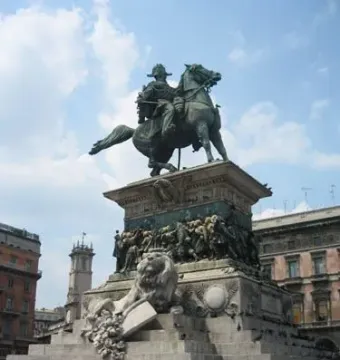
July 2007 © МаратД · CC BY-SA 4.0
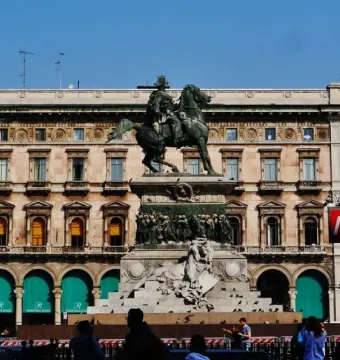
October 2018 © Zairon · CC BY-SA 4.0
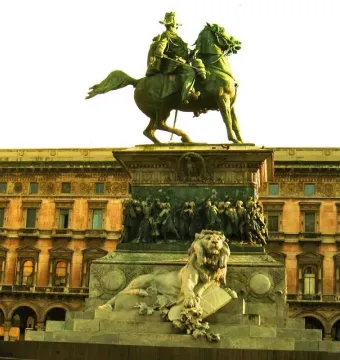
© lubieniebieski · CC BY 3.0
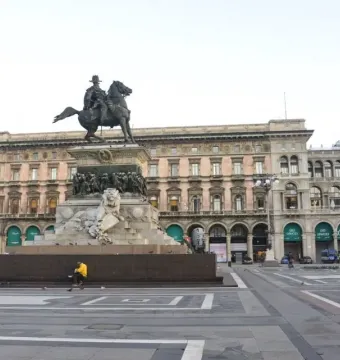
October 2016 © ManuelaVitale · CC BY-SA 4.0
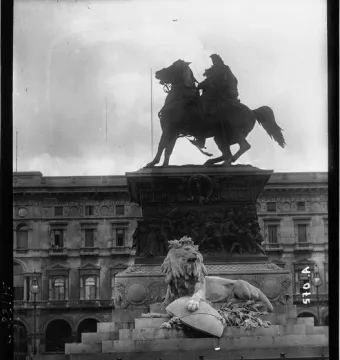
© Agence de presse Meurisse. Agence photographique (commanditaire) · Public domain
Identification | |
| Title | Monument to Victor Emmanuel II |
| Type | Equestrian monument |
| Original Italian title | Monumento a Vittorio Emanuele II |
Historical context | |
| Dedicated to | Victor Emmanuel II, King of Italy (1820–1878) |
| Commissioned by | King Umberto I |
| Commission date | 1878 |
| Reason for commission | After the death of Victor Emmanuel II in 1878 |
Creator | |
| Artist | Ercole Rosa |
| Artist nationality | Italian |
| Completion after artist's death | The monument was completed after Ercole Rosa's death in 1893 by the Barzaghi brothers under the direction of Ettore Ferrari |
| Construction manager | Giannino Ferrini, engineer from the Municipal Technical Office |
Discovery and provenance | |
| Casting of reliefs | The bronze relief was cast at F.lli Barigozzi on 9 January 1895 |
| Foundations discovered | 18 May 2012 |
| Inauguration date | 14 June 1896 |
| Installation date | 1896 |
| Proposed locations in Milan | Near the Royal Palace or in the center of Piazza del Duomo |
| Bronze parts completed | 1893 |
| Bronze casting site | Barigozzi foundry in the Isola district of Milan |
| Final location | Center of Piazza del Duomo, Milan |
| Selected for Milan statue | In 1879, Ercole Rosa was chosen to make the Milan monument |
| Original project location | Vercelli |
History and restoration | |
| Vandalism | On 9 March 2023, the monument was defaced with non-washable yellow paint by two activists from Ultima Generazione |
| Restoration completed | August 2023 |
| Later vandalism | On 2 October 2025, the monument was defaced with red paint and writing during a pro-Palestinian demonstration |
Physical characteristics | |
| Bronze relief dimensions | 2.30 m high; 90 m²; 8.6 t |
| Equestrian statue weight | 12.7 t |
| Equestrian statue height | 5.60 m |
| Overall dimensions | 320 m²; 14.80 m high in total |
| Pedestal height | 8 m |
Materials | |
| Statue material | Bronze |
| Pedestal materials | Red granite base; white Carrara marble stairway; Carrara marble upper pedestal |
| Bronze relief material | Bronze |
| Lion material | Marble |
Technique | |
| Bronze relief model maker | Ettore Ferrari |
| Original relief material planned | Marble |
| Reason for change of relief material | After Ercole Rosa's death, the relief was cast in bronze instead of being carved in marble |
| Equestrian statue models | Wax models by Ercole Rosa |
| Lion sculptor | Serafino Bianchi |
Appearance | |
| Pedestal decoration | Reliefs and allegorical palm branches on the upper pedestal, with eagles inside oak wreaths on the longer sides of the entablature |
| Base decoration | Two reclining lions on the side stairways, each with one paw on a shield or plaque |
| Horse pose | The horse stands with all four legs on the pedestal |
| Composition effect | Energetic yet stable |
| Depiction of the rider | Victor Emmanuel II is shown reining in his horse while turning to encourage his soldiers at the Battle of San Martino |
Iconography and meaning | |
| Historical scene depicted on pedestal | The entry of Piedmontese troops into Milan after the Battle of Magenta during the Second Italian War of Independence |
| Historical battle depicted | Battle of San Martino, June 1859 |
| Historical context | The Battle of San Martino was the last clash of the Second Italian War of Independence (27 April–12 July 1859) |
| Front inscription | GIUGNO MDCCCLIX (June 1859) |
| Front inscription meaning | Commemorates Victor Emmanuel II's entry into Milan on 8 June 1859 |
| Rear inscription | INAUGURATO MDCCCXCVI (14 June 1896) |
| Rear inscription meaning | Refers to the monument's inauguration date |
| Lion shield inscriptions | Roma and Milano |
| Lion symbolism | They represent the major conquests of the Risorgimento |