
Aleksis Kivi Memorial
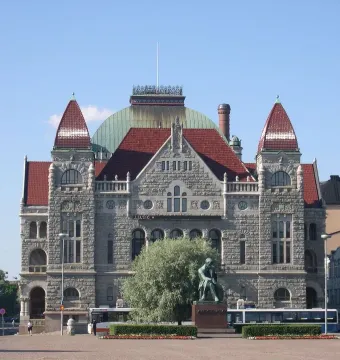
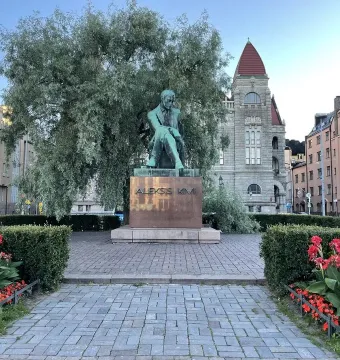
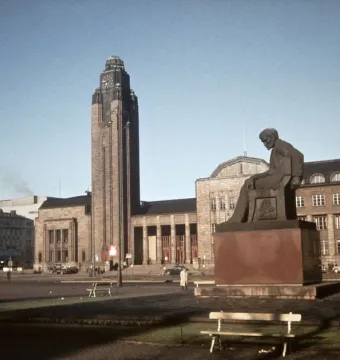
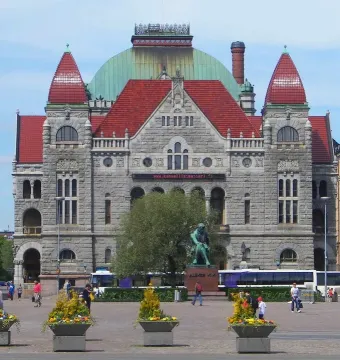
Aleksis Kivi Memorial is a statue dedicated to the Finnish author Aleksis Kivi (1834–1872), designed and sculpted by Wäinö Aaltonen. It shows a contemplative, even melancholic Kivi seated in a chair. The chair includes reliefs inspired by three of Kivi’s works: Sydämeni laulu, Keinu, and Seitsemän veljestä pakenee Impivaarasta. The back of the chair also carries two stanzas from his poem Ikävyys (“Melancholy”), presented in the original Finnish and in English translation. The memorial combines portrait sculpture with literary references to honor Kivi’s work and legacy.
© Andrew McMillan · Public domain
December 2022 © Misters32 · CC BY-SA 4.0
© Arvo Kajantie · CC BY 4.0
© Benreis · CC BY-SA 3.0
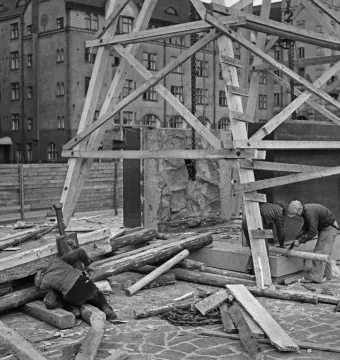
© Hugo Sundström · CC BY 4.0
Identification | |
| Title | Aleksis Kivi Memorial |
| Subject | Aleksis Kivi, Finnish author and national writer |
| Type | Commemorative bronze statue |
Historical context | |
| Final commission | Despite the competition results, Wäinö Aaltonen was ultimately commissioned in 1932 to make a plaster model |
| Related proposal style | Cubist-futurist proposals were also entered at the Tampere competition |
| Related work | Runoilija ja muusa (Poet and Muse) (1928), depicting a dreaming poet and the muse awakening him |
| Tampere competition entries | He submitted three proposals, which won the first three prizes |
| Earlier related work | Aaltonen worked on the subject as early as 1926 in connection with a similar monument competition in Tampere |
| Selection method | Chosen through a contest |
| Later related work | Musica, a 52 cm high gilded sculpture |
| Competition winners | Carl Wilhelms won the first stage and Aukusti Veuro won the second stage, but later renounced the victory |
| First competition outcome | No suitable sculpture was found in the first competition |
| Subject selection | Chosen by writers because Aleksis Kivi was regarded as the national writer |
| Commissioning initiative | Initiated by the writers' club Kirjallinen Työ |
| Project duration | Implementation stretched over twenty years |
| Honoree lifespan | 1834–1872 |
| Intended anniversary | Unveiling was intended to mark the 50th anniversary of Aleksis Kivi's death in 1922 |
| Competition history | A two-stage sculpture competition was held in Helsinki from 1928 to 1930 |
Creator | |
| Source model for depiction | Aaltonen based Kivi's depiction on a portrait by painter AE Forsell |
| Role | Designed and sculpted by Wäinö Aaltonen |
| Artist | Wäinö Aaltonen |
Materials | |
| Model material | Plaster |
| Model material | Fired and glazed clay model preserved in the National Gallery of Finland collection |
| Finished material | Bronze |
Technique | |
| Casting date | 1939 |
| Style development | Originally a more abstract cubist piece, later redesigned to a more realistic, more traditional appearance |
| Plaster model date | Commissioned in 1932 and completed in 1934 |
Physical characteristics | |
| Scale | Overlife-size |
| Pose | Seated on a chair in a contemplative, melancholic pose |
| Base | Stone pedestal |
Appearance | |
| Expression | Reflective and melancholic |
| Figure depiction | Aleksis Kivi is shown seated and meditating |
| Chair decoration | Three reliefs are placed on or beneath the chair |
Iconography and meaning | |
| Relief 2 | Sydämeni laulu (Song of My Heart), based on the lullaby of Seunala Anna from Seitsemän veljestä; interpreted through the katabasis theme of Orpheus and the poet's desire for death |
| Inscription | Two stanzas from the poem Ikävyys (Boredom) are written on the back of the monument and chair back in Finnish; an English translation is also recorded in the source |
| Relief themes | The reliefs refer to illusions and nostalgic objects from Kivi's literary works and to themes in his literary production |
| Relief 1 | Keinu (Swing), based on a poem from Kanervala (1866); interpreted through the Orpheus myth as the artist's choice between art and love |
| Relief 3 | Pako Impivaarasta (Escape from Impivaara), based on a fragment from Seitsemän veljestä; shows the brothers escaping their burning sleigh on a freezing Christmas night to the old house of Jukola |
| Front inscription | ALEKSIS KIVI |
Location and ownership | |
| Owner and maintainer | Helsinki Art Museum |
| Associated place | Rautatientori |
| Location | Helsinki Railway Square, in front of the Finnish National Theatre, Helsinki, Finland |
History and restoration | |
| Inauguration attendance | Attended by thousands of people, including government and cultural institution representatives, Aleksis Kivi's relatives, and foreign journalists |
| Unveiling speeches | Professor Viljo Tarkiainen gave the celebration speech; the speeches reflected the threatening wartime atmosphere, including Finland's invitation to send negotiators to Moscow and the calling up of the field army |
| Unveiling performances | Student choirs and a male choir performed Metsämiehen laulu ('Song of the lumberjack') under Martti Turunen |
| Closing songs | Sydämeni laulu and Isänmaan virsi |
| Unveiling date | 10 October 1939 |
Significance | |
| Location significance | Its placement in front of the National Theatre was considered as important as the opening of the Swedish Theatre park |
| Literary reference | Mentioned in Bertolt Brecht's Flüchtlingsgespräche, set in the restaurant of the neighboring railway station |
| Brecht's comment | Brecht wrote that the sculpture looked as if Kivi were dreaming of a piece of bread |
| Brecht sighting date | April 1940 |
| Artist-related context | Wäinö Aaltonen was regarded as an unofficial national sculptor and therefore seen as a suitable artist for the national writer figure |
| Interpretation | The memorial was conceived as the opposite of the Runeberg Monument, representing Finnish-language/Finnish culture rather than prosperous Swedish-language culture |