
Venus Victrix
Venus Victrix is a semi-nude, life-size reclining neo-Classical portrait sculpture of Pauline Bonaparte by the Italian sculptor Antonio Canova. It shows her as Venus Victorious, continuing Canova’s revival of ancient Roman traditions of portraying mortal figures as deities. Commissioned by her husband Camillo Borghese, the sculpture was made in Rome between 1805 and 1808, after Pauline’s marriage into the Borghese family. It was later moved from Camillo’s house in Turin to Genoa, and around 1838 it reached its present home at the Galleria Borghese in Rome.
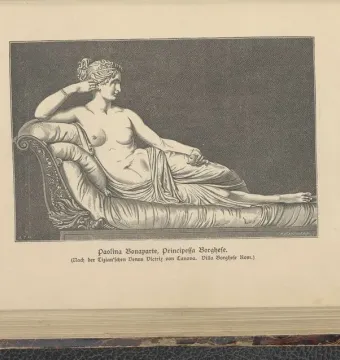
© Frédéric Masson · Public domain
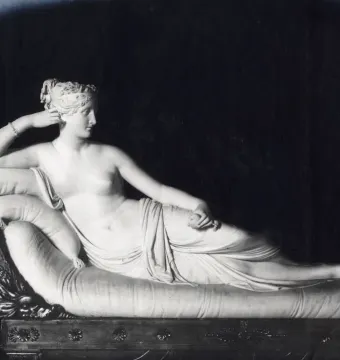
© Unknown authorUnknown author · Public domain
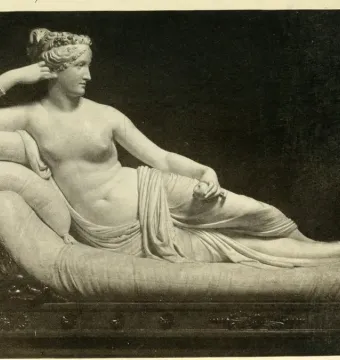
1909 © Internet Archive Book Images · No restrictions
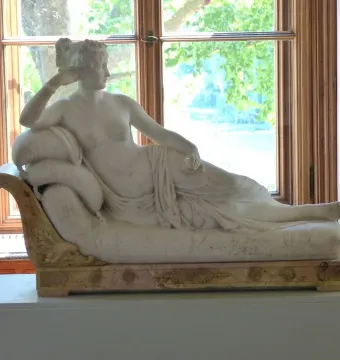
July 2014 © Wolfgang Sauber · CC BY-SA 4.0
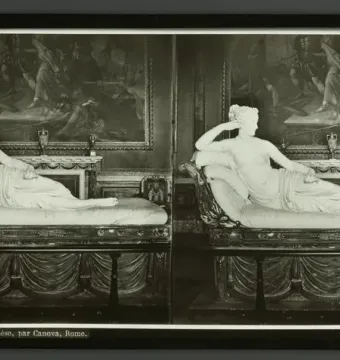
© Rijksmuseum · CC0
Identification | |
| Title | Venus Victrix |
| Translation of title | Venus Victorious |
| Type | Marble neoclassical portrait sculpture |
| Subject | Pauline Bonaparte |
| Iconographic subject | Venus Victrix (Venus/Aphrodite as victor) |
| Alternative titles | Pauline Bonaparte as Venus Victrix; Pauline Borghese as Victorious Venus; Vénus Vencedora; Venus the Victorious; Venus Borghese |
Historical context | |
| Style | Neoclassical |
| Commission date | 1804 |
| Commission purpose | To celebrate Pauline Bonaparte's marriage to Camillo Borghese |
| Historical artistic references | Ancient Roman practice of portraying mortals in the guise of deities; reclining portraits associated with Hermaphroditus; portraits of high-ranking sitters normally shown with strategic drapery; classical models including Correggio's Danaë, Titian's Venus of Urbino, and Giorgione's Sleeping Venus |
Creator | |
| Work process | Canova designed the composition and finished the work himself; intermediate stages and rough carving were carried out by workshop assistants |
| Artist | Antonio Canova |
| Workshop location | Rome, San Giacomo in Augusta, opposite the hospital |
| Artist nationality | Italian |
Discovery and provenance | |
| Removal from display | In 1820 Camillo Borghese had it removed and locked in a chest |
| Related work | Galatea, probably by Antonio Canova, for which Pauline Bonaparte is also said to have posed |
| Copy location | Embassy of the United Kingdom in France |
| Plaster version location | Gipsoteca Canoviana, Possagno |
| Current location | Galleria Borghese, Rome |
| Arrival at current location | 1838 |
| Reason for removal | To stop the servants' unauthorized paid entrance business and to maintain good relations with the papal court |
| Payment | 6,000 scudi |
| Subsequent locations | Genoa; later Palazzo Borghese in Campo Marzio, where it was displayed until 1820 |
| Original installation | Camillo Borghese's residence in Turin |
| Completion date | 1808 |
| Execution place | Rome |
| Work started | 1804, when Pauline began posing |
| Commissioner relationship | Her husband |
| Commissioned by | Camillo Borghese |
Physical characteristics | |
| Attribute | An apple |
| Base mechanism | Originally had a rotating mechanism for viewing from all angles |
| Base | Wooden base draped like a catafalque |
| Pose | Reclining on a couch |
| Anatomical treatment | The head is a relatively realistic portrait of Pauline Bonaparte, while the torso is neo-classically idealized |
| Nudity | Semi-nude; the sculpture presents an integral nude, but it is debated whether Pauline Bonaparte actually posed naked |
| Scale | Life-size |
Materials | |
| Primary material | Marble |
| Surface finish | Waxed and highly polished; the sheen also comes from the fine quality of the marble |
Appearance | |
| Viewing conditions | Designed to be admired by candlelight |
Iconography and meaning | |
| Mythological meaning | The apple evokes Aphrodite's victory in the Judgement of Paris |
| Additional interpretation | May also allude to the Borghese family's claimed descent from Venus through Aeneas, founder of Rome |
| Initial intended identity | Diana, the chaste goddess of hunting and virginity |
| Pauline's response to Diana identification | She laughed and said nobody would believe she was a virgin |
History and restoration | |
| Damage aftermath | The tourist was identified by the Carabinieri using surveillance images and agreed to pay restoration costs |
| Damage to plaster copy | The right foot, especially the big toe, was damaged by a tourist in August 2020 while taking a selfie |
| Restoration | Restored in 1996; the waxed surface was also recently restored |
| Study drawing focus | Another drawing explores the relationship between Venus-Pauline, the chaise longue, and the mattress |
| Study drawing variant | One drawing shows Pauline raising her left arm over her head |
| Preparatory drawings | Four preparatory study drawings survive |
Significance | |
| Artistic effect | Noted for its excessive sensuality |
| Social context | Nude portraits of high-ranking subjects were unusual at the time |
| Post-Napoleonic interpretation | After Napoleon's fall the work was seen as decontextualized and, because it celebrated the Bonapartes, lost legitimacy after Waterloo |
Other | |
| Sitter's age when posing began | 25 years old |
| Sitter's status at the time | At the height of her social splendor and holding the title of Imperial Highness |
| Artist-sitter relationship | Canova was often invited to the Borghese Palace and knew Pauline well |
| Anecdotal remark | Pauline reportedly joked that a stove or fireplace in the studio kept her warm; the anecdote may be apocryphal |
| Comparison work | Napoleon as Mars the Peacemaker (1806) |
Location and ownership | |
| Display context | Exhibited in Room I on the ground floor of Galleria Borghese, in the Hall of Helen and Paris / Stanza di Elena e Paride |
| Associated room decoration | The room has a ceiling painting by Domenico de Angelis dating to 1779, inspired by a relief on the façade of Villa Medici, and related to the Stories of Venus and Aeneas and the Judgement of Paris on Mount Ida |
| Former display context | At Palazzo Borghese in Campo Marzio it was illuminated in the evening by tallow torches; the mattress still bore traces of this |