
Obelisk at Slottsbacken
Obelisk at Slottsbacken is an obelisk monument beside the Royal Palace on Slottsbacken in Stockholm’s Old Town, considered the centre point of the Swedish capital. Commissioned by King Gustav III, it commemorates the deeds of Stockholm’s citizenry during the Russo-Swedish War of 1788–1790. The neo-Egyptian design was made by Louis Jean Desprez and the monument was erected in 1800 by Jonas Lidströmer. After severe deterioration, the original obelisk was dismantled in 2017 and rebuilt with newly quarried Bohus granite, with the final top piece installed in June 2020.
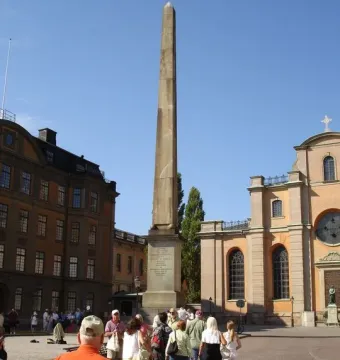
August 2006 © Jim G · CC BY 2.0
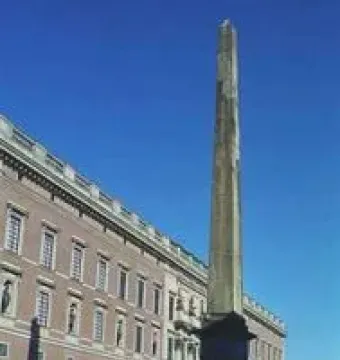
© Nike George · CC BY-SA 3.0
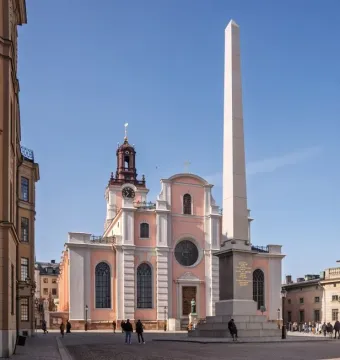
March 2025 © ArildV · CC BY-SA 4.0
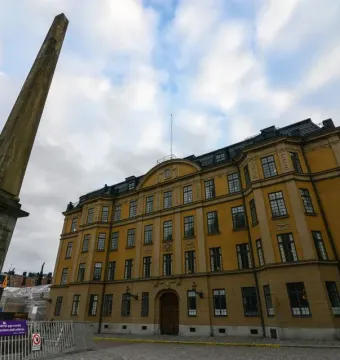
© Jorge Láscar · CC BY 2.0
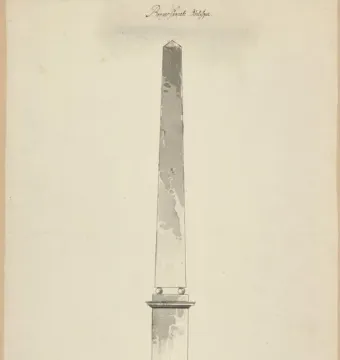
January 1790 © Unknown authorUnknown author · CC0
Identification | |
| Title | Obelisk at Slottsbacken |
| Type | Obelisk monument |
Historical context | |
| Year erected | 1800; according to other sources, 1799 |
| Street-number significance | All street numbers in Stockholm have their common origin from the obelisk, with a few exceptions |
| Exception to street-number origin | Some small streets originate from Birger Jarlsgatan |
| Unveiling date | October 1800 |
| Unveiled by | King Gustav IV Adolf |
| Designer | Louis Jean Desprez |
| Purpose | To thank the citizens of Stockholm for their support while the king was leading the Swedish Navy and Army in the war |
| Ordered to commemorate | the deeds of Stockholm's citizenry during the Russo-Swedish War of 1788–1790 |
| Decision to build | 27 January 1792 |
| Commissioned by | King Gustav III |
Creator | |
| Erected by | Jonas Lidströmer |
| Erected by | Jonas Lidströmer, inventor and colonel-mecanicus |
Materials | |
| Original material | Stone |
| Original granite source | Believed to have been quarried in nearby Ulfsunda |
| New material | Bohus granite |
| New stone type | Tossene Grå Bohus |
| New stone source | An area near Hunnebostrand; delivered from one of Hallindens Granit's quarries |
| Processing company | Zaarstone, Vilshult |
Physical characteristics | |
| New construction | Built from solid stone rather than stone drums |
| New weight | 280 tons |
| Original height | Nearly 22 meters, including a pedestal of unspecified height |
| Original construction | Made of 17 granite pieces |
| Height | 22 meters |
| Original weight | 150 tons |
Technique | |
| Construction method | Made of many heavy stone boulders rather than cut from one piece, unlike the typical method in classical antiquity |
Appearance | |
| Design style | Neo-Egyptian |
Location and ownership | |
| Location | Slottsbacken, Gamla Stan, Stockholm, Sweden |
| Location | Adjacent to the Royal Palace at the western end of Slottsbacken, in the northern part of the old town |
| Nearby building to the west | Sankt Nikolai Church |
| Geographic significance | Considered to be the very centre point of the Swedish capital city |
History and restoration | |
| Assessment after removal | The stones were so damaged they could not be repaired |
| Capstone installed | 17 June 2020 |
| Rebuilt | Spring 2020 |
| Reconstruction began | April 2020 |
| Condition in 2012 | In poor condition, with significant deterioration from water entering cracks and joints and causing frost damage |
| Repair estimate | About one year |
| Reason for dismantling | Repair and restoration work after age- and weather-related damage |
| Dismantled | June 2017 |
| Safety measure in 2012 | The area around the monument was fenced off to protect the public from possible falling stones and collapse |
Significance | |
| Commemorated event | The Swedish-Russian War of 1788–1790 |
| Purpose | To show gratitude to the burghers of Stockholm who guarded the city during the war |