
Sakuntala by Camille Claudel
Sakuntala is a sculpture by French artist Camille Claudel, created in several versions and media beginning in 1886. It depicts a young couple, with a man kneeling and embracing a woman who leans toward him. The work takes its name from Kālidāsa’s fourth- to fifth-century play Shakuntala and is inspired by the moment when Shakuntala reunites with her husband Dushyanta after a long separation. A terracotta study from around 1886 is in the Musée d’Orsay in Paris, and a finished plaster version from 1888 is in the Musée Bertrand in Châteauroux. A marble version completed in 1905, renamed Vertumnus et Pomona, is in the Musée Rodin in Paris, and bronze casts from 1905 were made for Eugène Blot under the title L'Abandon.
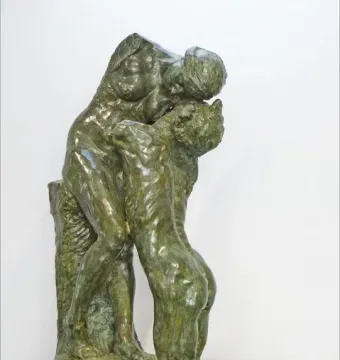
August 2018 © Jean-Pierre Dalbéra · CC BY 2.0
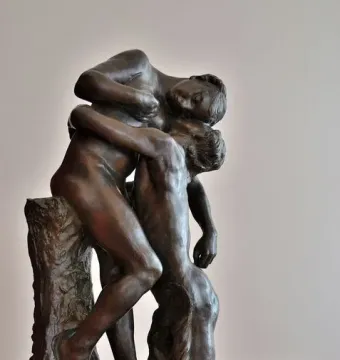
© Patrick · CC BY-SA 2.0
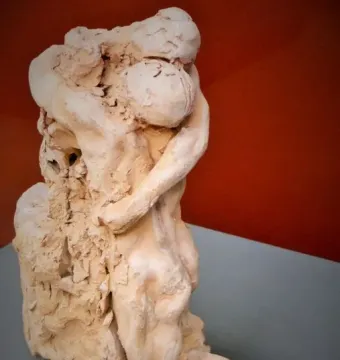
June 2018 © Ibex73 · CC BY-SA 4.0
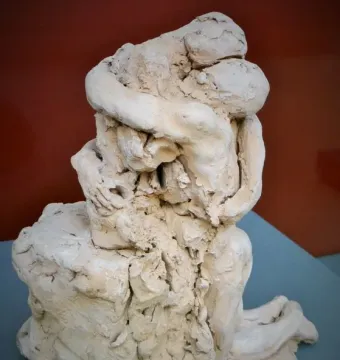
June 2018 © Ibex73 · CC BY-SA 4.0
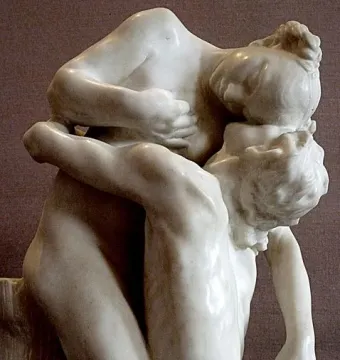
© photographed by uploader. Sculpture is by Camille Claudel · Public domain
Identification | |
| Title | Sakuntala |
| Plaster version | 1888; Musée Bertrand, Châteauroux |
| Marble version | 1905; Musée Rodin, Paris |
| Bronze version | From 1905; made for Eugène Blot and shown at the Autumn Salon under the title L'Abandon |
| Alternative titles | Sakountala; Çacountala; Vertumnus et Pomona; L'Abandon |
| First designs | Two terracotta designs made in 1886 |
| Terracotta study | Around 1886; Musée d'Orsay, Paris |
| Type | Sculpture / sculpted group |
Creator | |
| Related later work | From the female figure of Śakuntalā, Claudel later created her Niobid |
| Artist | Camille Claudel |
| Artist nationality | French |
Historical context | |
| Inspiration | Kālidāsa's Shakuntala, an ancient Indian drama |
| Third design date | Circa 1887/88 |
| Autobiographical cycle | The work inaugurates a cycle of works described as autobiographical and based on literary, mythological, or symbolic references |
| Versions | Created in several versions between 1886 and 1905, in different media |
| Date first created | 1886 |
| Narrative source | The reunion of Śakuntalā and her husband Dushyanta after a long separation |
| Second version exhibition | Salon of 1888 |
| Third design status | Lost |
Physical characteristics | |
| Style and emotional quality | The figures are stretched toward one another in an intense, profound emotion; the style is expansive and intimate |
| First design dimensions | 22 × 19 × 12 cm and 17 × 14 × 12 cm |
| Figure description | The king kneels, raises his head toward Śakuntalā, stretches toward her, and holds her at the waist; Śakuntalā bends toward him, yields to tenderness, and rests her head on his head |
| Depicted figures | Śakuntalā and the king Dushyanta |
| Subject | A young couple: a kneeling man embracing a woman leaning toward him |
| Original scale | Life-size |
| Depicted moment | The moment when the lovers reunite and embrace |
Materials | |
| Third design material | Probably clay or plaster |
| Final sculpture material | Patinated plaster |
| Bronze material | Bronze |
| Later material | Marble |
| Second version material | Plaster |
| Original material | Terracotta |
Technique | |
| Marble finish | Polished surface |
| Bronze casting | Cast by Eugène Blot |
History and restoration | |
| Re-display | Displayed again at the museum in 1995 |
| Donation | Donated in 1895 to the Musée Bertrand, Châteauroux |
| Neglect and rediscovery | Left in damp storage, rediscovered in 1975 by Jacques Cassar, then restored |
| Second version reception | Awarded an honorable mention at the Salon of 1888 |
Location and ownership | |
| Current location | Musée Bertrand, Châteauroux |
Significance | |
| Artistic significance | One of Camille Claudel's first major masterpieces; it brought her artistic recognition and inaugurated her own aesthetic, distinct from Rodin's |
| Reception | The marble version is described as the most accomplished and most admired version |
| Critical reception | L'Abandon has been described as one of the most famous and recognized masterpieces created by Camille Claudel |
| Interpretive note | The work has been said to reflect Claudel's own life |
Other | |
| Related personal context | Claudel arrived in Paris in 1882, began studying sculpture in 1882, worked with Auguste Rodin from 1884, separated from him after 1892, moved away in 1898, and opened her own studio in 1898 |