
Vargas Swamp Lancers
Vargas Swamp Lancers, also known as the Monument to the Lancers, is a monument by Colombian sculptor Rodrigo Arenas Betancur in Paipa, Boyacá, Colombia. It honors the Battle of Vargas Swamp, fought on July 25, 1819, and highlights the charge of the 14 lancers led by Colonel Juan José Rondón. Standing 33 meters tall, it was erected in 1969 to mark the sesquicentennial of Colombia’s independence. The structural design was by Guillermo González Zuleta. It was declared a National Monument in 1975 and later appeared on the reverse of a 1,000-peso Colombian banknote issued in 1987.
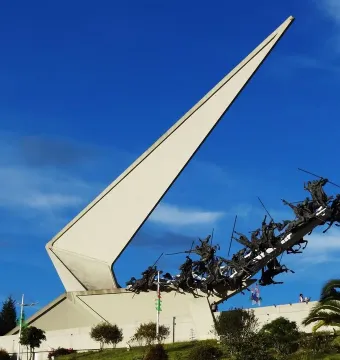
December 2012 © Petruss · CC BY-SA 3.0
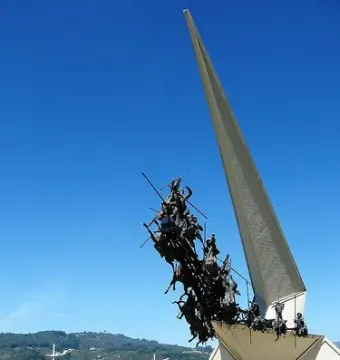
August 2012 © Juanseptimo VII · CC BY-SA 4.0
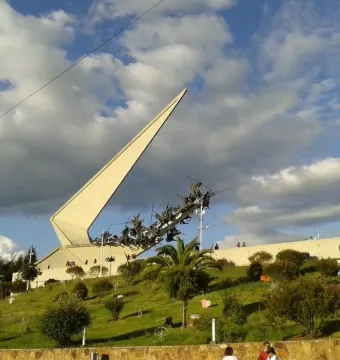
December 2013 © Jrdelacruz · CC BY-SA 3.0
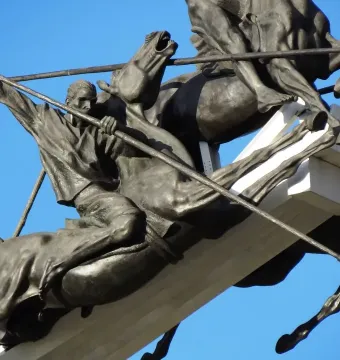
December 2012 © Petruss · CC BY-SA 3.0
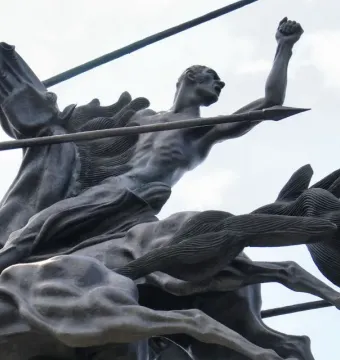
September 2012 © Martinduquea · CC BY-SA 3.0
Identification | |
| Title | Vargas Swamp Lancers |
| Type | monument; large sculptural complex |
| Alternative names | Lanceros del Pantano de Vargas; Monumento a los Lanceros; Monument to the Lancers; Monument aux Lanciers |
Creator | |
| Artist | Rodrigo Arenas Betancur |
| Engineer | Guillermo González Zuleta |
| Artist nationality | Colombian |
Discovery and provenance | |
| Location | At the site of the Battle of Vargas Swamp, Paipa, Boyacá Department, Colombia |
Historical context | |
| Dedicated to | The Battle of Vargas Swamp |
| Historical event commemorated | The Battle of Vargas Swamp, fought on 25 July 1819 |
| Historical context | The sculpture portrays the decisive counter-attack by the lancers of the Llano Arriba squadron during the Battle of Vargas Swamp, when Colonel Juan José Rondón led 14 lancers against Spanish horsemen on a narrow swampland track |
Iconography and meaning | |
| Number of lancers | 14; 15 including Rondón |
| Inocencio Chincá's fate | He was mortally wounded by Ramón Bedoya and died three days later |
| Inocencio Chincá's role | He killed Spanish Captain Ramón Bedoya with a lance thrust during the battle |
| Quoted rallying cry | Rondón: "Let the brave follow me!" |
| Quoted order | Bolívar: "Colonel, save the homeland!" |
| Named lancers | Captain Julián Mellado; Captain Valentín García; Captain Miguel Lara; Captain Domingo Mirabal; Captain Celedonio Sánchez; Lieutenant José de la Cruz Paredes; Lieutenant Rozo Sánchez; Lieutenant Pablo Matute; Lieutenant Pedro Lancheros; Sub-lieutenant Bonifacio Gutiérrez; Sub-lieutenant Saturnino Gutiérrez; Sub-lieutenant Miguel Segovia; Sub-lieutenant Pablo Segovia; Sergeant José Inocencio Chincá |
| Battle outcome | The lancers’ counter-attack was a decisive point in winning the battle; after Bolívar’s main force supported them, Barreiro’s army fell back after suffering about 500 casualties |
| Depicted figures | Fourteen llanero horsemen on horseback in full charge |
| Terrain depicted | A narrow track through swampland |
| Weapons depicted | Lances |
| Depicted cavalry unit | The Llanero cavalry squadron of Llano Arriba |
| Opposing force | Spanish regular army commanded by Colonel José María Barreiro |
| Depicted army | The Republican army of Simón Bolívar |
| Commander depicted | Colonel Juan José Rondón |
| Subject depicted | The charge of the 14 lancers under Colonel Juan José Rondón |
Physical characteristics | |
| Steps | 36 steps in the concrete part |
| Weight of each horse | 3 tons each |
| Weight | Approximately 235 tons |
| Number of horses | 15 bronze horses |
| Dimensions | 100 m long, 30 m wide, 33 m high |
| Height | 33 m |
Materials | |
| Materials | Bronze, steel, and concrete |
History and restoration | |
| Construction date | 1969 |
| Dedication date | 1970 |
| Dedication occasion | 150th anniversary of the Colombian Declaration of Independence |
| Reason for erection | Built for the sesquicentennial (150th anniversary) of independence |
| National monument status | Declared a National Monument by Decree 1744 of 1 September 1975 |
Significance | |
| Claimed distinction | Largest monument in Colombia |
| Depiction on currency | Its image appeared on the reverse of a series of 1,000 Colombian peso banknotes released in 1987 |
| Symbolic meaning of steps | The 36 steps commemorate Simón Bolívar being 36 years old on the day of the battle |