
The Goat Amalthea with the Infant Jupiter and a Faun
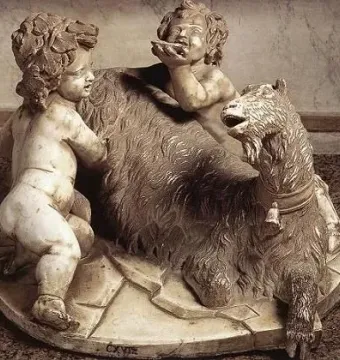
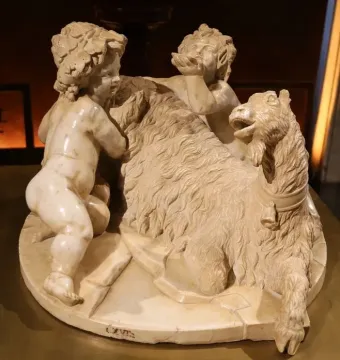
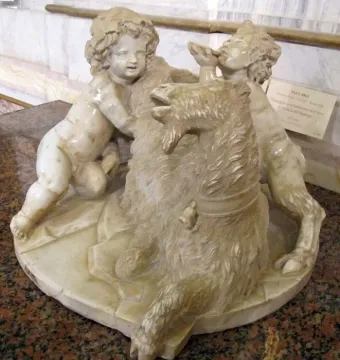
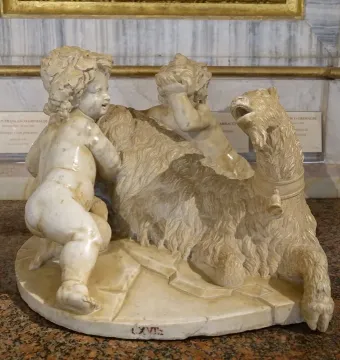
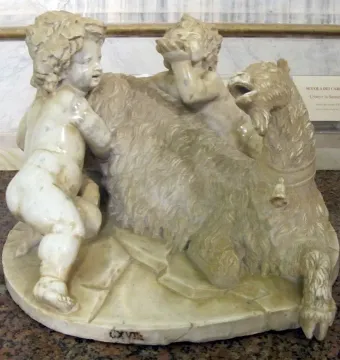
The Goat Amalthea with the Infant Jupiter and a Faun is the earliest known work by the Italian artist Gian Lorenzo Bernini. Made between 1609 and 1615, it is now part of the Borghese Collection at the Borghese Gallery in Rome. The sculpture belongs to a series of marble putti groups attributed to Bernini and is the only one that can be dated approximately. According to Filippo Baldinucci, Bernini had already shown remarkable talent as a child. In 1615, a carpenter was paid to provide a wooden base for the group, and some writers date the work to 1609 based on stylistic evidence and interpretation of the dated pedestal.
· CC BY-SA 3.0
December 2017 © Sailko · CC BY 3.0
© Sailko · CC BY 3.0
April 2019 © Daderot · Public domain
June 2014 © Sailko · CC BY 3.0
Identification | |
| Title | The Goat Amalthea with the Infant Jupiter and a Faun |
| Original title | La Chèvre Amalthée avec Jupiter enfant et un faune |
| Other title | Giove bambino e un fauno nutriti dalla capra Amaltea |
| Type | Marble sculpture group |
Creator | |
| Artist | Gian Lorenzo Bernini |
| Artist nickname | Le Bernin |
| Artist nationality | Italian |
| Attribution | Attributed to Gian Lorenzo Bernini; attributed by Roberto Longhi in 1926 |
Historical context | |
| Dating basis | Stylistic grounds and the interpretation of a 1615 invoice for the wooden pedestal |
| Date | Probably around 1609; generally dated between 1609 and 1615, with some writers proposing 1615 |
| Career status | Earliest known work by Bernini |
| Context of commission | One of Bernini's early works made under Cardinal Borghese's patronage for the villa gardens |
| Patron | Cardinal Borghese, nephew of Pope Paul V |
Discovery and provenance | |
| Original location | Lanfranco's loggia |
| Later location | Villa Borghese, Rome |
| Current ownership | Borghese Collection |
Location and ownership | |
| Current location | Galleria Borghese, Rome |
History and restoration | |
| Pedestal | A wooden pedestal was made in 1615; some writers think it replaced an earlier base |
| Relocation | Moved to the Villa Borghese at the end of the 18th century by Antonio Asprucci |
| Protection and return | Safeguarded by Napoleonic troops and later returned to its place of origin |
| Public presentation | Presented to tourists in 1997 |
Physical characteristics | |
| Height | 45 cm |
Materials | |
| Material | Marble |
| Pedestal material | Wood |
Technique | |
| Surface treatment | Different finishes in the marble create varying tactile, luminous, and chromatic effects |
Appearance | |
| Depiction of materials | The goat's fur, the children's skin, and the milk are rendered with contrasting finishes and luminosities |
| Style | Naturalism and liveliness inspired by Hellenistic art |
| Realism | Expressive, realistic treatment of matter and its variations |
Iconography and meaning | |
| Setting | Near Mount Ida |
| Figures depicted | Amalthea the goat, the infant Jupiter, and a faun |
| Allegory of hearing | The goat's bleating and the bell around its neck |
| Allegory of taste | The satyr drinking from the shell |
| Allegory of touch | The milking of the infant Jupiter |
| Allegory of sight | The play of gazes |
| Allegorical interpretation | Amalthea is also interpreted as an allegory of the four senses |
| Mythological background | Rhea hid Jupiter from Cronus; Amalthea nourished him near Mount Ida |
| Subject | The infant Jupiter, the goat Amalthea, and a faun |
Significance | |
| Status in Bernini's oeuvre | One of Bernini's first sculptures and one of three surviving marble groups of putti attributed to him |
| Artistic interpretation | Seen as an early work that already shows the qualities that later made Bernini famous |
| Theme in Bernini's early work | Part of Bernini's repeated early interest in putti and imitation of nature |
Other | |
| Authorship note | Some sources say the work may have been created with the help of Bernini's father |
| Uncertainty about date | The exact date is uncertain; the work is only approximately dateable |
| Early attribution history | For some periods it was thought to be an ancient original because of its style |
| Earlier rumour about authorship/date | Some rumours placed its creation between ages 8 and 12, but this is rejected as false |