
El Caballito
El Caballito is a bronze equestrian statue of Charles IV of Spain, designed by sculptor and architect Manuel Tolsá and located in Mexico City. The project was initiated by Miguel de la Grúa Talamanca, Marquis of Branciforte, then viceroy of New Spain. The statue was cast in one piece under Tolsá’s supervision, using 450 quintals of bronze, near the temple of Saints Peter and Paul. It was inaugurated on 8 December 1803, after a temporary wooden and gilded stucco figure had stood on the pedestal. After Mexican independence, the statue was nearly destroyed but was preserved by Lucas Alamán and moved several times before being placed in 1979 in its current location, in front of the Palace of Mining.
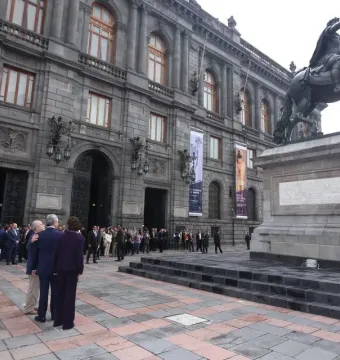
June 2017 © Gobierno CDMX · CC0
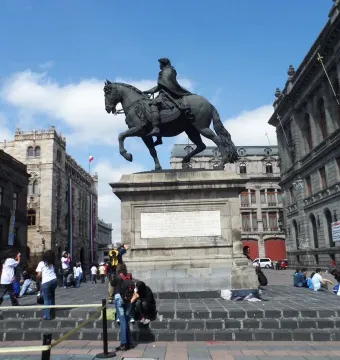
September 2012 © Melssmm · CC BY-SA 3.0
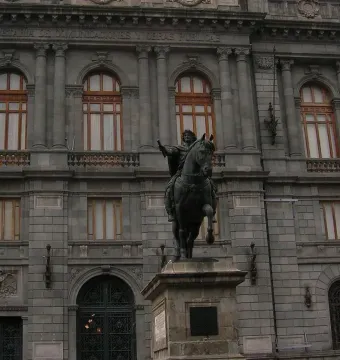
August 2006 © JonathanVitela · CC BY 2.0
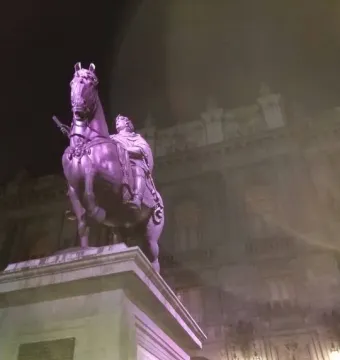
September 2022 © PetrohsW · CC BY-SA 4.0
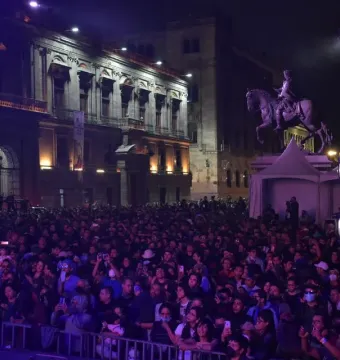
March 2022 © Secretaría de Cultura CDMX · CC BY 2.0
Identification | |
| Name | Equestrian Statue of Charles IV |
| Subject | Charles IV of Spain |
| Title | El Caballito |
| Type | Equestrian statue |
Creator | |
| Artist | Manuel Tolsá |
| Artist role | Sculptor and architect; director of the Academy of San Carlos |
Historical context | |
| Dedication | In honour of King Charles IV of Spain, the last ruler of New Spain before Mexican independence |
| Commission initiator | Miguel de la Grúa Talamanca, Marquis of Branciforte, Viceroy of New Spain |
| Construction period | 1796–1803 |
| Construction permission | Granted before construction began |
Discovery and provenance | |
| Temporary statue | A temporary wooden and gilded stucco statue representing the Spanish monarch |
| Pedestal inauguration | Inaugurated with popular festivities and bullfights |
| Pedestal inauguration date | 8 December 1796 |
| Site preparation | The Plaza Mayor (today the Zócalo) was cleared and fitted with an elliptical balustrade with four entrance gates for the monument project |
| Place of creation | Mexico City, Mexico |
| Initial location | Plaza Mayor (Plaza de la Constitución, or the Zócalo), Mexico City |
Materials | |
| Primary material | Bronze alloy |
| Temporary statue materials | Wood and gilded stucco |
| Horse model | Tambor, a horse owned by the Marquis of Jaral del Berrio |
Technique | |
| Casting method | Horse and rider were cast together in a single pour under Tolsá's supervision |
| Casting location | Near the Church of St. Peter and St. Paul; also identified as Colegio de San Gregorio |
| Bronze used | About 450 quintals of bronze alloy (1 Castilian quintal = 46 kg) |
| Finishing work | Removal of casting tubes, corrections, smoothing, fine chiseling, and application of a green painted layer over 14 months by skilled craftsmen, including Tolsá's apprentices |
Physical characteristics | |
| Construction details | The base, sword, and some ornamental elements were added later by mechanical fittings and joints |
| Original finish | Green painted surface layer |
| Weight | About 13 tonnes |
| Size rank | Second largest surviving copper-alloy statue cast in a single operation in the world |
Appearance | |
| Symbolic mark | An Aztec quiver mark beneath the hoof, perhaps indicating allegiance to Spain |
| Associated smaller version | A smaller, slightly different version is displayed in the Tolsá Museum opposite the statue |
Location and ownership | |
| Current location | Plaza Manuel Tolsá, in front of the Palace of Mining, Mexico City, Mexico |
| Current location since | 1979 |
| Previous locations | The courtyard of the ancient university; the intersection of Paseo de la Reforma and Paseo de Bucareli |
| Protection at previous location | It was protected by a grille at the Paseo de la Reforma and Bucareli site |
| Current plaque | Mexico preserves the statue only as a monument of art, not as praise to a Spanish king |
History and restoration | |
| Work stoppage | INAH stopped the work on 20 September 2013 |
| 2017 re-exhibition | The sculpture was shown again in an official ceremony on 28 June 2017, after remaining covered by scaffolding for much of the restoration period; a time capsule deposited in the 1970s was found during the work |
| 2016 condition and results | At the start of the works, about 45% of the original surface layer had been lost and the surface was unstable; dust, soot, rain runoff, soluble corrosion products, graffiti, detachments, loss of elements, and moisture stains were present; about 46.5 m² were cleaned over nearly six months, around 25.5 m² were not damaged in 2013, and about 13 m² of green pictorial layer were recovered |
| 2016 conservation decisions | The project treated the work as a dialogue with the sculpture and preferred 'surface layer' over 'patina'; wax and asphalt were removed, artificial patination was rejected, and a system of artificial coatings was designed and applied after analysis and experimentation |
| 2016 findings | A green painted layer of original origin was found beneath grime, wax, and asphalt; 85 stratigraphic tests and more than 60 samples were analyzed by Javier Vázquez, a specialized chemist |
| 2016 studies | Three-dimensional laser scanning, infrared and ultraviolet photography, ground-penetrating radar, ultrasound, colorimetry, millimetric surface observation, surface cleaning tests, stratigraphic sampling, sample analysis, mass spectrometry with inductively coupled plasma, infrared spectrometry, gas chromatography, electrochemical evaluation, and X-ray fluorescence spectrometry |
| 2016 restoration project | A new diagnosis and restoration project began in May 2016 under INAH supervision, involving the INAH, the Government of Mexico City, and FCHCDMX, with conservation-restoration, history, experimental science, engineering, and anthropology teams |
| Current commemorative interpretation | The plaque frames the statue as a monument to art and as testimony to the old controversy surrounding it |
| 2013 damage | About 50% of the stable surface layer was removed; the pedestal stone partially dissolved and was stained by dissolved copper |
| 2013 unauthorized intervention | In May 2013 the Government of the Federal District authorized a restoration project, but the contractor worked without INAH authorization and used a nitric acid solution that removed dirt, surface material, the protective patina, and part of the bronze alloy |
| 2013 condition | Dirty and cracked, with environmental exposure and previous interventions having caused loss of historical and technological information; the surface and pedestal were deteriorated |
| Relocation history | Moved in 1822 to the courtyard of the ancient university to prevent destruction, made publicly accessible there in 1824, moved in 1852 to the intersection of Paseo de la Reforma and Avenida Bucareli, and moved to Plaza Manuel Tolsá in 1979 |
| Post-independence controversy | After Mexican independence, there were calls to destroy the statue because of anti-Spanish sentiment; it was covered in a blue tent in 1821 and later saved by Lucas Alamán, who persuaded Guadalupe Victoria to preserve it for its aesthetic qualities |
| Reception | Alexander von Humboldt said it was second only to the Marcus Aurelius statue in Rome for this genre; it was considered one of Manuel Tolsá's finest achievements |
| Inauguration | The statue was moved to its designated place and unveiled with celebrations and bullfights; Alexander von Humboldt attended |
| Inauguration date | 9 December 1803 |
Significance | |
| Historical note | Larger cast bronze statues existed, but they were destroyed |
| Comparative assessment | For this genre, Humboldt ranked it just below the equestrian statue of Marcus Aurelius in Rome |
Other | |
| Work attribution | The text attributes the work to Tolsá and his team |