
Apollo and Daphne
Apollo and Daphne is a marble sculptural group created in 1622 by Baroque artist Bernini for Cardinal Scipione Caffarelli-Borghese, who commissioned it to decorate his villa. The work remains there today and is regarded as one of the great artistic wonders of the Baroque period. It is now preserved in the Borghese Gallery in Rome, alongside several other major early works by the artist. The sculpture depicts the climactic moment of the story of Apollo and Daphne as told in Ovid’s Metamorphoses, in which the nymph Daphne escapes Apollo’s advances by transforming into a laurel.
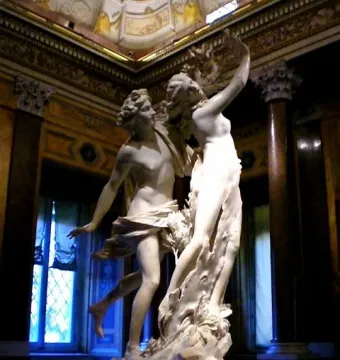
1622 © Gian Lorenzo Bernini · CC BY-SA 3.0
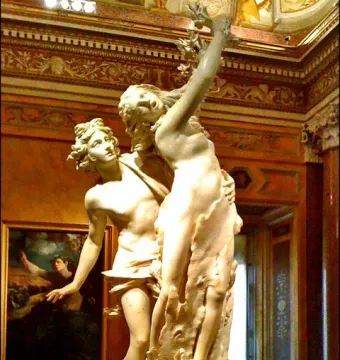
June 2011 © Jean-Pierre Dalbéra · CC BY 2.0
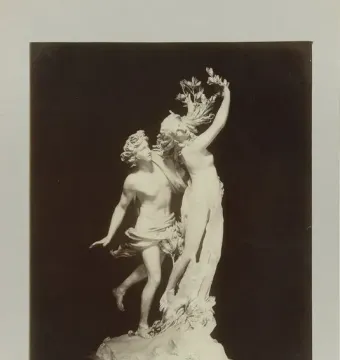
© Rijksmuseum · CC0
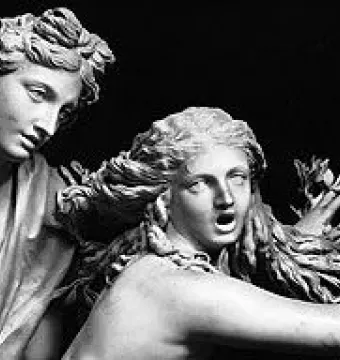
October 2012 © LenaKronberg · CC BY-SA 3.0
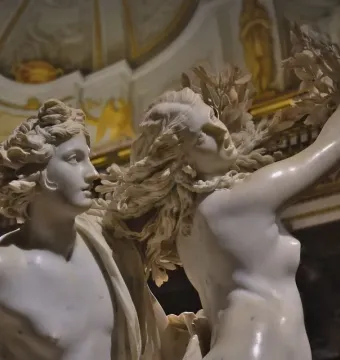
© User:Jorganes · CC BY-SA 4.0
Identification | |
| Title | Apollo and Daphne |
| Type | life-sized marble sculptural group |
| Style | Baroque |
| Original title | Apollo i Dafne |
Creator | |
| Artist | Gian Lorenzo Bernini |
| Artist nationality | Italian |
| Artist life dates | 1598–1680 |
| Collaborator | Giuliano Finelli |
| Collaborator origin | Carrara |
Historical context | |
| Part of commission | The last of four sculptural groups commissioned by Cardinal Scipione Borghese |
| Related works in commission | Aeneas, Anchises and Ascanius; The Rape of Proserpina; David |
| Commissioned by | Cardinal Scipione Caffarelli-Borghese |
| Commissioned for | the cardinal's villa |
| Date of creation | 1622–1625 |
Discovery and provenance | |
| Original placement | Villa Borghese |
| Current location | Galleria Borghese, Rome |
| Installation date at current location | September 1625 |
Physical characteristics | |
| Height | 243 cm |
| Scale | life-size |
Materials | |
| Material | marble |
Technique | |
| Assistant's contribution | Finelli carved the foliage, roots, leaves springing from Daphne's hands, and her windswept hair |
Appearance | |
| Preferred viewing angle | side view |
| Viewpoint effect | From the side, Apollo's and Daphne's reactions can be seen simultaneously |
Iconography and meaning | |
| Subject | Apollo and Daphne, the climax of the story in which Daphne escapes Apollo's advances by transforming into a laurel tree |
| Literary source | Ovid's Metamorphoses |
| Symbolism | Daphne symbolizes unattainable love and virginity |
| Inscription at base | A cartouche at the base bears a moralizing couplet by Maffeo Barberini, later Pope Urban VIII |
| Inscription meaning | Whoever loves and pursues the joys of fleeting beauty fills the hand with leaves and plucks bitter berries |
| Purpose of inscription | To give a Christian moral meaning to a pagan subject and justify the sculpture's presence in the Borghese collection |
History and restoration | |
| Completion date | Autumn 1625 |
| New base | A new base with a second sculpted parchment in the form of an eagle, by Lorenzo Cardelli |
| Location change | At the end of the 18th century, Antonio Asprucci moved the sculpture to the center of the room and installed it on a new base; the room became the Hall of Apollo and Daphne |
| Work interrupted | Summer 1623 |
| Work resumed | April 1624 |
| Reason for interruption | Bernini paused work to finish David after Cardinal Alessandro Peretti died and the commission passed to Cardinal Borghese |
| Work began | August 1622 |
Significance | |
| Notability | One of Bernini's most famous works |
| Historical significance | Considered one of the artistic wonders of the Baroque period and one of the works that helped define Baroque sculpture |
| Reception | Immediately received an enthusiastic welcome and was celebrated as one of the young artist's most beautiful masterpieces |
| Later reputation | It remained highly regarded in Bernini's lifetime and was praised by later writers including Pierre Cureau de la Chambre, Filippo Baldinucci, Johann Joachim Winckelmann, and Leopoldo Cicognara |