
Ecstasy of Blessed Ludovica Albertoni
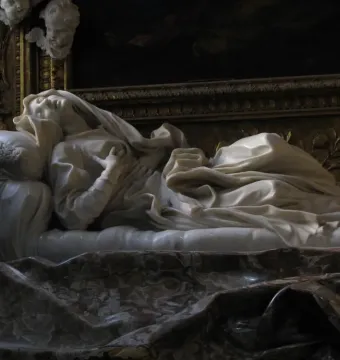
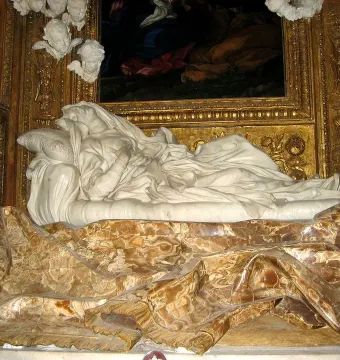
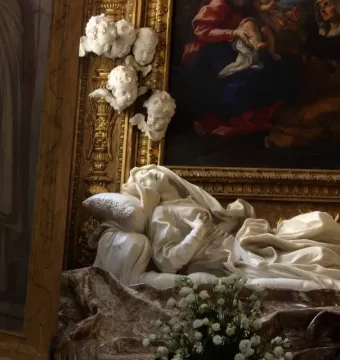
Ecstasy of Blessed Ludovica Albertoni is a late Baroque tomb monument by Gian Lorenzo Bernini, created for the church of San Francesco a Ripa in Rome. Commissioned by Cardinal Paluzzo Paluzzi degli Albertoni, it was made between 1671 and 1674 and installed on 31 August 1674. The work depicts Blessed Ludovica Albertoni in a state of religious ecstasy, awaiting the descent of the Holy Spirit. Carved from white Carrara marble with a red and white veined marble drapery over the sarcophagus, it is enhanced by colored marble, side sculptures, and dramatic light from a hidden window. The monument is often compared with Bernini’s Ecstasy of Saint Teresa and is considered one of his late masterpieces.
October 2009 © Yair Haklai · CC BY-SA 3.0
© Gian Lorenzo Bernini · CC BY-SA 3.0
July 2015 © Miguel Hermoso Cuesta · CC BY-SA 4.0
© Gep · Public domain
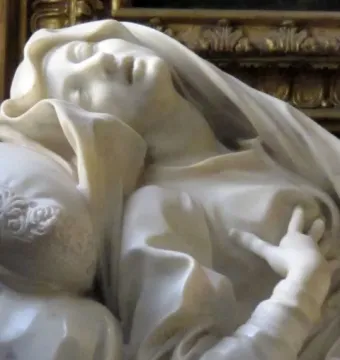
© Gian Lorenzo Bernini · CC BY-SA 2.0
Identification | |
| Title | The Ecstasy of Blessed Ludovica Albertoni |
| Alternative titles | Ecstasy of Blessed Ludovica Albertoni; Saint Ludovica Albertoni; Blessed Ludovica Albertoni; Beata Ludovica Albertoni; original Italian title: L'Estasi della beata Ludovica Albertoni |
| Type | Funerary monument |
Historical context | |
| Style | Baroque, specifically High Baroque |
| Execution date | 1671–1674 |
| Completion date | 1674 |
| Installation date | 31 August 1674 |
| Artist's age at start | About 70–71 years old |
| Historical significance | One of Bernini's last sculptures |
Creator | |
| Artist | Gian Lorenzo Bernini |
| Artist nationality | Italian |
Discovery and provenance | |
| Subject | Blessed Ludovica Albertoni |
| Religious observance date | 31 January |
| Veneration and beatification | Remembered for her piety during the Sack of Rome in 1527, her mystical visions and levitation, marked by the Roman Senate in 1606, named patroness of Rome in 1625, and beatified by Pope Clement X in 1671, who granted her the title of Blessed |
| Subject's burial year | 1533 |
| Subject's burial place | San Francesco a Ripa, Rome |
| Subject's religious life | Entered the Third Order of St. Francis after her husband's death and lived under the guidance of the Franciscan friars of San Francesco a Ripa |
| Subject's background | Born into a noble Roman family, educated as a Catholic, married Giacomo della Cetera in 1494, had three daughters, was widowed in 1506, gave up her property, became a Franciscan tertiary, and helped the needy while caring for the sick |
| Subject identity | Ludovica Albertoni, a Roman noblewoman (1473 or 1474, Rome – 31 January 1533, Rome) |
| Bernini's working conditions | Bernini accepted the project without pay while also working on the Tomb of Pope Alexander VII and the Altar of the Blessed Sacrament in St. Peter's Basilica, which delayed progress |
| Material purchase date | 7 February 1674 |
| Estimated execution time under revised chronology | About 6 months |
| Alternative proposed start | Late 1673, based on a record of Bernini buying white marble on 7 February 1674 |
| Work start date | 1671, though some historians doubt this and suggest a start in late 1673 |
| Commission context | After Ludovica Albertoni's beatification in 1671, the Altieri family decided to dedicate and renovate her chapel in San Francesco a Ripa; several artists competed for the work, and Bernini was awarded the commission |
| Commission year | 1671 |
| Commissioner's relation to subject | Distant relative and descendant of Ludovica Albertoni |
| Commissioned by | Cardinal Paluzzo Paluzzi degli Albertoni |
Physical characteristics | |
| Hidden windows | Two small vertical windows concealed in the rear wall and opening directly to the outside |
| Compositional effect | The narrow composition and lighting make the blessed woman appear to rise or levitate |
| Lighting | Raking light from the hidden windows illuminates the white statue and intensifies the mystical effect in the chapel's penumbra |
| Location | Altieri Chapel, Church of San Francesco a Ripa, Trastevere, Rome, Italy |
| Architectural setting | A stage-like architectural setting with two very inclined side walls and a set-back rear wall, framing the monument and creating a vault-like focus where there had previously been a wall |
| Chapel size | Very small |
| Chapel | Altieri Chapel, specially designed for this monument by Giacomo Mola in 1622–1625 |
| Placement within church | On the altar of the Altieri Chapel, in the left arm of the transept |
Materials | |
| Primary material | White Carrara marble |
| Secondary materials | Red marble with white veins; colored marble; jasper; gold; white stucco; alabaster; gilded bronze |
| Figure material | White Carrara marble |
| Sarcophagus covering material | Red marble with white veins |
| Sarcophagus material | Red marble |
Appearance | |
| Background painting | A canvas by Giovanni Battista Gaulli showing the Virgin Mary with the Child and Saint Anne, conceived as a paradisiacal vision in deliberate contrast to the sculpture |
| Surrounding figures and decoration | Several putti, sculpted cherub heads, and a high relief of stylized pomegranates behind her, with burning hearts decorating the base of the windows |
| Support beneath figure | She rests on deeply wrinkled fabrics laid over a marble bed, which in turn rests on a block of jasper worked to resemble drapery |
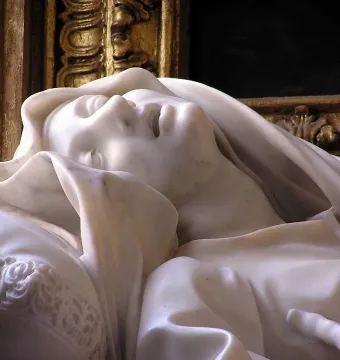
| Expression | Her face conveys intense agitation and mystical ecstasy |
| Drapery | Numerous naturalistic folds in her habit, with marble treated to appear flexible like wax and to create a light haze or vibration |
| Depicted pose | Ludovica Albertoni is shown reclining on a bed or mattress in a moment of mystical communion with God, with her head thrown back or bent and her eyes half-closed |
Iconography and meaning | |
| Subject depicted | Blessed Ludovica Albertoni in a state of religious ecstasy, awaiting the descent of the Holy Spirit |
| Theme | Christian ecstasy |
| Interpretation | A mystical vision that combines funerary lamentation with the theme of the Immaculata, and transforms heavy marble into a spiritual apparition |
| Lighting symbolism | The hidden light and white marble heighten the impression of a spiritual apparition or mystical transcendence |
| Artistic comparison | Often compared with Bernini's Ecstasy of Saint Teresa |
Location and ownership | |
| Current location | Church of San Francesco a Ripa, Rome, Italy |
| Custody | Kept in the church of San Francesco a Ripa in Rome |
History and restoration | |
| Restoration | Restored in 2019 by Elisabetta Zatti under the supervision of Aldo Mastroianni and Carlo Festa; the restoration covered the marble statue, gold background with reliefs, white stucco angels, and alabaster drapery with gilded bronze fringes |
Significance | |
| Style and character | Strong Baroque illusionism with highly naturalistic folds, sfumato-like marble treatment, and a scenographic effect similar to the Cornaro Chapel |
| Importance | Expresses the most incisive religious aspect of Bernini's late works |