
Theseus and the Minotaur
Theseus and the Minotaur, or Theseus over the Minotaur, is a sculptural work created by Antonio Canova between 1781 and 1783. It is displayed at the Victoria and Albert Museum in London, while the plaster model is preserved in the Canova Gypsotheca in Possagno. The subject comes from Ovid’s Metamorphoses and shows the Greek hero Theseus after killing the Minotaur, seated on the monster with his club in hand. Rather than depicting the violent struggle, Canova chose the moment after the conflict, emphasizing calm, restraint, and a neoclassical sense of noble serenity. The work also symbolizes the victory of reason over irrationality.
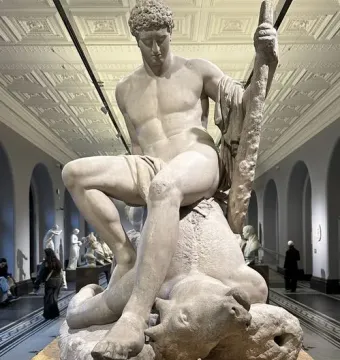
May 2026 © APK · CC BY 4.0
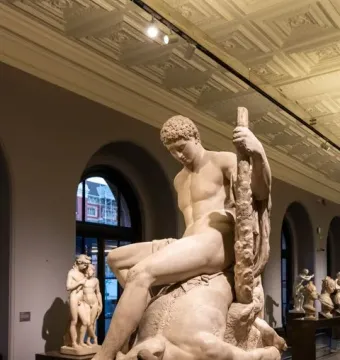
November 2025 © Mike Peel · CC BY-SA 4.0
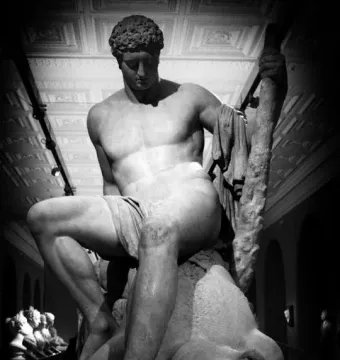
© Iza Bella · CC BY-SA 2.0 uk
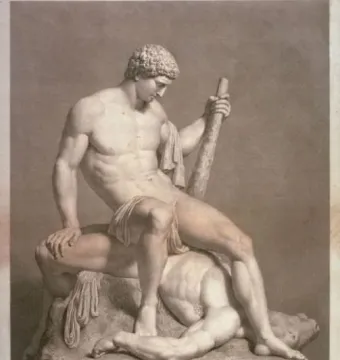
November 2016 © Raffaello Morghen · Public domain
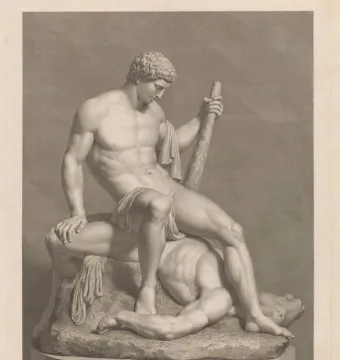
© Rijksmuseum · CC0
Identification | |
| Title | Theseus and the Minotaur |
| Italian title | Teseo e il Minotauro |
| Spanish title | Teseo y el Minotauro / Teseo sobre el Minotauro |
| Type | Sculptural work |
| Alternative title | Theseus over the Minotaur |
Creator | |
| Artist | Antonio Canova |
Historical context | |
| Subject chosen by | Girolamo Zulian, with the suggestion of Gavin Hamilton |
| Artist's career stage | One of Canova's earliest works after settling in Rome |
| Completion context | By the time the sculpture was completed, Zulian had left Rome for Constantinople and released the work to Canova |
| Commissioner's contribution | Provided the marble block |
| Commissioned by | Girolamo Zulian, Venetian ambassador to Rome and patron of Canova |
| Date created | 1781–1783 |
Provenance | |
| First recorded buyer | Count Moritz von Fries |
| First recorded buyer's residence transfer destination | Vienna |
| Next owner | Charles Vane, 3rd Marquess of Londonderry |
| Acquired by Charles Vane | Before 1822 |
| Installed at | Londonderry House, London |
| Installation date | Most likely in the 1820s |
| Remained at Londonderry House until | The house's contents were sold just before its demolition in the 1960s |
| Acquired by Victoria and Albert Museum | 1962 |
| Purchase price | £3,000 |
| Purchase support | One third of the price was provided by the National Art-Collections Fund |
Materials | |
| Plaster cast material | Plaster |
| Material | White marble |
Location and ownership | |
| Current location | Victoria and Albert Museum, London |
| Plaster cast location | Gipsoteca Canoviana, Possagno |
| Plaster model status | The plaster of the work is preserved at the Gipsoteca Canoviana in Possagno |
Iconography and meaning | |
| Subject | Theseus, helped by Ariadne, kills the Minotaur in the labyrinth of Crete, as told in Ovid's Metamorphoses |
| Depicted moment | Immediately after Theseus has killed the Minotaur |
| Depicted figure | Theseus, the Greek hero |
| Depicted monster | The Minotaur, a monstrous creature with the head of a bull and the body of a man |
| Ideological context | In harmony with Enlightenment thought |
| Allegorical meaning | Victory of reason over irrationality |
Appearance | |
| Contrast with earlier action | Theseus is shown after the fight, unlike the angry, furious state in which he killed the Minotaur |
| Minotaur pose | Lies on a rock in an inverted S-shaped position |
| Mood | Physical and spiritual calm, peace, and tranquillity |
| Theseus expression | Looks down at the defeated Minotaur with pity rather than hatred |
| Theseus pose | Seated, relaxed, and weary, with an uncontracted body |
| Composition | Theseus sits on the slain Minotaur like a hunter over prey; the Minotaur lies on a rock in an inverted S-shaped pose |
Style | |
| Artistic style | Neoclassical |
| Stylistic influence | Explicit reference to classical Greek and Hellenistic art, especially in the anatomical forms of Theseus |
| Theoretical reference | Responds to Winckelmann's idea of 'noble simplicity and quiet grandeur' as characteristic of Hellenistic art |
| Comparison with Baroque sculpture | Unlike Bernini and other Baroque sculptors, Canova avoids the bloody moment of combat and chooses the calm aftermath |
Significance | |
| Early reception | Early viewers thought it was a copy of a Greek original and were shocked to learn it was contemporary |
| Dissemination | Widely disseminated through an engraving by Raffaello Sanzio Morghen |
| Impact | Helped establish Canova's reputation |