
Michael Faraday Memorial
The Michael Faraday Memorial is a stainless steel, box-shaped structure designed by modern movement architect Rodney Gordon in 1959 and built in 1961. It stands on the centre of what was once the northern roundabout of the Elephant and Castle gyratory system in London. The memorial commemorates Michael Faraday’s importance as a scientist and was placed here because Faraday was born nearby in Newington Butts. Its interior contains a London Underground electrical substation for the Northern and Bakerloo lines. Originally intended to be clad in glass so the transformer workings could be seen, the design was changed to a metal casing to reduce the risk of vandalism. The monument was given Grade II listed building status in 1996.
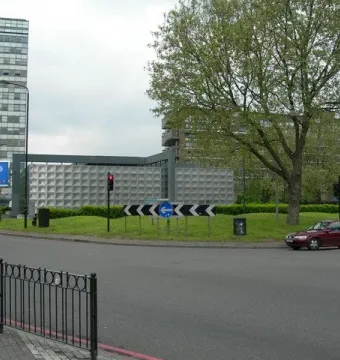
May 2006 © Danny Robinson · CC BY-SA 2.0
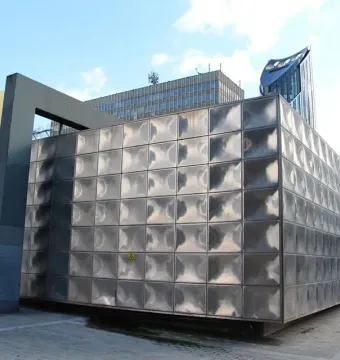
© Fred Romero · CC BY 2.0
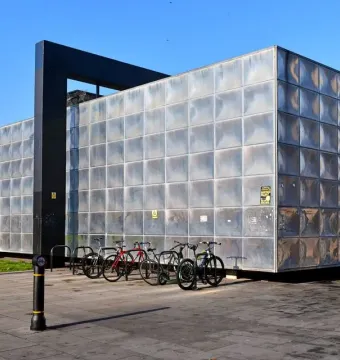
November 2019 © Images George Rex · CC BY-SA 2.0
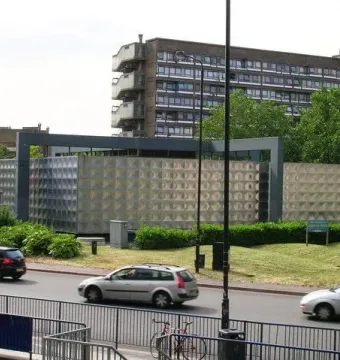
June 2006 © R Sones · CC BY-SA 2.0
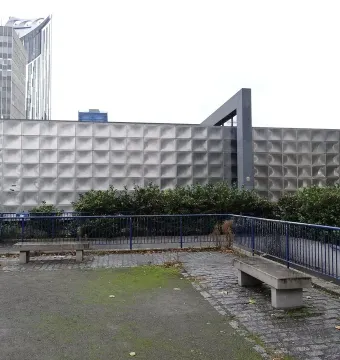
October 2012 © Randomly London · CC BY-SA 2.0
Identification | |
| Title | Michael Faraday Memorial |
| Type | Sculptural memorial / monument |
Historical context | |
| Design date | 1959 |
| Construction date | 1961 |
Creator | |
| Designer | Rodney Gordon |
| Designer style | Modern movement architect |
Location and ownership | |
| Substation relation | The memorial wraps around the building of a London Underground electrical substation serving the Northern line and the Bakerloo line |
| Nearby inscription | There is an inscription in the concrete paving nearby explaining that it is the Faraday Memorial |
| Placement reason | Michael Faraday's birthplace was nearby in Newington Butts |
| Purpose | To commemorate Michael Faraday's importance as a scientist |
| Location | Centre of the former northern roundabout of the Elephant and Castle gyratory system, Elephant and Castle, London |
Physical characteristics | |
| Interior use | Contains a London Underground electrical substation for the Northern line and Bakerloo line |
| Original design | A glass-clad box with glass side walls intended to allow the workings of the transformer to be seen |
| Form | Box-shaped structure in the form of a broken rectangular rod |
Materials | |
| Material | Stainless steel |
History and restoration | |
| Lighting update | In May 2012, the failed 16-year-old lighting scheme was replaced by Southwark Council with a new disco-themed lighting scheme that animates every evening after dark |
| Reason relocation changed | Regeneration plans evolved from retaining the roundabout to retaining the memorial in its current position by 'peninsulaising' it, making it easier to access |
| Relocation plans | Early-2000s plans to move the memorial 400 metres south-east to the Walworth Road next to the Cuming Museum, possibly as part of a proposed science museum, were shelved |
| Design change reason | The glass design was abandoned because of the risk of vandalism, and it was changed to a metal casing |
| Lighting scheme | A lighting scheme was designed in 1996 by a local schoolgirl from English Martyrs R.C. Primary School, as the result of a competition held by Blue Peter |
| Listing status | Grade II listed in 1996 |
Appearance | |
| Interpretive meaning | The wrapping form is meant to recall Faraday's achievements as a pioneer in the study of electricity |
| Omitted design features | Some aspects of Gordon's original design explaining the connection to Faraday were left out when it was constructed |
Significance | |
| Public recognition note | Few people realise why it is there |
Other | |
| Associated person | Aphex Twin (electronic musician) |
| Claim about the structure | In a 2001 interview, Aphex Twin satirically claimed to have bought the structure and lived inside it |
| Appearance in media | Briefly appears in the official video for Aphex Twin's 'T69 Collapse' |