
Preliminary Works for Saint Longinus
The preliminary works for Saint Longinus show how Giovanni Lorenzo Bernini developed the sculpture through a series of models and revisions. In the 1620s, the statue was one of four commissioned for the niches at the center of St. Peter’s Basilica in Vatican City. Bernini likely made an early bozzetto around 1631, now in the Fogg Art Museum at Harvard, though its design differs from the final statue. A later terracotta model in the Museum of Rome is closer to the finished work and is cut into sections that match the marble divisions. Bernini and his assistants probably created many more studies, including 22 small models recorded in 1635 and another group of eight sketches in Düsseldorf.
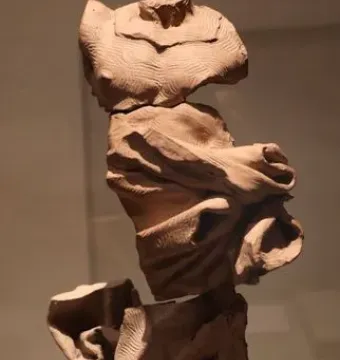
March 2023 © Francesco Bini · CC BY-SA 4.0
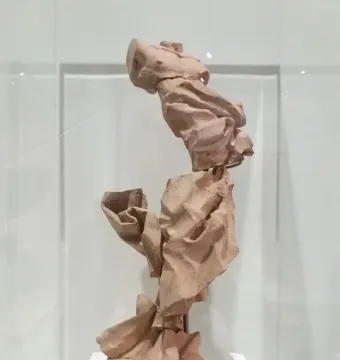
November 2019 © Romainbehar · CC0
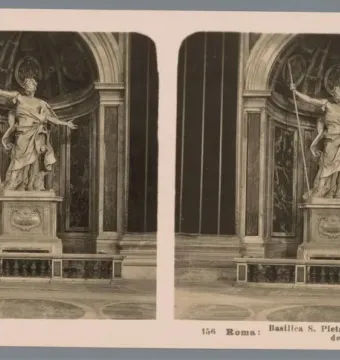
© Rijksmuseum · CC0
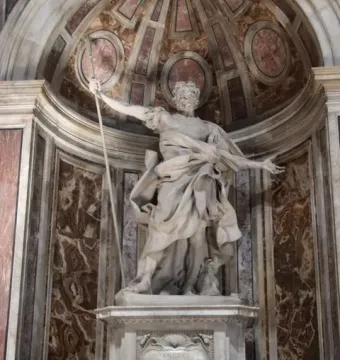
August 2019 © Gary Todd · Public domain
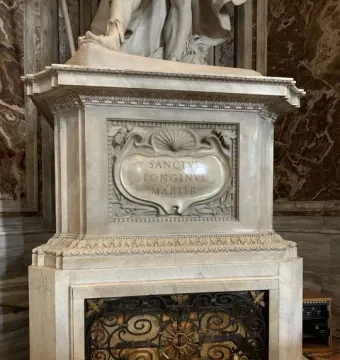
August 2021 © Chabe01 · CC BY-SA 4.0
Identification | |
| Title | Saint Longinus |
| Type | Sculpture |
| Original title | San Longino |
Historical context | |
| Subject | Saint Longinus, the Roman centurion who pierced Jesus Christ's side during the crucifixion and was later converted to Christianity |
| Commissioned for | One of four statues for the niches in the crossing of St. Peter's Basilica, alongside Saint Andrew, Saint Helena, and Saint Veronica |
| Relic context | The four saints were chosen because relics associated with them were present in the basilica |
| Counter-Reformation context | Designed within the Counter-Reformation emphasis on clear, doctrinally accurate, emotionally comprehensible religious art |
Creator | |
| Commissioned by | Pope Urban VIII |
| Patronage note | Pope Urban VIII was a great patron and protector of Bernini |
| Artist nationality | Italian |
| Artist's role at St. Peter's Basilica | Chief architect of St. Peter's Basilica from 1627 to 1647 |
| Artist | Gian Lorenzo Bernini |
Discovery and provenance | |
| Later terracotta sketch discovery | Recovered during excavations in the 1980s |
| Joachim von Sandrart's observation | Joachim von Sandrart counted 22 small models for the sculpture in Bernini's studio in 1635 |
| Later terracotta sketch significance | The cut positions match the divisions of the marble blocks in the final sculpture, suggesting Bernini used the model to plan assembly |
| Later terracotta sketch cuts | Cuts along the right arm, drapery, and torso |
| Later terracotta sketch condition | Cut into several pieces |
| Additional drawings | A set of eight drawings survives in the Düsseldorf Museum Kunstpalast |
| Later terracotta sketch | A later terracotta sketch, closer to the final design, now in the Museo di Roma |
| Early bozzetto significance | Its design differs completely from the final statue and shows Bernini exploring different concepts |
| Early bozzetto | A rough terracotta bozzetto, probably by Bernini, dated to about 1631 and now in the Fogg Art Museum at Harvard |
| Preparatory models | Bernini and his assistants produced numerous preparatory models |
| Selection process | After discussions with the selection committee, Bernini was chosen to make the statue |
| Payment comparison | The same amount was paid to the other sculptors in the group |
| Payment | 3,300 Roman scudi |
Physical characteristics | |
| Height | More than 4 meters |
| Completion date | 1638 |
Materials | |
| Material | White marble |
Location and ownership | |
| Location | North-eastern niche in the crossing of St. Peter's Basilica, Vatican City |
| Associated building | St. Peter's Basilica |
Appearance | |
| Classical inspiration | The head was strongly inspired by the Hellenistic Borghese Centaur |
| Physiognomic reference | The expression is often compared to Saint Teresa in Ecstasy |
| Expression | The upward gaze and parted mouth convey spiritual renewal and inner transformation |
| Armor | His military armor lies on the ground beside his feet |
| Drapery | The robe twists and swirls intensely around the body |
| Pose | Arms outstretched, head turned toward the sky with a semi-open mouth, and the lance moved to the side |
| Depicted moment | The moment of Longinus's spiritual awakening or conversion to Christianity |
Technique | |
| Lighting effect | Natural sunlight from the basilica windows illuminates the statue |
| Chiaroscuro | Strong contrasts of light and shadow heighten the drama |
| Surface treatment | Claw-chisel marks create graphic patterns and a drawing-like shading effect |
| Carving depth | Some areas, especially the drapery, are deeply carved to increase contrast |
Iconography and meaning | |
| Healing and conversion | Longinus is shown as both spiritually and physically awakened, having converted and regained his sight |
| Blood and water symbolism | The blood and water from Christ's side symbolize the Eucharist and baptism |
| Lance symbolism | The lance alludes to Catholic beliefs associated with the Eucharist and baptism |
Significance | |
| Historical note | John Evelyn described the statue as a work of 'colossal significance' |
History and restoration | |
| Design development | The final design was shaped over about three years after agreement on the concept was reached |
| Baldachin influence | Changes in the design of Bernini's Baldacchino influenced the statue's composition, especially Longinus's upward gaze |
| Original Baldachino concept | The Baldacchino was first intended to be topped by a figure of the resurrected Christ |
| Revised Baldachino concept | It was later changed to a globe and cross |