
Monumento Nacional de Costa Rica
Monumento Nacional de Costa Rica is a work by French sculptor Louis-Robert Carrier-Belleuse, located in Parque Nacional in San José, the capital of Costa Rica. Cast in bronze on a pedestal, it is regarded as the country’s most important sculpture. The monument represents the triumph of Central American nations over the filibuster troops led by William Walker during the National Campaign of Costa Rica (1856–1857), an event linked to the formation of Costa Rican national identity. The composition includes five female figures carrying weapons and expelling two male figures. The sculpture was completed in Paris in 1891 and later inaugurated by President Rafael Yglesias Castro.
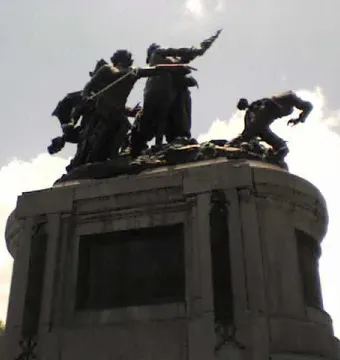
© Louis-Robert Carrier-Belleuse · Public domain
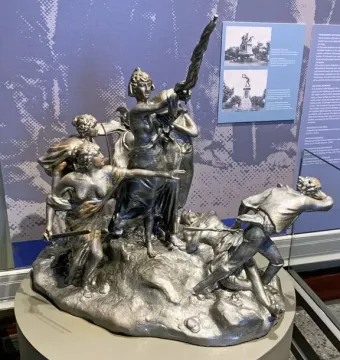
January 2020 © Mariordo (Mario Roberto Durán Ortiz) · CC BY-SA 4.0
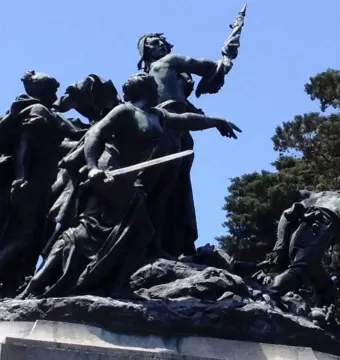
1891 © Louis-Robert Carrier-Belleuse · Public domain
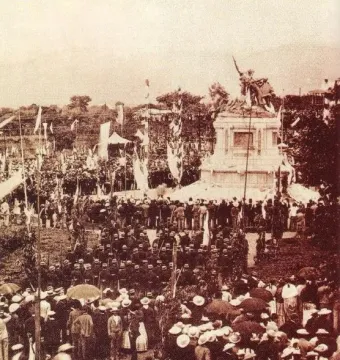
September 1895 © Rodtico21 · Public domain
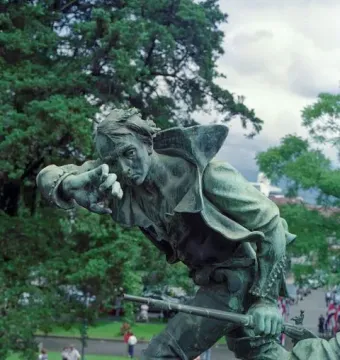
September 1995 © Rafael Nájera · CC0
Identification | |
| Title | Monumento Nacional de Costa Rica |
| Type | national monument; sculptural ensemble |
Creator | |
| Artist | Louis-Robert Carrier-Belleuse |
| Artist nationality | French |
Discovery and provenance | |
| Created | 1891 |
| Created in | Paris |
| Installed | 1895 |
| Unveiled on | 15 September 1895 |
| Unveiled by | President Rafael Yglesias Castro |
| Scale models | Several scale models were made and given to the five Central American presidents of the time and other notable people |
| Replica location | A replica of the model given to the Marqués de Peralta is exhibited at the Museo Nacional de Costa Rica |
Location and ownership | |
| Nearby landmark | The National Library of Costa Rica is immediately northwest of the monument |
| Location | Parque Nacional, San José, Costa Rica |
Materials | |
| Material | bronze |
| Base material | stone |
Physical characteristics | |
| Support | on a pedestal |
| Main structure | bronze sculptural group on a stone pedestal |
| Pedestal reliefs | Four bronze bas-reliefs on the pedestal |
| Composition | Five female figures and two male figures |
Iconography and meaning | |
| Historical theme | The victory of the Central American nations over the filibuster invaders |
| National significance | Represents the defense of Costa Rica's independence and sovereignty during the National Campaign of 1856–1857 |
| Purpose | Commemorates the National Campaign of 1856–1857 |
| Pedestal relief subjects | The Battle of Santa Rosa; the Second Battle of Rivas, including the death of Juan Santamaría on 11 April 1856; the capture of the Río San Juan; and the leaders of the National Campaign under Juan Rafael Mora |
| Associated enemy leader | William Walker, an American who tried to conquer Central America between 1855 and 1857 |
| Historical reference | The National Campaign of Costa Rica (1856–1857), led by Juan Rafael Mora Porras |
| Central female figure | Represents Costa Rica and liberty; wears a Phrygian cap and carries the Costa Rican flag |
| Male figures | One figure represents William Walker fleeing; the other represents soldiers killed in the conflict |
| Honduras figure | Female figure carrying a bow and arrow |
| Guatemala figure | Female figure carrying an axe |
| El Salvador figure | Female figure carrying a sword |
| Nicaragua figure | Female figure with a broken sword, representing Nicaragua |
| Depicted figures | Five female figures representing the five Central American republics and two male figures |
Significance | |
| Artistic significance | Considered the most important sculpture in Costa Rica |
| Historical significance | The National Campaign of 1856–1857 is regarded as decisive in the formation of Costa Rican national identity |
History and restoration | |
| Restoration | Restored in 2001 after oxidation and corrosion had turned it greenish |
| Restoration duration | Five months |
| Restoration cost | 20 million colones |
| Reinauguration date | 1 March 2002 |
| Reinauguration attendees | President Miguel Ángel Rodríguez Echeverría and Minister of Culture Enrique Granados Moreno presided over the ceremony |
| Inauguration attendees | Veterans of the war attended the inauguration in historical uniforms |