
Richard Coeur de Lion
Richard Coeur de Lion is a Grade II listed equestrian statue of Richard I, the 12th-century English monarch known as Richard the Lionheart. Created by Baron Carlo Marochetti, it was first modelled in clay and shown at the Great Exhibition in 1851 before being cast in bronze and installed in Old Palace Yard, outside the Palace of Westminster in London. The statue stands on a granite pedestal facing south towards the House of Lords entrance. Completed with bronze bas-reliefs in 1867, it survived wartime damage and was conserved and restored in 2009.
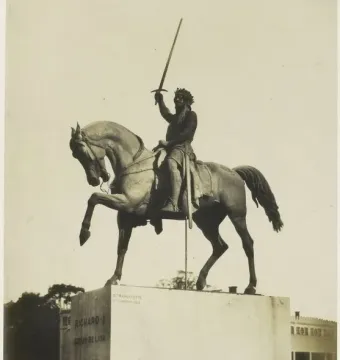
1851 © Rijksmuseum · CC0
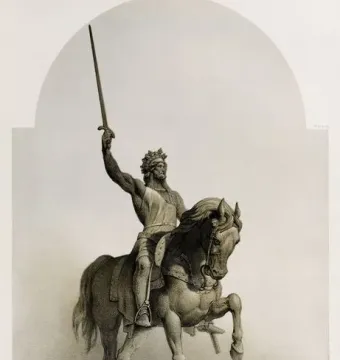
September 2007 © Rawpixel Ltd · CC BY 2.0
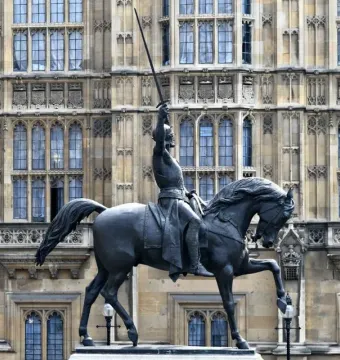
May 2018 © Loco Steve · CC BY-SA 2.0
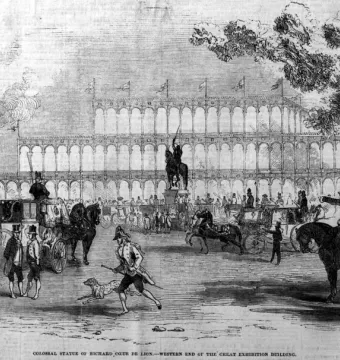
© Unknown artistUnknown artist, ILN Staff · Public domain
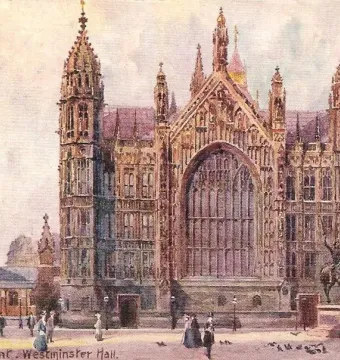
© Charles Edwin Flower (1871 - 1951) · Public domain
Identification | |
| Title | Richard Coeur de Lion |
| Listed status | Grade II listed |
| Inscription | RICHARD I CŒUR DE LION / 1189–1199 |
| Type | Equestrian statue |
Historical context | |
| Installation dispute | Installation was delayed for several years by disagreement over the statue's purpose and site, with opposition to both the Great Exhibition memorial idea and the proposed location outside the newly completed Palace of Westminster |
| Reliefs added | 1866–1867 |
| Initial workmanship problems | The horse's tail fell off the day after the Great Exhibition display, and later the statue was found to be riddled with holes and never properly attached to its pedestal |
| Preferred site | Old Palace Yard |
| Alternative sites considered | Hyde Park, Buckingham Palace, Carlton Gardens near the Horse Guards, Marble Arch, and outside Westminster Abbey looking down Victoria Street |
| Original purpose | Originally intended as a memorial to the Great Exhibition of 1851 |
| Depicted subject | Richard I of England (Richard the Lionheart), a 12th-century English monarch who reigned from 1189 to 1199 |
Creator | |
| Patrons | European royalty and nobility |
| Nationality | Italian-born |
| Sculptor | Baron Carlo Marochetti |
Discovery and provenance | |
| Fundraising for bronze cast | In 1853 a subscription was raised for casting the statue in bronze, led by Queen Victoria and Prince Albert |
| Bronze casting completed | 1856 |
| Public reception at first display | Well received; attracted enthusiastic reviews and critical acclaim |
| First display | Great Exhibition of 1851, shown as a clay model outside the west entrance of the Crystal Palace in Hyde Park |
Location and ownership | |
| Current location | Old Palace Yard, outside the Palace of Westminster in London, in front of the entrance to the House of Lords |
| Orientation | Facing south towards the entrance to the House of Lords |
Physical characteristics | |
| Pedestal decoration | Bronze bas-reliefs on the east and west sides |
| Height | 9 meters |
| Pedestal maker | Freeman & Co. of Penryn, Cornwall |
| Pedestal designer | Baron Carlo Marochetti |
Materials | |
| Pedestal material | Granite |
| Relief material | Bronze |
| Inscription material | Bronze letters |
| Model material | Clay |
| Statue material | Bronze |
Iconography and meaning | |
| Subject depiction | Richard I on horseback, wearing a crowned helmet and chainmail shirt with surcoat, raising a sword |
| Artistic interpretation | Marochetti said the work was inspired by a romanticized image of Richard I rather than an accurate depiction of a 12th-century knight |
| Relief subjects | The Battle of Ascalon and Richard I on his deathbed pardoning Bertran de Gourdon, the archer who fatally shot him in 1199 |
| Horse depiction | The horse is shown pawing or stamping the ground as if preparing to charge into battle |
History and restoration | |
| Conservation and restoration | A conservation and restoration project was undertaken by Parliamentary authorities in 2009; it removed dirt and old black wax, repatinated the bronze, applied clear wax protection, and cleaned and treated the bas-reliefs and pedestal |
| World War II damage | During the Blitz a German bomb exploded a few metres away; the statue was peppered with shrapnel, the pedestal and horse's tail were damaged, and Richard's sword was bent |
| Repairs | The sword was replaced in 1947 and other repairs were carried out |
Significance | |
| Artistic and public reception | Marochetti's works were popular with European royalty and nobility, though often less well regarded by critics and the artistic establishment |
| Critical commentary | Contemporary responses ranged from praise by John Ruskin and The Art Journal to criticism by Francis Turner Palgrave and The Times; the statue was also said to be especially appreciated by London's cabbies |
Other | |
| Public access | The sculpture is not accessible to the general public because the House of Lords courtyard area is fenced off and used as a car park; from the street, only the west-side relief is visible |
| Cultural context | It is one of the few works in and around the Houses of Parliament by a non-British artist, in a collection otherwise dominated by British art |
| Related unrealized project | Marochetti also planned an unexecuted second giant equestrian statue of Edward the Black Prince for Old Palace Yard, intended to face Richard I |
| Collection note | Queen Victoria bought one statuette version of the Black Prince and gave it to Edward, Prince of Wales; it remains in the Royal Collection |