
Granite Bowl
Granite Bowl in Berlin’s Lustgarten is a monumental granite vessel installed outdoors in front of the Old Museum in 1831. With a diameter of 6.91 meters and a weight of nearly 75 tons, it is the largest bowl made from a single stone. The work became known as one of the wonders of the Biedermeier era and as a technical masterpiece. It was created by stone mason Christian Gottlieb Cantian from a piece of the Great Markgrafenstein, worked on in Rauens Mountains and later polished in Berlin with the help of a steam engine. The sculpture belongs to the German Historical Museum and is nicknamed the “Soup Bowl” by Berliners.
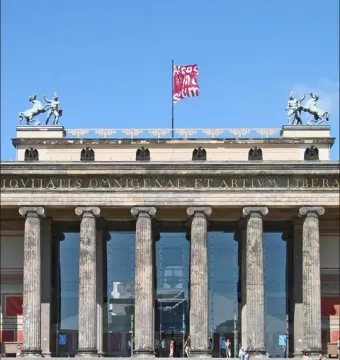
August 2011 © Jean-Pierre Dalbéra · CC BY 2.0
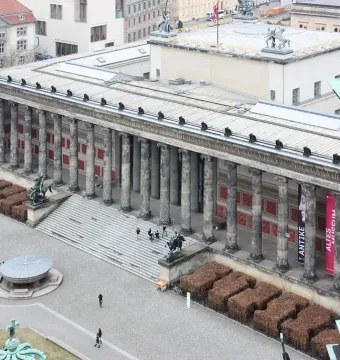
March 2013 © Dguendel · CC BY 3.0
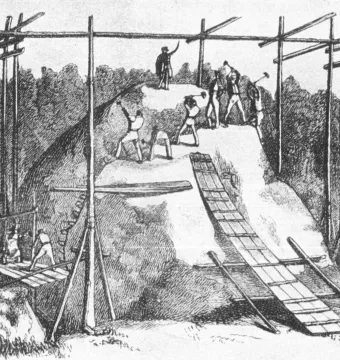
1827 © Unknown authorUnknown author · Public domain
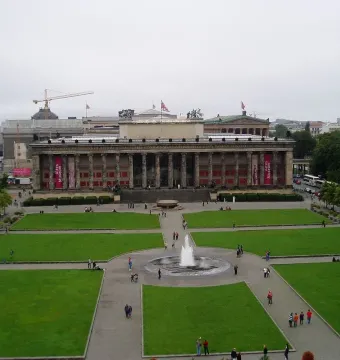
July 2011 © Muns · CC BY 3.0

© Roger Rössing · CC BY-SA 3.0 de
Identification | |
| Title | Granite Bowl |
| Nickname | Soup Bowl |
| Type | Monumental granite bowl |
| Alternative names | Granite bowl in the Lustgarten; The Great Granite Bowl; Große Granitschale; Granitschale im Lustgarten; Great Granite Bowl; Berlin bowl |
Historical context | |
| Style and era | Biedermeier |
| Commission year | 1826 |
| Intended comparison | Planned to surpass the Vatican's porphyry bowl in the Sala Rotunda |
| Intended size after royal commission | 22 feet (6.90 m), after an earlier planned size of 17 feet (5.34 m) |
Creator | |
| Maker | Christian Gottlieb Cantian |
| Maker's profession | Building inspector and stonecutter |
| Placement designer | Karl Friedrich Schinkel |
| Commissioned by | Frederick William III of Prussia |
Discovery and provenance | |
| Source stone mass | Approximately 700–750 tons |
| Intended location | The rotunda of the Altes Museum, later changed to the area in front of the museum staircase |
| Blank cut date | September 1827 |
| Earlier intended stone | A 600-ton granite block near the school authority at Neuendorf in the Oderberg district, first considered but rejected because it was too brittle |
| Transport route to the Spree | Moved on wooden rollers over a boardwalk and a road through the forest built to the Spree; the route is still recognizable today |
| Source stone size | 7.8 m long, 7.5 m wide, 7.5 m high |
| Source stone age | About 1.42 billion years old |
| Source stone material | Red Karlshamn granite |
| Stone source | The Großer Markgrafenstein / Great Markgraf Stone in the Rauensche Berge, southeastern Brandenburg |
| Inspiration for commission | William Cavendish, 6th Duke of Devonshire, admired the exhibited bowls and ordered one for himself |
| First public display | 1826 Academy Exhibition in Berlin |
| Source stone origin | Moved to the Rauens from Karlshamn, southern Sweden, during the Saalian or Weichselian glaciation |
Physical characteristics | |
| Largest known feature | Largest bowl carved from a single stone |
| Weight | About 75 tons |
| Diameter | 6.91 m |
| Circumference | About 21.7 m |
| Shape | Circular |
| Slab thickness | 5 feet (1.57 m) |
Materials | |
| Material | Granite, specifically red Karlshamn granite |
Technique | |
| Exterior profiling completed | Mid-September 1828 |
| Polishing difficulty | The curves and hollows were especially difficult to polish |
| Machine-assisted polishing significance | First time in Germany that such a hard stone was polished with machine assistance |
| Polishing duration | Two and a half years |
| Transport preparation | By mid-September 1828, including a wooden beam frame |
| Underside completion | 26 April 1828 |
| Hollowing completed | 4 August 1828 |
| Splitting method | 95 iron wedges |
| Turning of slab | 23 December 1827, using 100 workers and 23 hoists |
| Splitting attempts | The first split failed; a second attempt in early November 1827 also failed |
| Stonecutting start | May 1827 |
| Workforce during stonecutting | 20 workers daily |
| Stone turning during cutting | Turned about 90 degrees in mid-June 1827 using ten winches |
History and restoration | |
| Outdoor placement approval | 21 February 1829 |
| Estimated cost | 12,000 thalers |
| Weimar Republic damage | Onlookers climbed onto the bowl during rallies and demonstrations, damaging its polished surface |
| Final cost | 33,386 thalers, officially approved after revision |
| Planned museum opening context | The Altes Museum opened in 1830 |
| 1936 relocation | Moved to the green area north of the Berlin Cathedral during the redesign of the Lustgarten into a parade ground |
| World War II damage | Damaged by grenades that landed in it |
| 1981 relocation attempt | Attempted return to its historical location for Schinkel's 200th anniversary; it cracked during transport |
| Post-crack restoration | Reassembled, but the joint could not be fully concealed |
| 1997–1999 restoration | The pedestal of grey Lusatian granite was replaced with reddish granite from France |
| Mounting dispute | Cantian wanted high columns; Schinkel wanted it close to the ground on plain granite pedestals in front of the museum staircase |
| Temporary workshop in Berlin | A specially built building at the Packhof near the Altes Museum, with a 10-horsepower steam engine |
| Weight during transport | 70–75 tons |
| River transport vessel | A specially braced wooden ship |
| Transport duration | Six weeks |
| Daily transport rate | 600 feet (188 m) per day |
| Examination in 1831 | Examined by von Klöden and Wöhler at Cantian's request; the bowl was kept under a protective roof in winter |
| Loading for river transport | 54 workers |
| Cracks discovered during polishing | Three cracks, possibly caused by natural conditions or during splitting in the Rauens Mountains |
| Arrival in Berlin | 6 November 1828 |
| Reason polishing was done in Berlin | To avoid scratches and damage during transport, and because finishing beforehand would have been too costly |
Location and ownership | |
| Current setting | Outdoors |
| Owner | German Historical Museum |
| Official handover | 10 November 1834 to the Royal Museum |
| Provisional installation | 14 November 1831 |
| Final mounting | Free-standing on three pedestals, allowing a view into the interior |
| Current location | Lustgarten, Berlin, in front of the Altes Museum |
Significance | |
| Historical significance | Considered a Biedermeier world wonder, a technical marvel of its time, a patriotic symbol, a cult stone, a myth, and a landmark of the German capital |
| Artistic documentation | Depicted in several sketches and oil paintings by Johann Erdmann Hummel |
| Hummel's focus | He was interested in precise perspective and reflections rather than symbolism |
| People depicted by Hummel | Cantian, Hummel's sons, and their cousin appear in one of the pictures |
| Interpretive context | In the post-Napoleonic era, publicly visible monuments and transported ancient objects were used as symbols of national greatness and power |
| Granite symbolism | In the Biedermeier period, granite was associated with strength, steadfastness, patriotic identity, and mythic meaning |
| Related statement by Cantian | He described his work as 'patriotic granite' in Academy exhibition brochures |
| Goethe reference | Goethe's 1828 essay 'Granite Works in Berlin' supported the idea that large erratic blocks were remnants of larger rock masses |
Other | |
| Original Ukrainian title | Гранітна чаша в Люстгартені |