
Canapone
Canapone is the monument to Leopold II, Grand Duke of Tuscany, in Grosseto, Italy. It stands at the center of Piazza Dante, the city’s main square, and is a recognized historical landmark. The statue commemorates Leopold II for the reforms he initiated in the Maremma region, especially in public health, land reclamation, and infrastructure development. These efforts were important in transforming the area during the 19th century. The name Canapone is a local nickname used affectionately by the people of Grosseto and refers to the Grand Duke’s light-colored hair, with canapo meaning “coarse flax.”
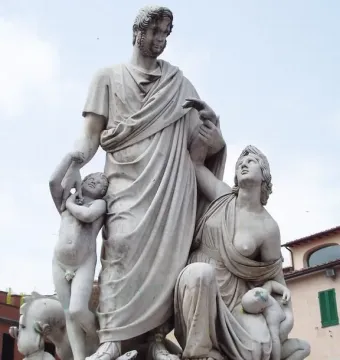
June 2007 © Vinattieri Matteo · CC BY 2.5
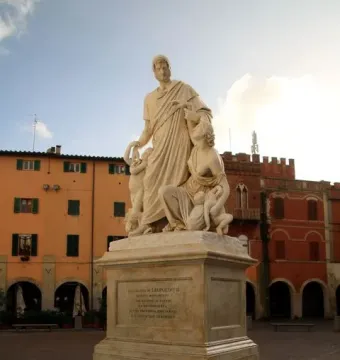
December 2019 © Mongolo1984 · CC BY-SA 4.0
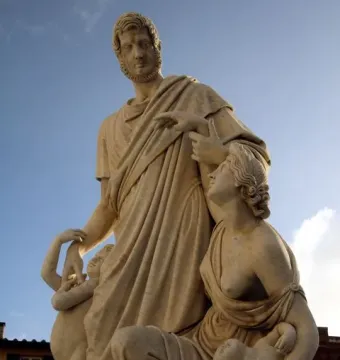
December 2019 © Mongolo1984 · CC BY-SA 4.0
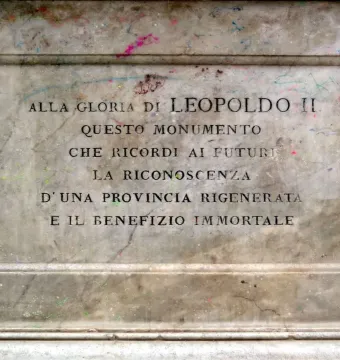
March 2014 © Flo Sorg · CC0
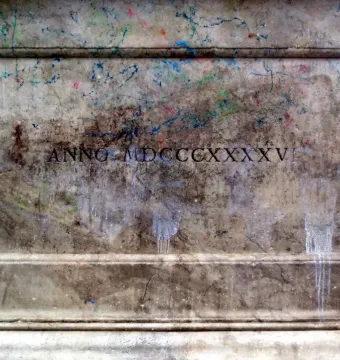
March 2014 © Flo Sorg · CC0
Identification | |
| Title | Monument to Leopold II, Grand Duke of Tuscany |
| Type | monument; statue |
| Subject | Leopold II, Grand Duke of Tuscany |
| Dedication | Dedicated to Grand Duke Leopold II of Lorraine |
| Common name | Canapone |
Historical context | |
| Model completed | 1842 |
| Inauguration date | 1 May 1846 |
| Installation date | spring 1846 |
| Public celebrations | continued until 4 May 1846 |
| Creation date | before the middle of the 19th century |
| Commission oversight | an official delegation |
| Commissioned by | the municipal administration of Grosseto |
| Commission date | 1836 |
Creator | |
| Artist | Luigi Magi |
| Artist origin | Asciano |
| Sculptor | a sculptor from Asciano; name not given |
Discovery and provenance | |
| Related publication | La Maremma personificata che narra le sue passate e presenti vicende |
| Pamphlet author | canon Giovanni Chelli |
| Pamphlet dedication | dedicated to Leopold II |
Physical characteristics | |
| Form | sculptural group on a high pedestal |
| Placement | set on a high base with an inscription |
Materials | |
| Material | white marble; Seravezza-white marble |
Appearance | |
| Griffin figure | a griffin biting the serpent |
| Snake figure | a dying serpent crushed beneath the child’s feet |
| Second child figure | a dying child resting his head on the woman's left thigh |
| Child figure | a nude child in Leopold II's right hand, shown as joyful and older than the dying child |
| Woman figure | a seated, sad-faced woman representing the Maremma |
| Central figure size | the central statue is taller than the others |
| Depiction of Leopold II | dressed as an ancient Roman, calm and dignified, with a relaxed face, characteristic beard, and gaze turned to his left |
| Figure arrangement | Leopold II stands at the center and supports a seated woman to his left while holding a nude child in his right hand |
Iconography and meaning | |
| Nickname origin | a local reference to Leopold II's light-colored hair; canapo means "coarse flax" |
| Allegorical subject | an allegory of Leopold II's role in the regeneration of the Maremma |
| Woman symbolism | Maremma |
| Dying child symbolism | the suffering of the people of Maremma and the generations lost to malaria |
| Child symbolism | future generations whose survival was secured by Leopold II's reforms |
| Serpent symbolism | malaria |
| Griffin symbolism | the city of Grosseto; the emblem in its coat of arms; the joint effort of ruler and community to overcome disease and promote progress |
| Overall interpretation | symbolic figures express historical suffering and civic rebirth; Leopold II is presented as having helped eradicate malaria and transform Maremma |
Location and ownership | |
| Urban planner/engineer | Angiolo Cianferoni |
| Original use of nearby well | to supply water to nearby residences |
| Nearby infrastructure affected | an artesian well at the entrance to Via Ricasoli was decommissioned and buried during installation; its cast-iron superstructure was later relocated to Arcidosso |
| Original installation site | center of Piazza delle Catene, now Piazza Dante |
| Urban context | focal point and culmination of the reorganization of the city's main square as part of a broader urban redevelopment plan |
| Current location | center of Piazza Dante, Grosseto |
| Location | center of Piazza Dante, Grosseto, Italy |
History and restoration | |
| Inaugurated by | gonfalonier Guglielmo Ponticelli |
| Ceremonial attendees | civil, religious, and military authorities |
| Inaugural address delivered by | Domenico Pizzetti, capitular vicar of the cathedral chapter |
| Celebration events | music, horse races, fireworks, hot air balloon ascents, and a public lottery |
| Inscription | "To the glory of Leopold II / this monument / as a reminder to future generations / of the gratitude / of a regenerated province / and of his immortal benefaction" |
Significance | |
| Historical significance | historical landmark in Grosseto; a collective expression of gratitude for Leopold II's role in the regeneration of the Maremma, especially his reforms in public health, land reclamation, infrastructure, and efforts to combat malaria and improve living conditions |
| Commemorative purpose | a reminder to future generations of the gratitude of a regenerated province |