
Washington Monument
Washington Monument is a monumental Doric column located in Baltimore, Maryland. Designed by Robert Mills, who was also the designer of the colossal Washington Obelisk, it began in 1815 on land donated by John Eager Howard and was completed in 1829. The structure stands 54 meters tall and contains a museum dedicated to President George Washington. It is a notable monument in the United States and one of Baltimore’s historic constructions.
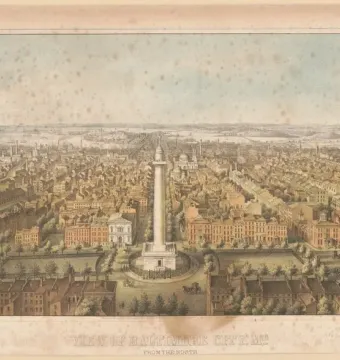
1862 © E. Sachse & Co. · Public domain
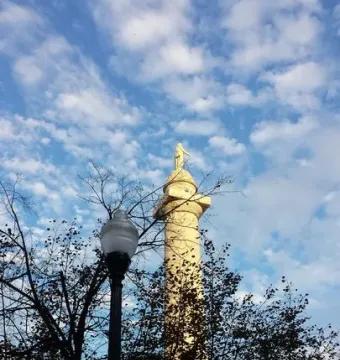
© R. Corbet · CC BY-SA 4.0
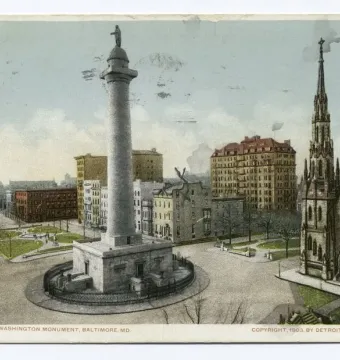
© Detroit Publishing Company · Public domain
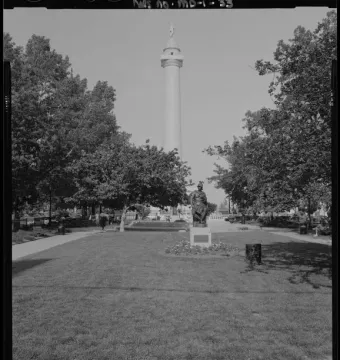
© Smalling, Walter Jr., creator · Public domain
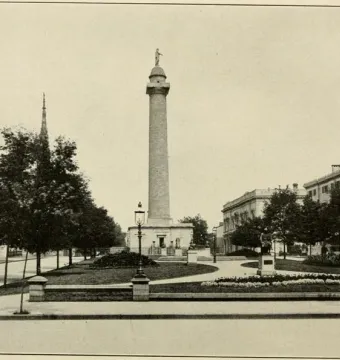
1914 © National star-spangled banner centennial commission; O'Connell, Frank Albert, 1886-; Coyle, William F · No restrictions
Identification | |
| Title | Washington Monument |
| Type | Monumental Doric column |
| Style | Doric, with Neoclassical influence |
| Alternative name | Coluna de Washington; Colonna di Washington |
Historical context | |
| Subject | George Washington |
| Purpose | Memorial to George Washington |
| Significance | First major monument to honor George Washington |
Creator | |
| Designer | Robert Mills (1781–1855), American architect |
| Related work | Mills also designed the Washington Monument in Washington, D.C. |
Discovery and provenance | |
| Land donation | Built on land donated by Colonel John Eager Howard (1752–1827) on the Belvidere estate |
| Relocated site | Mount Vernon Place / Washington Place area in the Mount Vernon district of Baltimore after residents feared the tall column could fall on their houses in a natural disaster |
| Original intended site | Old colonial-era Courthouse Square on North Calvert Street between East Lexington and East Fayette Streets |
| Design selected | 1814 |
| Design competition | Announced in 1813 in Baltimore; prize $500; budget $100,000 |
| Lottery authorized | 1810 |
| Board of managers formed | 1809 |
| Proposed | 1807 |
Physical characteristics | |
| Height | 54.45 meters (178 feet 8 inches) |
| Steps | 227 |
| Form | Marble column on a low square base with gallery, topped by a standing figure of Washington |
| Original design | Richly ornamented design with six iron galleries dividing the shaft into seven sections with text and images, an interior spiral staircase, and a quadriga at the top |
| Completed design | The original elaborate design was significantly simplified before construction of the completed column |
Materials | |
| Material | White marble |
| Marble sources | Marble from three Baltimore County quarries: General Charles Carnan Ridgely's quarry near Hampton Mansion for the base, Scott's quarry for the column, and Mrs. Frances D. T. Taylor's quarry for the statue |
Technique | |
| Construction milestone | First marble laid in 1816 |
| Architectural influence | The completed column is very similar to the Colonne Vendôme in Paris, ultimately derived from Trajan's Column in Rome |
| Masonry work completed | 1829 |
| Construction began | 1815 |
| Cornerstone laid | 4 July 1815 |
| Construction completed | 1829 |
Appearance | |
| Exterior features | Plain unfluted shaft, exterior wood doors painted to imitate ancient Roman bronze doors, and bronze inscriptions on all facades documenting eight principal events in Washington's life |
| Interior features | Interior staircase, subterranean vaults, and stuccoed interior |
| Base features | Ground-floor gallery with a staircase |
| Statue | Standing figure of George Washington resigning his commission as Commander-in-Chief of the Continental Army |
| Sculptor of statue | Italian-born sculptor Causici (full name not given in source) |
| Historical scene depicted | Washington's resignation took place in the Old Senate chamber in the Maryland State House, Annapolis, Maryland, on December 23, 1783 |
Location and ownership | |
| View | The museum and observation platform offer a view of the surrounding area and city |
| Public display location | Maryland Center for History and Culture, two blocks from the monument |
| Location | Mount Vernon Place, Mount Vernon district, Baltimore, Maryland, United States |
| Contains | Museum dedicated to President George Washington and the construction of the monument |
| Position in setting | Centerpiece of the intersecting Mount Vernon Place and Washington Place |
History and restoration | |
| 1915 time capsule | A sealed copper box placed behind a plaque during the 1915 centennial celebrations; discovered in October 2014 and opened on 2 June 2015 at the Walters Art Museum |
| Original cornerstone | The monument's original 1815 cornerstone, long known to exist but with its exact location unknown; discovered in February 2015 during digging for a sewage tank |
| Original cornerstone material | Nearly perfect granite cube with a marble lid |
| Original cornerstone weight | Between 1,000 and 1,500 pounds (about 450 to 700 kg) |
| Original cornerstone contents | Three well-preserved glass jars surrounded by newspapers from 1 and 3 July 1815, plus a carved panel; it was expected to contain additional items including coins and a metal plate |
| Reopening occasion | Bicentennial of the cornerstone being laid |
| Analysis location | Walters Art Museum |
| Time capsule opening | 2 June 2015 |
| 1815 cornerstone contents revealed | Fully revealed on 2 June 2015 at the Walters Art Museum |
| Notable artifact | A copy of the United States Declaration of Independence printed in the Baltimore Federal Gazette on 3 July 1815 |
| Artifact significance | The newspaper appears to have been the last item placed in the stone |
| Historical interpretation | The inclusion of the Declaration suggests the monument was not only the first monument to honor George Washington, but also one of the earliest American monuments celebrating American national independence |
| Time capsules discovered | Two time capsules were discovered during restoration: the original 1815 cornerstone and a 1915 Centennial time capsule |
| Cornerstone ceremony | Laid on 4 July 1815 by Governor Levin Winder, head of the Maryland Freemasons; overseen by the Monument's Board of Managers, with Board president James Buchanan present |
| Rededication | 4 July 2015 |
| Additional 1830s additions | Bronze inscriptions on all facades and a cast-iron fence around the base added in 1838 |
| Cornerstone ceremony significance | Described as the first expression of national gratitude and a memorial of the blessings and advantages derived from Washington's character and conduct |
| Reopening | 4 July 2015 |
| Publicity | The cornerstone ceremony was printed in the local newspaper, reprinted in other major cities, and published in a souvenir booklet with illustrations |
| Visitor history | The monument was visited during construction; by 1819 guests were leaving evidence in the subterranean vaults, and by shortly after 1820 visitors were climbing to the top |
| Notable early visitor | Nathaniel H. Carter visited in February 1823 and climbed to the top, escorted by a boy with a candle |
| Battle of Baltimore connection | Baltimore considered its successful defense during the Battle of Baltimore a reason for the monument's propriety |
| Inscription wording | Former president John Quincy Adams helped determine the wording of the eight events |
| Fence symbolism | Symbolic references to Maryland and to strength achieved through the union of the original thirteen colonies |
| Cultural context | One of the earliest and leading symbols of American pride and gratitude toward George Washington for decades |
| Closures and restoration | Closed by the City of Baltimore in June 2010 for safety reasons because of missing mortar and rusted support brackets; damaged on 30 October 2010 when a van hit the southeast corner and damaged about 15 feet of the fence; reopened in 2015 after restoration |
| Partnership and restoration | In 2012 the City of Baltimore partnered with the Mount Vernon Place Conservancy to restore, maintain, and manage the monument and the park squares of Mount Vernon Place |
| Restoration cost | $5.5 million |
| Restoration start | January 2014 |
Significance | |
| Historical popularity | Mid-19th-century maps paired the Baltimore column with the Capitol building because the Washington, D.C. monument had only just begun |
| National capital monument relation | Mills's Washington Monument in Washington, D.C., begun in 1848 and completed and dedicated in 1885 |
| Other related memorial | Washington monument in what is now Washington Monument State Park near Boonsboro, Maryland, first constructed in 1827 |
Other | |
| Associated person | George Washington (1732–1799) |
| Associated categories | Monuments in the United States; Buildings and structures in Baltimore; Statues of George Washington; Mount Vernon (Baltimore) |
| Tourist status | Open to tourists |
| Annual lighting ceremony | Since 1971, the city has held an annual Lighting of the Washington Monument on the first Thursday in December |
| Holiday village | A holiday village is held before the lighting ceremony in the West Square of Mount Vernon Place |
| Lighting sequence | The switch is typically followed by a fireworks show |
| Holiday lights duration | The holiday lights remain on the monument until after Christmas Day |
| 49th annual Monument Lighting | Held virtually due to the COVID-19 pandemic |