
Equestrian Statue of the Duke of Wellington
The equestrian statue of the Duke of Wellington is a monument dedicated to Arthur Wellesley, first Duke of Wellington. It stands in front of the Royal Exchange in Glasgow, Scotland, now known as the Gallery of Modern Art. Sculpted by the Italian artist Carlo Marochetti and erected in 1844 through public subscription, the statue commemorates the successful conclusion in 1815 of the long French Revolutionary Wars and Napoleonic Wars. It is one of Glasgow’s most iconic monuments and is classified as a Category A sculpture, a designation reserved for buildings or works of national or international importance.
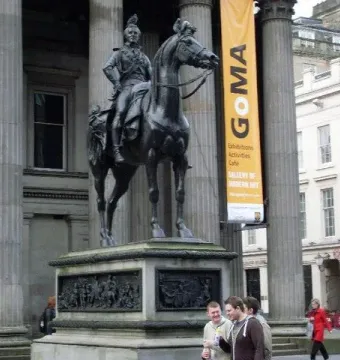
January 2008 © Stephen Sweeney · CC BY-SA 2.0
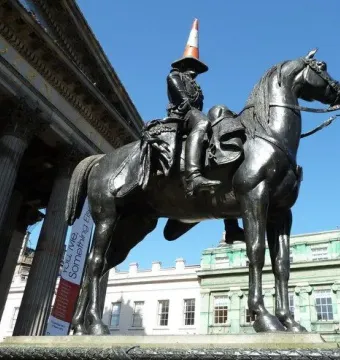
September 2011 © Andy Farrington · CC BY-SA 2.0
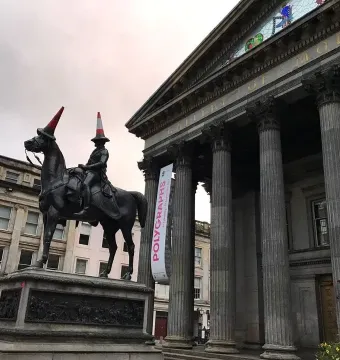
July 2017 © Dmso · CC BY-SA 4.0
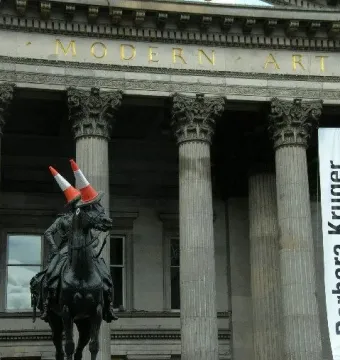
August 2005 © Paul Johnston-Knight · CC BY-SA 2.0
March 2012 © Kim Traynor · CC BY-SA 3.0
Identification | |
| Title | Equestrian statue of the Duke of Wellington |
| Type | Equestrian statue |
| Subject | Arthur Wellesley, 1st Duke of Wellington |
| Horse depicted | Copenhagen, Wellington's favorite horse |
| Alternative title | Monument to the Duke of Wellington |
Creator | |
| Sculptor | Carlo Marochetti |
| Sculptor nationality | Italian-born French |
Historical context | |
| Funding | Public subscription |
| Artist controversy | The choice of a non-British artist caused controversy among contemporaries |
| Donors | About 10,000 people |
| Date erected | 1844 |
| Commemorates | The successful end in 1815 of the French Revolutionary Wars and the Napoleonic Wars |
| Date unveiled | 8 October 1844 |
| Date proposed | 1840 |
Physical characteristics | |
| Material | Bronze |
| Plinth material | Scottish Peterhead granite |
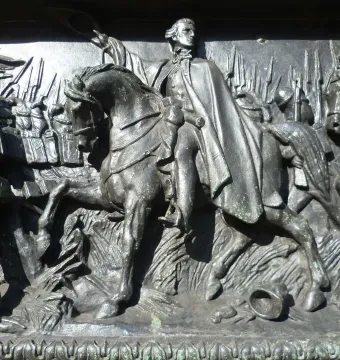
| Bas-reliefs | Bronze bas-reliefs of the Battle of Assaye and the Battle of Waterloo, plus two smaller bas-reliefs showing a soldier returning from war and resuming peaceful pursuits |
Appearance | |
| Depicted attire | Field marshal's uniform with the insignia of his awards and honours |
Location and ownership | |
| Location | Outside the former Royal Exchange, now the Gallery of Modern Art, Royal Exchange Square, Glasgow, Scotland |
| Country | Scotland, United Kingdom |
| Heritage status | Category A listed sculpture |
| City | Glasgow |
History and restoration | |
| Security measures | In 2015 Glasgow City Council tested £1.2 million high-tech CCTV software to detect people placing cones on the statue |
| Inauguration details | Unveiled before around 20,000 spectators, including 200 former soldiers who had served under Wellington; attendees included General Neil Douglas and Sheriff of Lanark Archibald Alison; the ceremony featured military bands, cannon salutes, and a troop parade |
| Placement under statue | Commemorative papers and medals sealed in crystal glass bottles |
| Other cone-related modifications | During the 2002 UEFA Champions League final the cone was replaced with a football-themed headdress bearing the Amstel logo; during the 2012 Olympics it was painted gold; in June 2010 it was replaced with a 'feel free' branded glitter cone; during the 2014 Commonwealth Games a replica statue with a cone appeared at the opening ceremony and a gold cone was then placed on the statue again; on 31 January 2020 a cone painted with the EU flag was placed on the head; during the COVID-19 pandemic a blue surgical mask was added; in March 2022 a cone in Ukrainian flag colors was attached; in June 2023 This Is Rigged placed a cone with its logo on the statue |
| Cone tradition start | At least since the 1980s |
| Council response to cone tradition | In 2005 Glasgow City Council and Strathclyde Police asked the public not to replace the cone because of minor damage to the statue and the risk of injury while attempting to place one |
| 2013 restoration proposal | Glasgow City Council proposed a £65,000 restoration project that included doubling the height of the plinth to deter vandals, but the plan was withdrawn after public opposition, including an online petition with more than 10,000 signatures |
| Estimated cone removal cost | About £100 per callout, potentially up to £10,000 per year |
Significance | |
| References in popular culture | Finnie, the 2026 Commonwealth Games mascot, references the statue and cone tradition with a traffic cone instead of a horn; several Boston statues were decorated with traffic cones during the 2026 FIFA World Cup as a direct reference to the Glasgow tradition; Banksy called the statue his 'favorite work of art in the UK' in June 2023 |
| Known for | The statue is traditionally topped with a traffic cone, often described as an expression of Glaswegian humour |
| Cultural recognition | Included in Lonely Planet's 2011 list of the '10 strangest monuments on Earth' |
| Status | One of Glasgow's most iconic landmarks |
Other | |
| Artist's other works mentioned | Queen Victoria Statue and Prince Albert Statue at George Square |